Most affiliate articles do not underperform because they are too short. They underperform because they are too vague, too padded, or too obviously trying to make a commission before they’ve earned any trust.
That is the real answer hiding inside the question, “How Long Should Affiliate Articles Be in 2026?” People keep looking for a magic word count, as if 2,143 words is somehow noble and 847 words is lazy. It doesn’t work like that. Length matters, sure. But only in relation to intent, competition, search behavior, and how much proof a reader needs before they’ll believe you enough to click.
If you want affiliate articles that rank better, convert better, and feel less like stretched taffy, the goal is not “write long.” The goal is “write complete.” Sometimes that takes 900 words. Sometimes it takes 2,500. Sometimes your bloated 3,800-word masterpiece should’ve been two cleaner articles and one strong comparison table.
Here’s how to figure out the right length for affiliate articles in 2026, without guessing, stuffing, or boring your reader into closing the tab.
How long should affiliate articles be in 2026? The practical answer
A good working range for most affiliate articles in 2026 is 1,000 to 2,500 words.
That range covers a lot of ground because affiliate articles are not all doing the same job. A “best tools for email creators” roundup has different demands than a “ConvertKit vs Beehiiv” comparison. A quick “best microphone under $100” article is not the same animal as a detailed “best course platforms for coaches” guide.
So no, there is not one ideal length. But there is an ideal match between article length and article purpose.
| Article type | Typical useful range | What the reader needs |
|---|---|---|
| Quick product pick | 700–1,200 words | Fast recommendation, clear fit, light proof |
| Best-of roundup | 1,200–2,500 words | Comparison, filtering, buying guidance |
| Versus article | 1,000–2,000 words | Tradeoffs, specific differences, decision help |
| Problem-solving affiliate guide | 1,500–3,000 words | Education first, product second, stronger trust |
| Niche buyer guide | 1,800–3,500 words | More detail, objections, use cases, proof |
If your article answers the question clearly, helps the reader choose, and makes the next step easy, you’re in good shape. If it’s long because you kept repeating “this tool is great for beginners and professionals alike,” you are not fooling anyone.
What actually determines the right affiliate article length
Word count is a consequence, not a strategy. Start with these factors instead.
1. Search intent
The bigger the question, the more room you need.
If someone searches “best email platform for creators,” they are usually comparing options, pricing models, features, and use cases. That needs some depth. If they search “Kajabi vs Teachable,” they want a cleaner decision path. Less sprawl. More direct comparison.
Search intent is one of the easiest ways to stop over-writing. Match the size of the answer to the size of the question.
2. Decision complexity
The more expensive, technical, or annoying a buying decision is, the more proof the reader tends to need.
A $9 plugin can often be sold with a concise article if the fit is obvious. A CRM, course platform, funnel tool, or hosting stack? Different story. More objections. More stakes. More explanation needed.
3. Competition
If the top-ranking pages are all in-depth and actually useful, showing up with a thin 600-word article is probably not your smartest move. Not because Google worships word count, but because readers comparing serious options usually reward completeness.
That said, a lot of search results are full of overinflated sludge. If competitors are writing 3,000 words to say 900 words’ worth of anything, a tighter and clearer article can absolutely win.
4. Your authority and proof
If you have first-hand experience, examples, screenshots, process notes, or clear criteria, you can often write shorter and still convert well. Why? Because credibility compresses length.
A reader will forgive brevity faster than they’ll forgive fluff. If your article has actual judgment in it, you do not need to compensate with extra beige paragraphs.
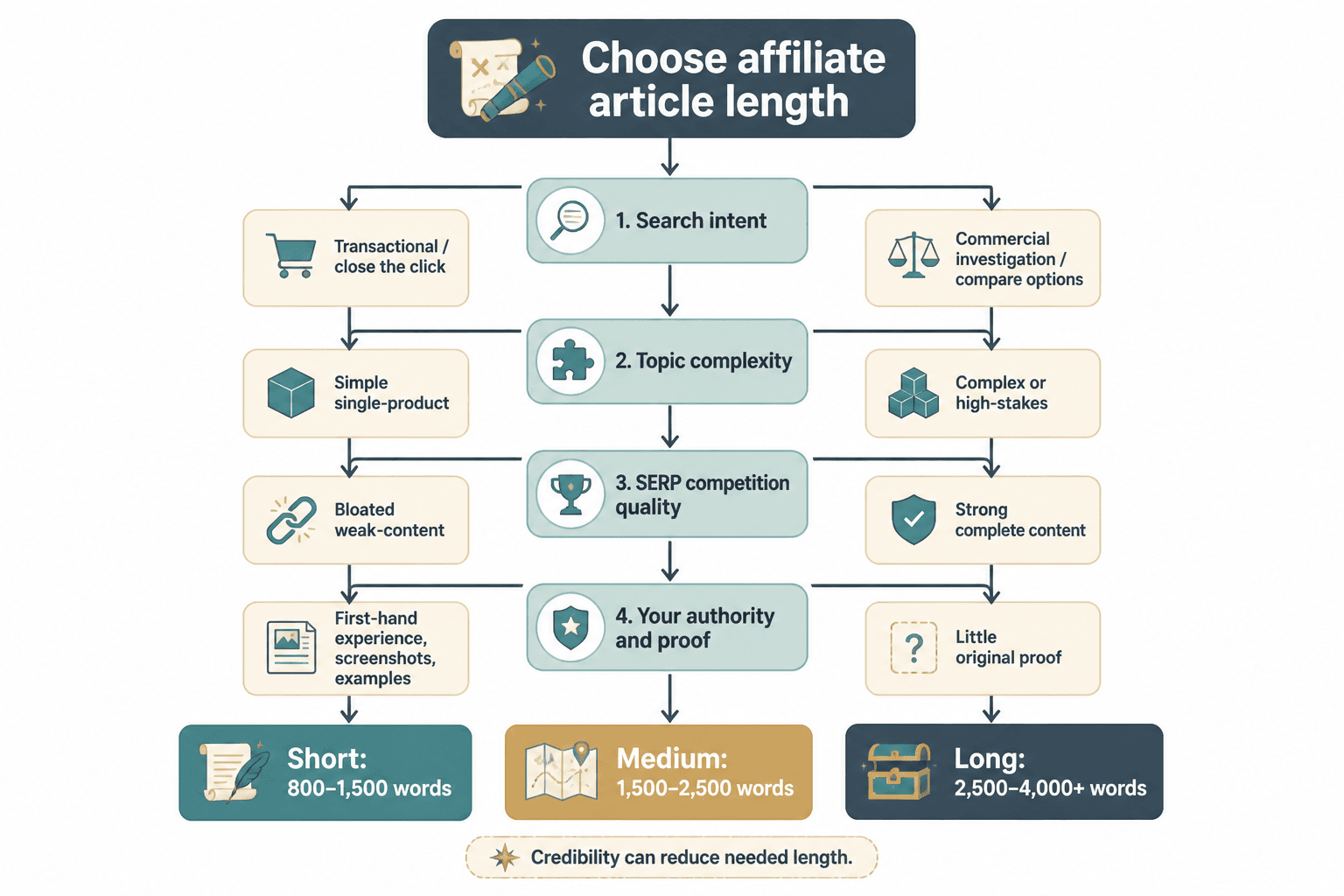
5. The article’s role in your funnel
Some affiliate articles are built to close the click. Others are built to start the relationship.
If your article is meant to capture search traffic and send readers straight to a product, shorter may work fine if the intent is transactional. If your article is also supposed to build trust, grow your list, or position your expertise, it may need more substance. That’s especially true for creators and consultants using affiliate content as part of a wider monetization system.
If you’re building around that bigger system, it’s worth exploring the broader affiliate articles hub and related ways to turn affiliate articles into more leads or sales.
When shorter affiliate articles work better
Short affiliate articles can work beautifully when the question is narrow and the reader is close to making a decision.
- Specific product comparisons
- Single-product recommendations
- Low-cost tool picks
- “Best for X” niche pages with tight scope
- Update articles tied to one clear use case
The mistake people make is thinking “short” means underwritten. It doesn’t. A short affiliate article still needs:
- A strong opening that confirms reader intent
- Clear selection criteria
- Specific reasoning behind the recommendation
- Useful pros, cons, and tradeoffs
- A clean next step
So yes, shorter articles can convert. But only if they remove friction instead of removing substance. There’s a difference.
If you want a fuller breakdown, read when short affiliate articles beat long ones. It’ll save you from padding every post into a lumbering content loaf.
When longer affiliate articles earn their keep
Longer affiliate articles make sense when readers need help understanding the category before they can choose a product.
That often includes:
- “Best X for Y” articles with several audience segments
- Buyer guides for expensive tools or software
- Education-led affiliate content
- Roundups with meaningful comparisons
- Articles tackling common objections and decision factors
Longer works best when it does one of three things:
- Clarifies a confusing decision
- Builds trust through better reasoning and proof
- Pre-qualifies the reader so the click is more intentional
That last point matters more than people think. More length can improve conversion quality, not just search performance. If your article helps the reader understand who a product is for, who it is not for, and what tradeoffs come with it, you tend to get fewer random clicks and more useful ones.
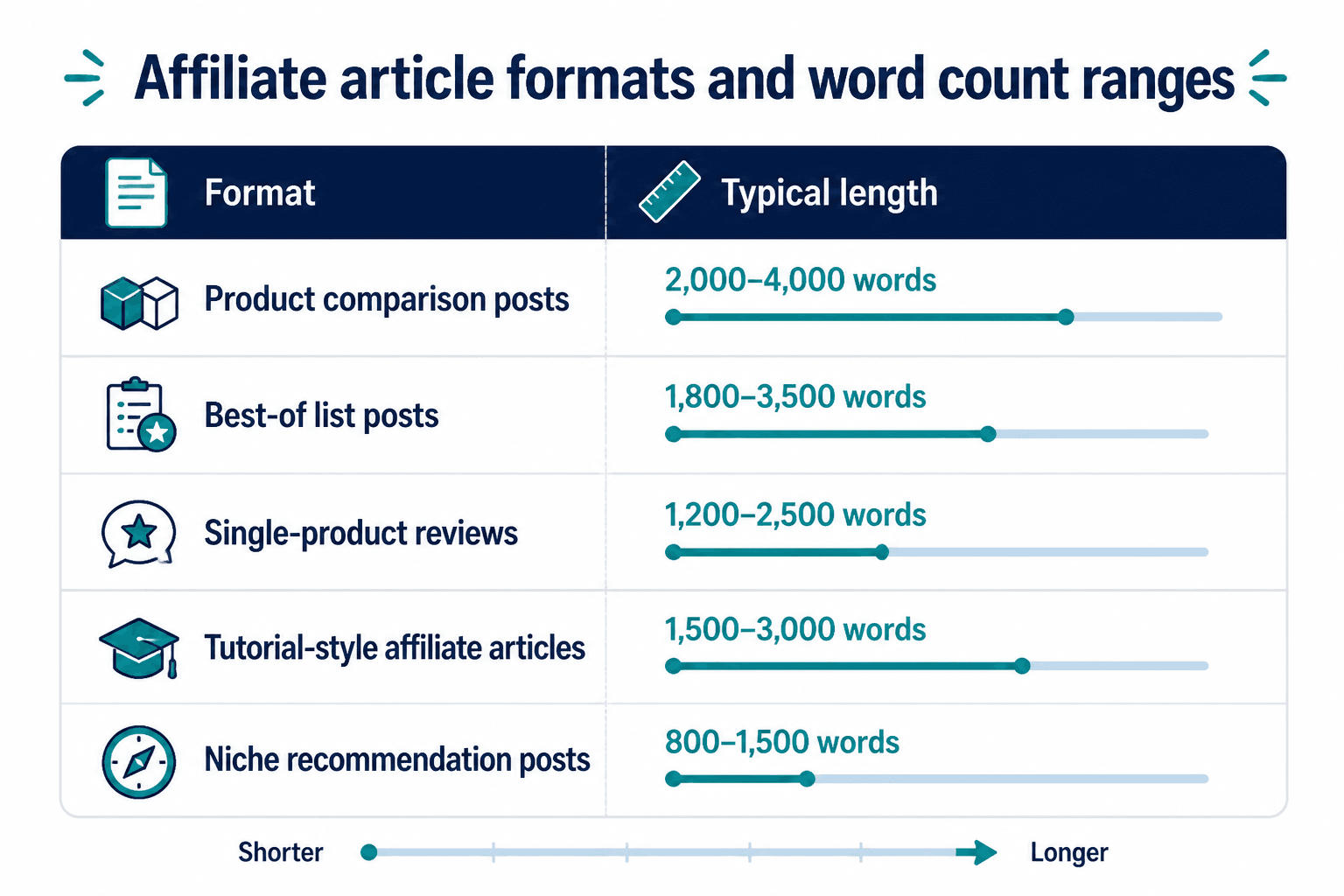
The best length by affiliate article format
Best-of list articles
Usually 1,500 to 2,500 words.
You need enough room to explain your selection logic, categorize options, and help different readers self-sort. But do not write a novel under each product. Give the best fit, the main strengths, one or two real limitations, and a reason to click.
Versus articles
Usually 1,000 to 2,000 words.
These should be tighter because the reader already knows the category. They are trying to choose between options, not attend a seminar. Prioritize side-by-side differences, use cases, pricing logic, setup friction, and who each option fits best.
Single product reviews
Usually 1,200 to 2,500 words.
A review needs more than “it has great features and an intuitive interface,” which is content malpractice at this point. Show what the product actually helps someone do, where it shines, where it falls short, and what kind of user should skip it.
Tutorial-style affiliate articles
Usually 1,500 to 3,000 words.
These often work well because they solve a problem first and recommend a product second. But they only work if the article is genuinely useful without the affiliate click feeling forced.
Niche recommendation posts
Usually 800 to 1,500 words.
Examples: “best scheduling tool for solo consultants” or “best camera for course creators on a budget.” These can stay relatively tight because the scope is already doing half the work.
What to include instead of adding empty length
If you need to make an affiliate article stronger, do not automatically make it longer. Make it more useful.
Here’s what actually improves performance:
- Clear criteria: Explain how you chose the products
- Audience fit: Say who each option is best for
- Tradeoffs: Include drawbacks without acting weirdly evasive
- Use cases: Show where each product fits in real workflows
- Comparison help: Make decision-making easier, not longer
- Proof: First-hand experience, examples, screenshots, or specific observations
- Honest recommendations: Not every option needs to be framed as “amazing”
Readers can smell commission breath. If your article sounds like every product was handcrafted by angels for “busy entrepreneurs,” trust evaporates fast.
This is why writing quality matters more than word count. If you need help with that side of things, read how to write better affiliate articles and this affiliate articles guide for creators who want better results.
A simple way to decide article length before you write
Use this quick filter before drafting.
- Define the search intent. Is the reader learning, comparing, or ready to buy?
- Measure the decision difficulty. Cheap and obvious, or expensive and messy?
- Check the scope. One product, two products, or a whole category?
- List the objections. What does the reader need to know before clicking?
- Decide the article’s job. Click now, build trust, rank over time, or all three?
- Draft the sections first. If the outline is strong, the right length usually reveals itself.
This approach is less glamorous than “just write 2,000 words,” but it is a lot more useful. Lazy word-count rules create bloated content. Structural thinking creates articles that actually do their job.
What changed for affiliate article length in 2026
The big shift is not that affiliate content suddenly needs to be much longer. It’s that generic content keeps getting easier to produce, which means thin-but-long articles are now even easier to ignore.
Readers have seen enough templated roundup content to spot the pattern quickly. Search engines have, too. That means the winning move in 2026 is not simply volume. It is relevance, specificity, structure, and clear recommendation logic.
In other words: if two articles are roughly the same length, the one with sharper judgment usually wins. And if a shorter article is more useful than a padded longer one, the shorter article can absolutely outperform it.
This is especially important if your affiliate content sits inside a larger content business. Articles should not just chase clicks. They should strengthen trust, support your wider monetization funnels and money content strategy, and connect to the reader’s next step cleanly.
Mistakes people make when trying to hit the “right” length
- Writing to a word count instead of a decision.
- Repeating product descriptions that readers could see on the sales page.
- Adding broad educational sections that belong in a separate article.
- Burying the recommendation too deep.
- Including too many options just to inflate the post.
- Skipping tradeoffs because they think honesty hurts conversions.
- Using AI to generate volume without adding judgment.
That last one is especially ugly. AI can help with structure, drafting, and cleanup. But it cannot replace actual evaluation. If your affiliate article reads like it was assembled by a polite blender, expect polite results.
FAQ
Is 1,000 words enough for an affiliate article?
Yes, if the topic is narrow and the buying decision is simple. It is often enough for niche recommendations, quick comparisons, or focused product picks.
Are longer affiliate articles better for SEO?
Only when the extra length helps the reader make a clearer buying decision. Longer pieces work when they add comparisons, tradeoffs, proof, and context. They fail when they just repeat product copy with more adjectives.
The better rule is simple: use enough length to answer the real decision, then stop. A strong affiliate article feels complete, not swollen.