
Most creator re-engagement flows fail for one very simple reason: they treat quiet subscribers like broken people who need to be lured back with a discount, a guilt trip, or a desperate “just checking in.”
That usually does not work. Not because your subscribers are cold or rude, but because inboxes are crowded, attention is inconsistent, and a lot of personal-brand emails are far too easy to ignore.
Better Creator Re-engagement Flows for Personal Brands are not about begging for clicks from people who stopped caring three months ago. They are about figuring out who is still a fit, reminding them why they joined, and making the next step feel useful and low-friction.
If your email list has gone a bit stale, this is how to wake up the right people without sounding like a brand intern trapped in an automation dashboard. We will cover what a re-engagement flow should do, what to send, how many emails to use, what to say, and when to let people go.
For the full path around this topic, head to the parent guide.
What a re-engagement flow is actually supposed to do
A re-engagement flow is not just a sequence for “inactive subscribers.” It is a filter.
Its job is to sort your list into three groups:
- People who still want your emails but got distracted
- People who like you but do not care about this topic anymore
- People who should probably be unsubscribed or suppressed
That matters because list quality beats list vanity every time. A smaller, cleaner list with actual interest is far more useful than a bloated one full of ghosts, accidental signups, and people who only remember you vaguely from a freebie in 2022.
For personal brands, this matters even more. Your email list is not just a distribution channel. It is part trust engine, part sales path, part relationship layer. If your re-engagement emails are clumsy, manipulative, or weirdly dramatic, people notice.
The goal is not to “win everyone back.” The goal is to re-qualify attention.
Why creator re-engagement flows usually underperform
Here is the usual mess:
- One vague subject line like “We miss you”
- No clear reason to open
- No reminder of the value they signed up for
- A random discount that feels disconnected from the relationship
- No segmentation by subscriber intent
- No clean exit for people who are done
And then people wonder why the flow flops.
The biggest mistake is assuming disengagement is always emotional. Sometimes it is. More often, it is practical. The content drifted. The offers changed. The emails got repetitive. The subscriber’s priorities moved. Or your last few newsletters read like recycled content scraps with a CTA stapled on the bottom.
People do not re-engage because you asked nicely. They re-engage because you gave them a reason that feels relevant now.
The 5 parts of a better creator re-engagement flow
A good flow usually has five working parts. Not twenty-three. This is not the place for automation fan fiction.
1. A clear trigger
Decide what “inactive” means for your audience and email frequency.
If you email weekly, someone who has not opened in 60 to 90 days may be a good fit for re-engagement. If you email less often, your window may need to be longer. The point is consistency, not pretending there is one sacred number.
2. A useful reason to return
“Still want to hear from me?” is weak on its own.
Better reasons include:
- A sharper content direction
- A new resource or framework
- A chance to update preferences
- A topic-specific mini series
- A clearer promise around what your emails now help with
3. A low-friction action
Do not ask people to leap through five hoops to prove they still care.
Your call to action should be simple:
- Click to stay on the list
- Choose topics
- Grab a relevant resource
- Reply with one word
- Read a genuinely useful piece of content
4. A clean off-ramp
Let people leave. Calmly. Respectfully. Without acting like an unsub is a personal betrayal.
This does two things: it improves list quality, and it makes the brand feel more confident. Nothing says “I am quietly panicking” like forcing dead subscribers to stay on a list they clearly do not read.
5. A follow-up path
If someone re-engages, do not dump them right back into your regular broadcast stream with no context. Route them into a short welcome-back sequence, a topic tag, or your main creator email sequences system so the next emails feel connected and intentional.
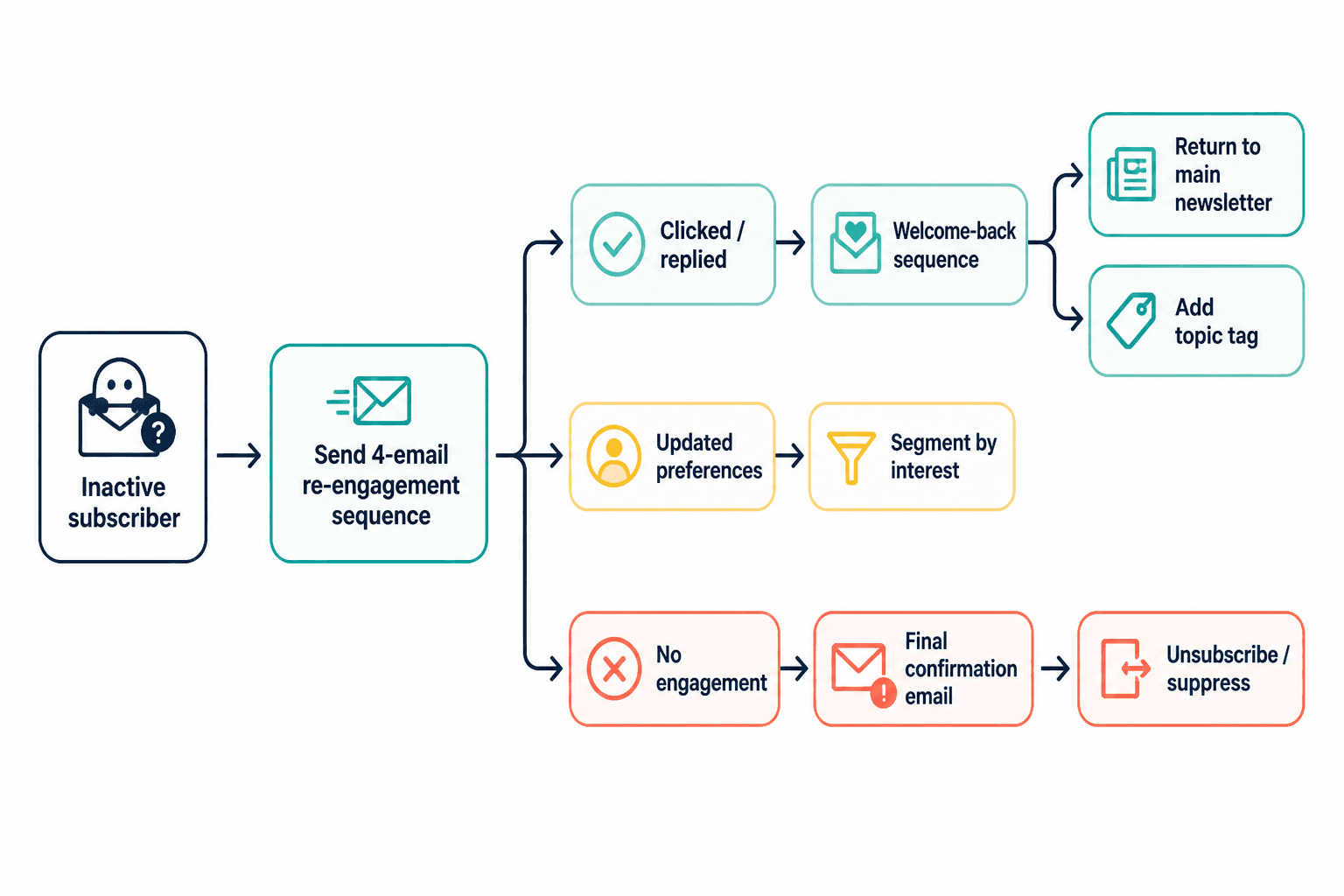
A simple 4-email re-engagement flow that works
You do not need a giant sequence. For most creators, coaches, consultants, and personal brands, four emails is enough.
Email 1: The relevance reset
This is your best shot, so do not waste it on emotional fluff.
Goal: remind them what you help with now and why it matters
Angle: “Here is what these emails are for now, and here is the easiest way to stay if it still fits.”
Example CTA: “If you still want practical emails on content systems and client-generating writing, click here and I will keep sending them.”
Email 2: The value proof email
Give them something immediately useful. Not a pitch wearing a fake moustache.
Goal: re-earn attention with a practical takeaway
Angle: “Here is a tactic, framework, checklist, or short lesson that helps solve the problem they likely signed up for in the first place.”
This email often performs better than the “we miss you” style because it respects the subscriber’s real question: “Why should I keep making room for you in my inbox?”
Email 3: The preference or path email
Some subscribers are not disengaged from you. They are disengaged from what you are sending.
Goal: let them choose a better-fit path
Angle: topic options, frequency options, or a clear split between newsletter content and offer-related updates
Example: “Want fewer emails, only writing templates, or just the higher-level strategy notes? Pick your lane.”
Email 4: The final permission email
This is the “stay or go” email. Keep it clean. No melodrama.
Goal: confirm interest or remove inactive contacts
Angle: “If this is no longer useful, no problem. If you want to stay, click below.”
A strong final email is clear and relaxed. It says: I want an engaged list, not a padded number. That is a good look.
What to write in each email without sounding robotic
The best re-engagement emails tend to sound like a capable person, not a lifecycle campaign template pulled from a software help doc.
That means your writing needs a few things:
- A clear reason for the email
- A reminder of the value they signed up for
- Specific language about what they will keep getting
- One action to take
- A tone that feels human, not needy
Here is a simple structure you can use.
The basic re-engagement email structure
- Open with what changed or what this email is about
- Remind them who your content is for
- Give one useful reason to keep receiving it
- Ask for one small action
- Offer an easy unsubscribe or opt-down path
Example:
I noticed you have not opened my recent emails, so here is the quick version.
I now send short, practical notes for creators and consultants who want sharper content, better trust, and more leads without turning every email into a mini funnel circus.
If that still sounds useful, click here and I will keep sending them.
If not, you can unsubscribe below with no hard feelings.
That works because it is specific, respectful, and not trying too hard. Which, frankly, is already better than a lot of email marketing.
Subject lines that do not feel tired
Your subject line does not need theatrical suspense. It needs enough clarity and relevance to earn a glance.
| Weak | Better |
|---|---|
| We miss you | Still want my best content emails? |
| Last chance | Should I keep sending these? |
| Don’t go | A quick reset on what I send now |
| Are you still there? | If you still want practical writing emails, click here |
| We have something special | One useful resource before I clean this list |
Specific beats sentimental. Every time.
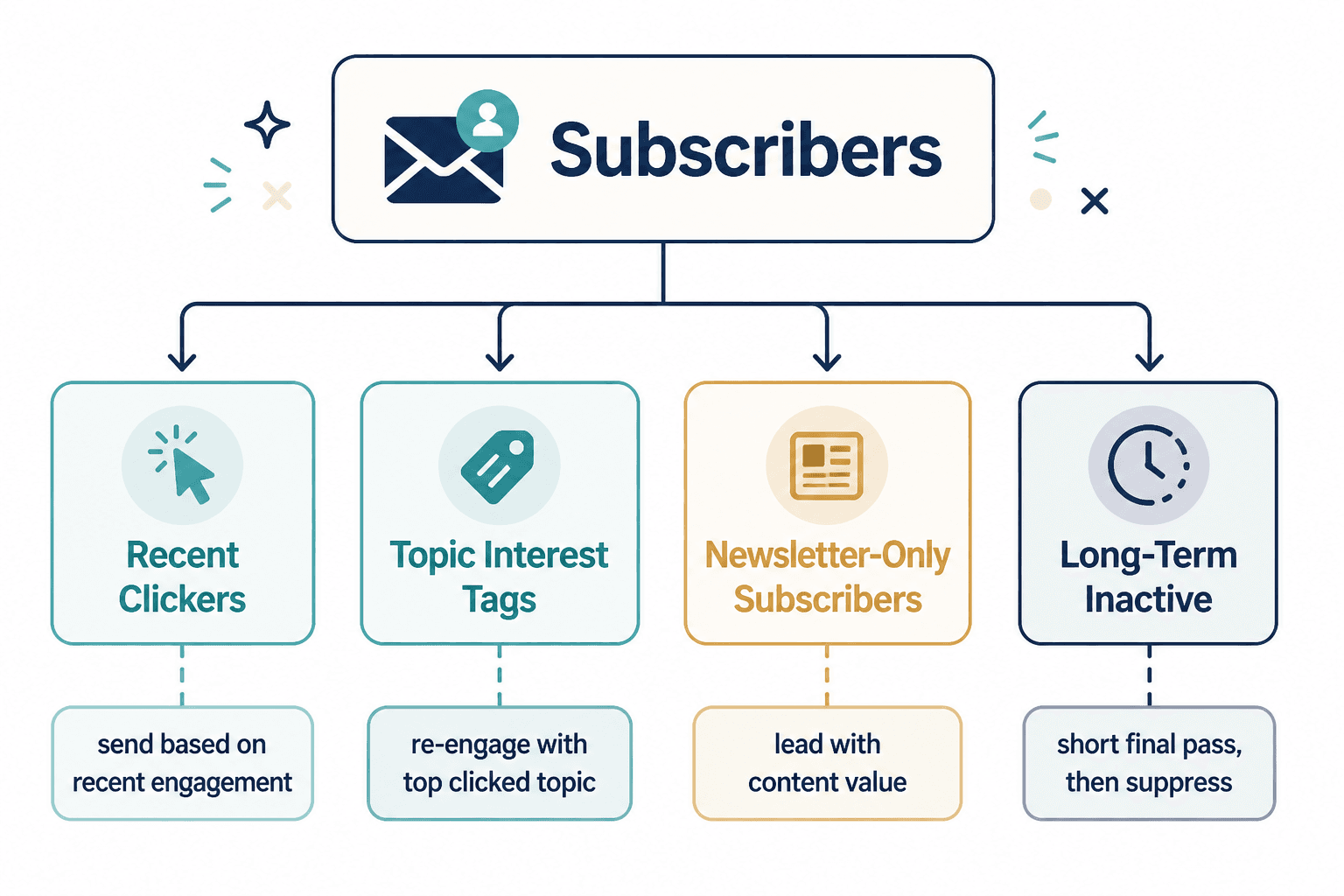
How to segment re-engagement flows for personal brands
If you have the setup for it, segmentation makes these flows much stronger.
You do not need enterprise-level complexity. Just enough to avoid sending the exact same message to wildly different people.
Useful segments include:
- Recent buyers: do not send generic “still interested?” emails to people who already paid you
- Lead magnet source: remind them of the topic they originally raised their hand for
- Topic interest tags: re-engage around the topic they clicked most
- Newsletter-only subscribers: focus on content value, not product urgency
- Long-term inactive subscribers: use a shorter, cleaner final pass before suppression
This is where your broader creator email systems matter. Re-engagement works better when your list is already somewhat organized, your sequence logic is not a spaghetti bowl, and your subscribers are not all dumped into one giant bucket called “newsletter humans.”
What to offer in a re-engagement flow
You do not always need an offer. But when you include one, make sure it fits the stage of the relationship.
Good re-engagement offers:
- A best-of email with your strongest content
- A topic-based mini guide
- A short checklist or template
- A preference update page
- A “start here” page for new positioning or content direction
- A low-pressure invitation to a relevant product or consultation
Bad re-engagement offers:
- A random discount with no context
- A hard sales pitch after months of silence
- A generic webinar registration
- A bait-and-switch “free resource” that is really a long sales sequence setup
If your business runs on trust, and personal brands usually do, the re-engagement flow should feel like service first and sorting second. Not “please buy this so my metrics feel less embarrassing.”
When to remove inactive subscribers
After the flow, remove or suppress people who do not engage.
The bigger point is simple: clearer structure and clearer writing make the piece more useful. That is usually what makes the ending land better too.