
Getting someone to subscribe to your Substack is not the hard part anymore. Keeping them reading is.
A lot of personal brands treat reader retention like a traffic problem. They tweak headlines, chase collaborations, post more on social, and wonder why open rates slide anyway. But most retention problems start inside the actual reading experience. The posts are too loose, the series goes nowhere, the value is buried, and every edition feels like it was written with a different brain.
If you want better Substack reader retention for personal brands, you need to make people feel two things quickly: this is worth my time, and I know what I am coming back for. That is the whole game. Not hype. Not volume. Not pretending every email is a manifesto.
Here’s how to make your Substack posts and series more readable, more consistent, and a lot harder to quietly ignore.
For the full path around this topic, head to the parent guide.
Why readers leave even when your ideas are good
Most unsubscribes are not dramatic. People do not usually storm out because one sentence offended their spirit. They drift.
They stop opening because your posts became work. They stop trusting the promise because the series got fuzzy. They stop remembering you because every issue feels structurally different. And if you are a personal brand, there is an extra risk: your writing starts sounding like your internal monologue instead of a crafted experience for the reader.
That is the uncomfortable bit. Strong ideas do not automatically create strong retention. Packaging matters. Structure matters. Rhythm matters. Readers are not grading your intelligence. They are deciding if they want this in their week again.
Start with a clearer retention promise
A lot of newsletters promise too much and too little at the same time.
Too much because the positioning is broad and grand. Too little because the reader cannot tell what they are actually subscribing to. “Thoughts on creativity, business, growth, mindset, and life” is not a retention promise. It is a polite warning label.
Your reader retention improves when people know the kind of value they will keep getting. Not every single topic. The pattern.
Give your newsletter a repeatable identity
- What kind of problems do you help readers solve?
- What lens do you use that makes your take worth returning to?
- What format or angle can they expect regularly?
- What kind of result should they leave with after reading?
For example, these are retention-friendly promises:
- Weekly breakdowns of what makes creator content convert without sounding pushy
- Short essays on personal brand positioning with practical rewrites
- A three-part monthly series unpacking one business growth mistake and how to fix it
- Case-study style posts showing why some newsletter issues get replies, shares, and sales while others die quietly
That is much stronger than “I write about marketing, writing, and building online.” So do half the internet and at least three people currently pretending to be thought leaders from a beach.
If your newsletter promise is mushy, retention gets mushy too.
For more on shaping the whole Substack approach, link this article naturally with Substack posts and series guide for creators who want better results and the broader Substack posts and series hub.
Make every post easier to finish
Retention is heavily affected by completion. If readers often bail halfway through, they slowly train themselves not to open next time. You do not need every issue to be short. You need it to feel easy to move through.
This is where a lot of personal brands get too self-indulgent. They confuse depth with drag. They write long openings, stack five ideas in one issue, and save the useful part for paragraph eleven like it is an Easter egg. Nobody asked for that.
Use a cleaner reading flow
- Open with the tension, not the backstory
- State the point early
- Keep one main idea per post
- Use subheads before attention drops
- Break long sections before they feel heavy
- End before the post starts repeating itself
A useful test: if someone skim-reads your issue in 90 seconds, do they still get the core point? If not, the structure needs help.
That does not mean writing shallow posts. It means respecting reader energy. There is a difference.
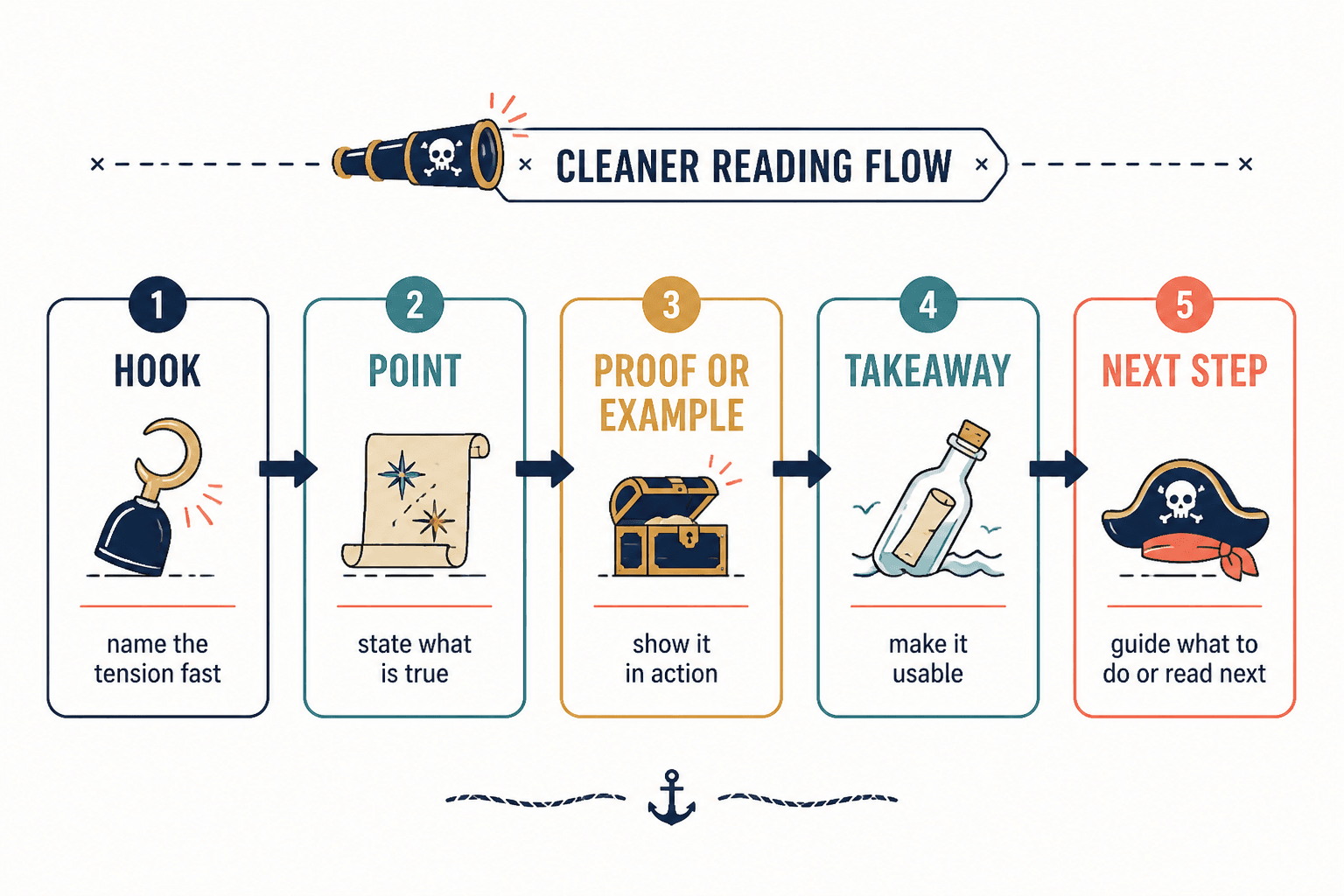
A simple post structure that improves retention
- Hook: name the problem, tension, or misconception fast
- Point: tell the reader what is actually true
- Proof or example: show the idea in action
- Takeaway: translate it into something usable
- Next-step: suggest what to read, do, or expect next
That last piece matters more than people think. Retention is not just about liking the current issue. It is about being guided toward the next one.
Series beat randomness when you want better Substack reader retention for personal brands
A strong recurring series is one of the easiest ways to improve retention because it creates familiarity. Familiarity lowers friction. Readers know what they are opening, why it matters, and what kind of payoff to expect.
But the keyword is strong. A weak series is just repeated confusion on a schedule.
What makes a series worth following
- A clear topic boundary
- A recognizable format or recurring angle
- A specific audience fit
- A built-in question or tension readers want resolved
- Consistent payoff from issue to issue
For example, instead of a vague “weekly reflections” series, a personal brand could run:
- Bad Content Fixes: one weak post or email example rewritten each week
- Client Pattern Notes: one repeated audience or sales mistake observed and explained
- Offer Teardowns: one issue unpacking why a positioning or conversion problem keeps happening
- Behind the Strategy: one issue explaining the thinking behind a real content decision
Those have shape. They give the reader a reason to stick around beyond “I like this person.” That matters because personal-brand newsletters often lean too heavily on personality and not enough on editorial clarity.
If you want examples of formats that can actually hold attention, pair this with Substack posts and series examples for coaches, consultants and personal brands and best Substack posts and series ideas and examples for creators.
Do not make readers remember your series on their own
One of the easiest retention wins is simple continuity language. Remind people where they are in the series and why they should care.
Good examples:
- “This is part 2 of the 4-part series on why expertise-led newsletters still struggle to convert.”
- “Last week, we looked at weak hooks. Today, the bigger problem: the middle of the post collapses.”
- “This issue continues the teardown series, where I break down one avoidable content mistake each week.”
That kind of framing sounds small, but it creates narrative memory. Readers feel oriented instead of dropped into another random installment from your beautiful, chaotic brain.
Stop writing intros that delay the useful part
Weak intros kill retention quietly.
A lot of Substack writers open with scene-setting, vague reflection, or a soft little ramble that only becomes relevant much later. That can work if you are genuinely brilliant on the page. Most people are not that brilliant every Tuesday.
If your audience is made up of creators, consultants, coaches, founders, or experts, they are busy and pattern-sensitive. They can smell throat-clearing. They do not always hate it enough to unsubscribe immediately. They just stop caring.
Better intro moves
- Start with the mistake people keep making
- Lead with a sharp claim you can support
- Open on a tension the reader already feels
- Use a quick example that earns the lesson fast
- State the payoff of reading in plain English
For example:
| Weak intro | Stronger intro |
|---|---|
| “I have been thinking a lot lately about the role consistency plays in creative work…” | “Consistency is not what keeps readers. Predictable value is.” |
| “When I started writing online, I did not realize how hard it would be to keep people engaged…” | “Most newsletter retention problems are not about frequency. They are about disappointing the reader too many times in a row.” |
| “Today I want to share a few thoughts on series structure.” | “If your newsletter series feels random, readers will treat it like optional homework.” |
See the difference? The stronger versions get to the point and create tension immediately. That is what earns attention long enough to deliver the rest.
Use consistency without becoming predictable in the boring way
Consistency helps retention, but not the shallow version people usually mean.
You do not need every issue to sound identical or hit the inbox at the same minute forever. You do need consistency in the things readers care about: usefulness, quality, tone, structure, and relevance.
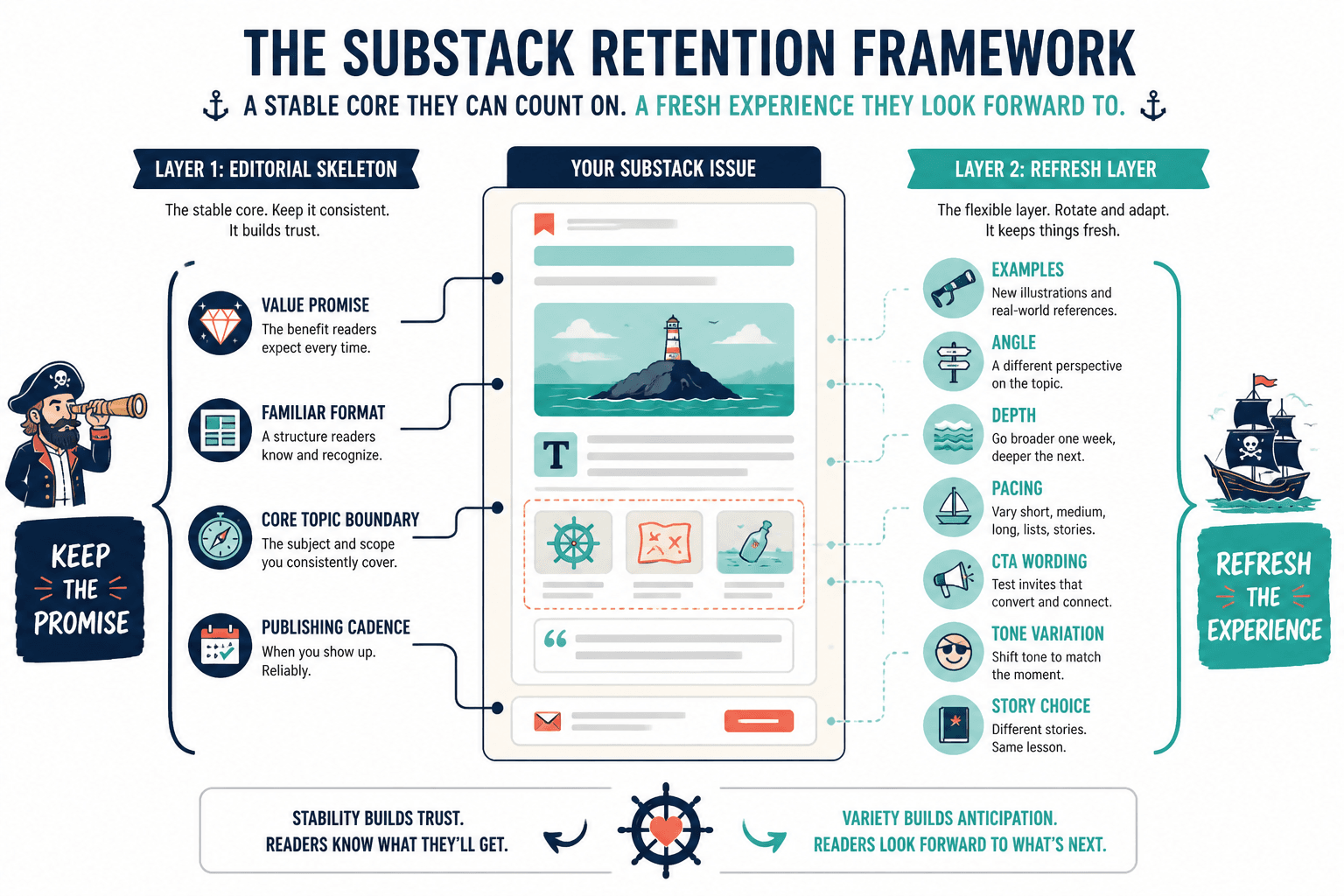
The consistency stack that actually matters
- Voice consistency: readers recognize your tone and thinking
- Value consistency: each issue delivers a clear takeaway
- Format consistency: the reading experience feels familiar enough to trust
- Topic consistency: your subject does not swing wildly without explanation
- Publishing consistency: you show up often enough to stay remembered
The trap is becoming mechanically repetitive. If every issue follows the same exact rhythm, uses the same canned CTA, and arrives with the same polished seriousness, readers stop feeling any spark. It starts reading like a content system instead of a person with a perspective.
So keep the editorial skeleton stable. Change the skin. Vary examples, angles, depth, and pacing. Keep the promise. Refresh the experience.
Give readers small payoffs, not just one big idea
One reason readers abandon long Substack posts is that the payoff is too delayed. They have to wade through context, opinion, setup, and side roads before getting anything practical or interesting.
Good retention writing gives readers little rewards as they go. A strong line. A useful distinction. A concrete example. A simple framework. A clean summary sentence. Something that keeps confirming, yes, staying here was worth it.
Ways to create those small payoffs
- Use subheads that make the argument easier to track
- Add mini summaries after dense sections
- Include practical examples before the reader gets tired
- Turn abstract points into concrete decisions
- Drop one memorable line where it sharpens the point
This is especially important if you write smart, strategy-heavy content. Expertise can get dense fast. Your job is not to become simpler than the topic. Your job is to make the insight easier to hold.
Use endings to pull readers forward
A bad ending feels like the writer ran out of runway. A good ending increases the chance of the next open.
Many personal-brand newsletters end with one of these:
- A vague summary
- A hard sell that does not match the issue
- A limp “what do you think?”
- A sudden sign-off with no continuation
Instead, use endings that create momentum.
Three endings that support retention
- Preview ending: hint at the next issue or next part in the series
- Application ending: give the reader one thing to test before next time
- Connection ending: invite a reply tied directly to the issue, not a generic engagement nudge
Examples:
The bigger point is simple: clearer structure and clearer writing make the piece more useful. That is usually what makes the ending land better too.