
Most weak blog titles do not fail because the topic is bad. They fail because the opening of the title is soft, vague, padded, or trying way too hard to sound clever.
You can have a useful article, a strong point, and solid SEO intent, then quietly kneecap the whole thing with a headline that opens like this:
- Things to Know About…
- Thoughts on…
- A Guide to…
- Some Tips for…
- What You Should Understand About…
That is not a headline opening. That is throat-clearing in business-casual clothing.
If you want clicks, clarity, and a title that does not sound like it was assembled by a tired content machine, the first few words have to do more work. They need to establish a clear promise, a specific problem, or a sharp angle fast.
That is what this article will help you fix. You will learn how to start blog titles and headlines without a weak opening, how to spot flabby openings quickly, and how to rewrite them into something cleaner, stronger, and much more worth reading.
If you are also tightening your broader title strategy, this pairs well with blog titles and headlines and how to rewrite boring blog titles and headlines.
What a weak headline opening actually does
A weak opening usually creates one of three problems:
- It hides the real point
- It delays the payoff
- It sounds generic enough to apply to 4,000 other articles
Readers do not sit around admiring your setup. They scan. They judge fast. They decide whether this looks useful, specific, and relevant to what they want right now.
So when a title opens with filler, the reader has to work harder to figure out what the article is about. And most of them will not. They will just skip it.
This matters for SEO too, but not in the cartoon version where one magic word fixes everything. A stronger opening helps because it makes the title clearer to humans first. That usually improves relevance, click interest, and the odds that your title matches what someone actually searched for.
A strong title opening gets to the point early. A weak one makes the reader dig for it. Guess which one wins.
How to Start Blog Titles and Headlines Without a Weak Opening
If you want to start blog titles and headlines well, stop thinking of the opening as a warm-up. It is not there to gently introduce the topic. It is there to carry the most important part of the headline as early as possible.
In practical terms, that means the opening should usually do at least one of these things:
- Name the problem
- Name the result
- Name the audience
- Name the tension
- Name the specific angle
- Name the action the reader wants to take
That does not mean every headline has to sound aggressive or formulaic. It means the front of the headline should carry meaning, not fluff.
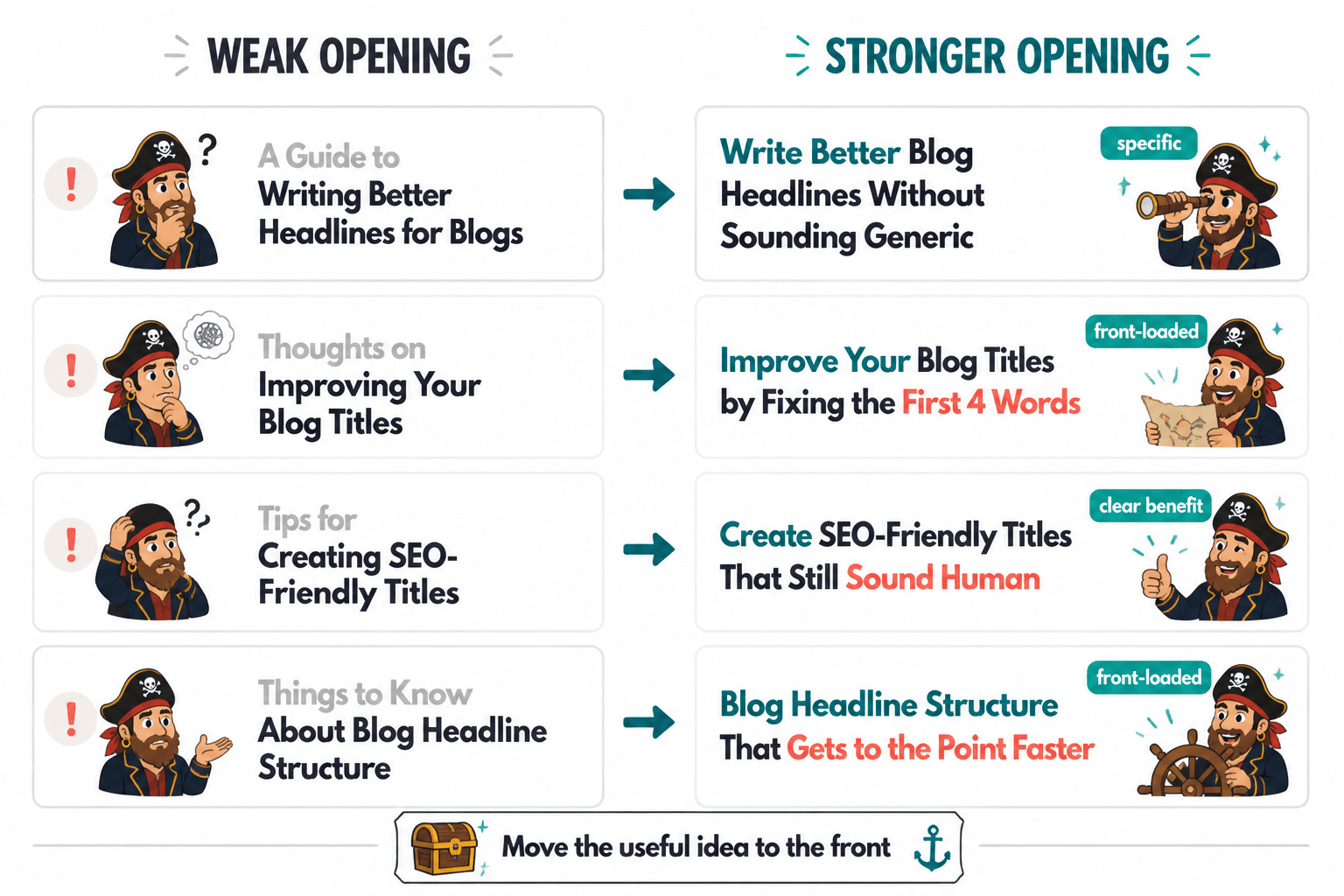
Compare these:
| Weak opening | Stronger opening |
|---|---|
| A Guide to Writing Better Headlines for Blogs | Write Better Blog Headlines Without Sounding Generic |
| Thoughts on Improving Your Blog Titles | Improve Your Blog Titles by Fixing the First 4 Words |
| Tips for Creating SEO-Friendly Titles | Create SEO-Friendly Titles That Still Sound Human |
| Things to Know About Blog Headline Structure | Blog Headline Structure That Gets to the Point Faster |
Notice what changed. The stronger versions cut the vague setup and move the useful idea to the front.
That is the whole game more often than people think.
The fastest way to diagnose a weak opening
Here is a simple test: cover the second half of your title and read only the opening.
If the first 3 to 6 words do not communicate something concrete, you probably have a weak opening.
Ask:
- Does this opening say anything specific?
- Would this opening fit almost any article in this category?
- Am I delaying the actual point?
- Did I open with a label instead of a benefit or problem?
- Did I choose a safe intro phrase because I could not decide on a sharper angle?
If the answer is yes to the last few, there is your problem.
A lot of weak openings are just indecision in a nicer outfit. The writer knows the topic, but has not committed to the angle. So instead of saying the real thing, they hide behind generic wrappers like “guide,” “tips,” “ways,” or “things to know.”
Those words are not banned. They are just often used lazily. If they are doing all the work in your opening, the title is probably underpowered.
7 weak headline openings that keep making titles worse
1. “A guide to…”
This one is not always terrible. But it is usually weak because it tells me the format, not the value.
Weak: A Guide to Blog Title Writing for Better SEO
Better: Write Blog Titles for SEO Without Making Them Awful
2. “Tips for…”
“Tips” is often code for “miscellaneous content confetti.” Sometimes it works. Usually it sounds thin.
Weak: Tips for Better Blog Headlines
Better: Better Blog Headlines Start With a Sharper First Phrase
3. “Things to know about…”
This is one of the flabbiest openers on the internet. It promises information but says almost nothing.
Weak: Things to Know About Writing Blog Headlines
Better: Write Blog Headlines That Sound Clear, Useful, and Click-Worthy
4. “How to understand…”
Unless your reader actually wants theory, this often adds distance instead of clarity.
Weak: How to Understand Blog Headline Psychology
Better: Use Blog Headline Psychology Without Sounding Manipulative
5. “Why you should…”
This can work, but a lot of the time it leads to preachy headlines nobody asked for.
Weak: Why You Should Improve Your Blog Titles
Better: Improve Your Blog Titles if You Want More Clicks From the Same Content
6. “The best way to…”
Big claim. Often weak follow-through. If you use this structure, the rest of the title needs real specificity.
Weak: The Best Way to Write Blog Headlines
Better: The Best Blog Headlines Usually Start With the Actual Problem
7. “Everything you need to know…”
Usually too broad. Often sounds inflated. Sometimes reads like the article will be 2,700 words of recycled soup.
Weak: Everything You Need to Know About Blog Titles
Better: Blog Titles That Hook Faster Without Sounding Clickbaity
What strong title openings usually start with instead
You do not need one perfect formula. But strong openings often begin with one of a few reliable moves.
Lead with the problem
This works when the reader already feels the pain and wants relief fast.
- Weak Blog Titles That Quietly Kill Good Content
- Boring Blog Headlines and How to Fix Them Fast
- Title Openings That Make Good Articles Easy to Ignore
Lead with the outcome
This works when the result is clear, desirable, and believable.
- Write Sharper Blog Titles Without Sounding Like a Copy Bot
- Create Click-Worthy Blog Headlines That Still Feel Natural
- Get More Opens by Fixing Your Headline’s First Few Words
Lead with the action
“How to” headlines still work when the action is specific enough to matter.
- How to Start Blog Titles and Headlines Without a Weak Opening
- How to Write Better Blog Titles When Your Drafts Sound Generic
- How to Rewrite Blog Headlines That Feel Flat on Arrival
Lead with contrast
Contrast creates tension. Tension creates interest. This is useful when readers are making a common mistake.
- SEO Blog Titles That Rank Without Reading Like SEO Blog Titles
- Simple Headlines That Get Clicks Without the Clickbait Stench
- Clear Blog Titles Beat Clever Ones More Often Than You Think
Lead with a specific angle
This helps your title feel more distinct and less mass-produced.
- The First 5 Words That Make or Break a Blog Headline
- Why Most Blog Titles Sound Weak Before the Reader Even Gets to the Middle
- The Headline Opening Mistake That Makes Useful Articles Feel Skippable
If your titles tend to sound stiff or over-optimized, read how to write blog titles and headlines without sounding salesy or robotic. It helps with the next problem people usually create right after fixing vagueness.
A simple framework for stronger opening words
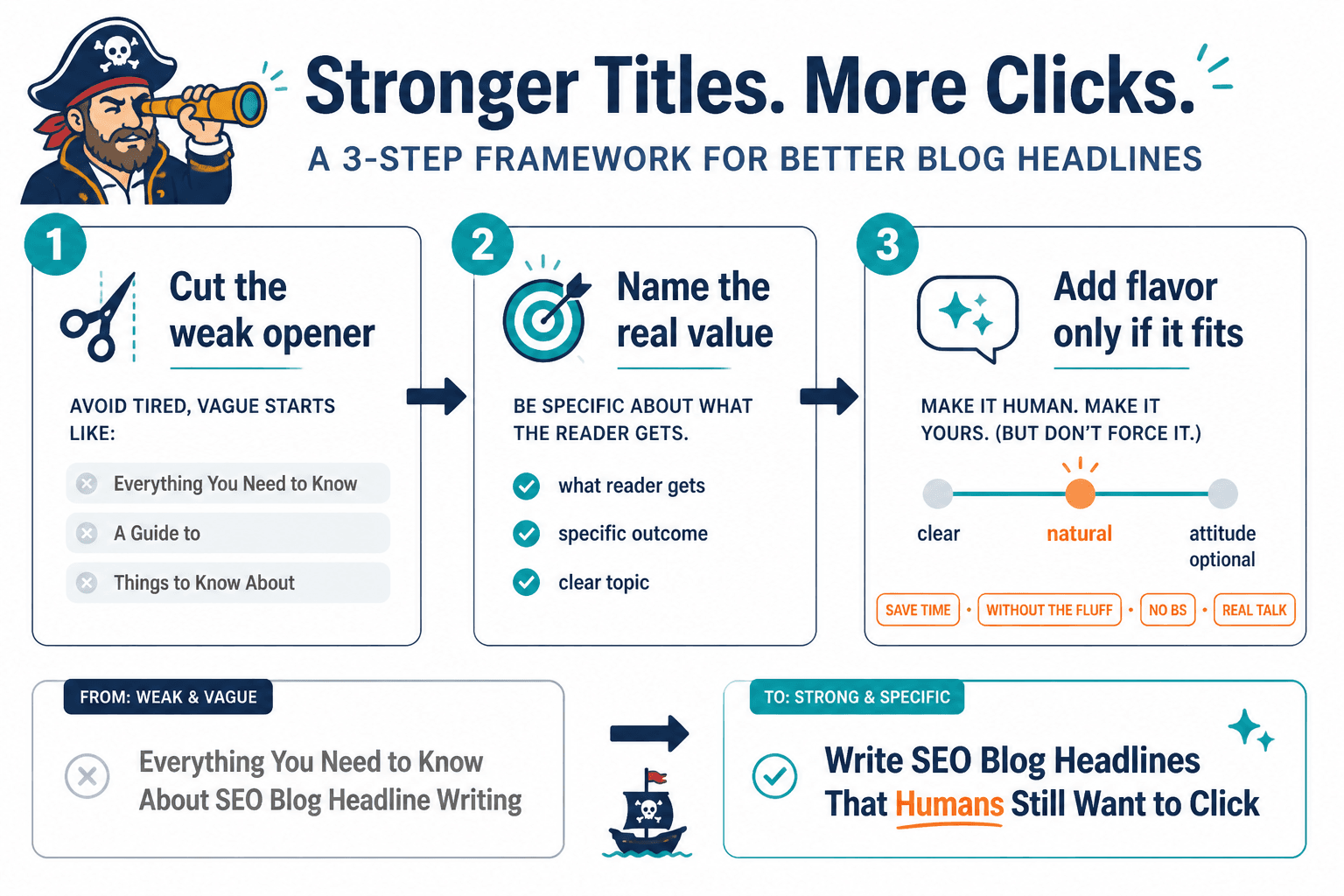
Here is an easy framework you can use when your title opening feels limp:
- Find the actual point of the article
- Identify the problem, result, or tension
- Move that element to the front
- Cut any setup phrase that only labels the content
- Keep the wording natural, not theatrical
Let’s make that practical.
Example 1
Original: A Guide to Writing Better Blog Titles for Personal Brands
The real point is not that this is a guide. The real point is writing better blog titles for personal brands.
Stronger options:
- Write Better Blog Titles for Your Personal Brand
- Better Blog Titles for Personal Brands That Need More Clicks
- Personal Brand Blog Titles That Sound Clear Instead of Generic
Example 2
Original: Tips for Making Your Blog Headlines More Effective
The real point is stronger headlines. “Tips for making” is just puffed-up scaffolding.
Stronger options:
- Make Your Blog Headlines More Effective by Fixing the Opening
- More Effective Blog Headlines Start With Better First Words
- Blog Headlines Get Stronger When the Opening Gets Specific
Example 3
Original: Everything You Need to Know About SEO Blog Headline Writing
The real point is probably not “everything.” It is likely some version of writing SEO-friendly headlines that still attract humans.
Stronger options:
- Write SEO Blog Headlines That Humans Still Want to Click
- SEO Blog Headlines Without the Keyword-Stuffed Awfulness
- How to Write SEO Blog Headlines That Do Not Sound Dead Inside
That last one has a bit more attitude, so use it only if it matches the brand voice. The point stands though: clarity first, then flavor.
Before-and-after headline rewrites
Sometimes the fastest way to learn this is to look at rewrites side by side.
| Before | After |
|---|---|
| A Guide to Better Blog Titles for SEO | Better Blog Titles for SEO That Still Sound Natural |
| Tips for Writing Headlines That Convert | Write Headlines That Convert Without Sounding Pushy |
| Things to Know About Catchy Blog Titles | Catchy Blog Titles Without the Clickbait Mess |
| How to Understand Effective Headline Structure | Use Headline Structure That Makes Readers Care Faster |
| Everything You Need to Know About Blog Headline Writing | Blog Headline Writing That Gets to the Point Early |
| Why You Should Improve Your Blog Headlines | Improve Your Blog Headlines if You Want Better Click-Through |
What makes the “after” versions better is not just shorter wording. It is stronger front-loaded meaning.
If you want more examples like this, better blog titles and headlines weak title fixes for personal brands is a useful next read.
How to avoid replacing one weak opening with another kind of bad
There is a common overcorrection here. People remove weak title openings, then replace them with fake drama, bloated claims, or weirdly aggressive copy.
So yes, cut the limp setup. But do not replace it with this kind of nonsense:
- The Brutal Truth About Blog Titles Nobody Wants to Admit
- This One Weird Blog Headline Trick Changes Everything
- Shocking Reasons Your Headlines Are Failing Miserably
- Insane Blog Title Hacks for Massive Results
Congratulations, you removed the beige and added spam.
A stronger opening should sound sharper, not more desperate. Good headlines create interest through relevance and specificity, not theatrical flailing.
Use these checks:
- Does the title sound like something a smart human would actually say?
- Is the promise real, not inflated?
- Does the opening create clarity instead of just noise?
- Would the reader feel slightly tricked after clicking?
If the answer to the last one is yes, back up.
Good opening words to use more often
You do not need a sacred list, but some opening patterns tend to carry more weight than others.
Useful starting words and structures include:
- How to…
- Why…
- What…
- When…
- Stop…
- Write…
- Fix…
- Create…
- Avoid…
- Better…
- Stronger…
- Simple…
- Blog titles that…
- Headlines that…
What matters is not the exact word. It is whether the phrase moves quickly into something meaningful.
For example, “How to” is not automatically good. “How to Think About Headlines” is still weak if the search intent is practical. But “How to Start Blog Titles and Headlines Without a Weak Opening” is specific, useful, and immediately relevant.
How SEO fits into this without making the title ugly
A lot of people keep weak openings because they are trying to wedge in a keyword phrase and do not know how to make it read naturally.
Fair. That is a real constraint. But usually the better move is not to stuff the keyword at the end after a generic intro. It is to integrate the phrase into a useful opening.
For example:
- Clunky: A Guide to Learning How to Write Better Blog Titles and Headlines
- Better: How to Write Better Blog Titles and Headlines That Get Clicked
Or for this article:
- Clunky: Tips for How to Start Blog Titles and Headlines Without a Weak Opening
- Better: How to Start Blog Titles and Headlines Without a Weak Opening
See the difference? One sounds like a phrase was dragged awkwardly through a template. The other sounds like an actual article someone meant to publish.
If you are trying to balance search intent with cleaner phrasing, the articles in this related blog SEO writing cluster can help you sort out the bigger system.
A practical title-start checklist
Before you publish, run the headline through this quick checklist