Most affiliate review articles fail for a boring reason: they all use the same angle.
They read like slightly rearranged product pages with a few personal opinions sprinkled on top, as if that makes the whole thing trustworthy. It does not. If your review sounds like “here are the features, here are the benefits, here is my link,” people can smell the commission from three tabs away.
Affiliate review angles creators can adapt fast are not about sounding clever. They are about framing the review around the question your audience is already asking. That one shift makes the piece more useful, more believable, and a lot more likely to convert without sounding like a desperate pitch in loafers.
This article will show you how to pick better review angles, how to match them to your audience, and how to turn one product into several article ideas that do not feel cloned from each other. If you create content as a coach, consultant, writer, freelancer, educator, or personal brand, this is how to make affiliate reviews less robotic and more persuasive.
What a review angle actually is
A review angle is the lens you use to evaluate and present the product.
Not the product category. Not the headline alone. Not “my honest review,” which usually means nothing. The angle is the specific perspective that shapes what you include, what you leave out, what examples you use, and why the reader should care.
For example, the same writing tool could be reviewed from very different angles:
- Best for busy solo creators
- Best for long-form repurposing
- Good but overpriced for small newsletters
- Strong for outlining, weak for voice
- Useful if you publish weekly, overkill if you do not
Same product. Very different article. Very different reader intent.
That is the point. A solid affiliate article does not just answer “is this good?” It answers “is this good for someone like me, in my situation, with my goals, budget, workflow, and tolerance for nonsense?”
Why generic affiliate reviews underperform
Readers do not need another 2,000-word reheating of the product homepage. They need help making a decision.
Generic reviews usually miss because they do three things badly:
- They cover everything equally instead of emphasizing what matters most
- They do not define who the product is actually for
- They try so hard to sound balanced that they become mushy and forgettable
And yes, a lot of them also sound like AI wrote them while half asleep.
If you want the review to perform, your angle needs to create relevance fast. The reader should feel, within the intro, that this article was built for their situation rather than sprayed at the internet in hopes of accidental clicks.
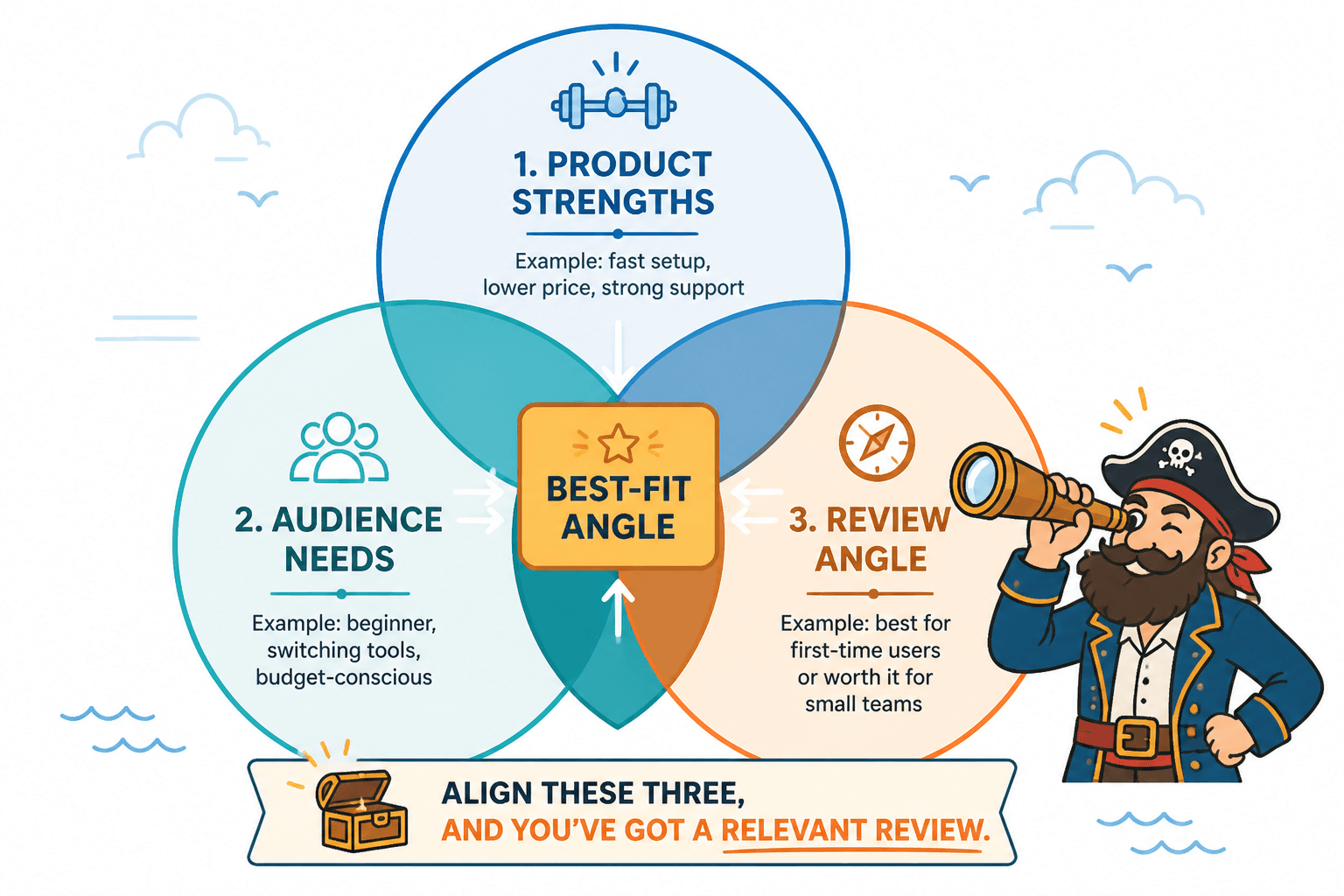
How to choose the right affiliate review angle
You do not need twelve angles per product. You need one good angle that fits your audience, your experience, and the buyer decision they are stuck on.
Start with the reader’s actual question
People rarely search for reviews because they want abstract information. They are usually trying to reduce risk.
They are asking things like:
- Is this worth the money?
- Is this better than the thing I already use?
- Will this save time or create more setup work?
- Is this made for people at my stage?
- What are the downsides nobody mentions?
- Do I need the paid version yet?
Your angle should answer one of those directly.
Use your audience context, not just the product category
A creator audience does not evaluate tools the same way a big in-house marketing team does. A solo consultant does not care about the same things as a VC-backed startup. If your audience is made up of practical, self-directed people, they usually care about speed, usefulness, friction, pricing, learning curve, and whether the tool fits into an already messy workflow.
That means your review angle should sound like it came from the life they are actually living. Not from a feature matrix.
Pick an angle you can support with proof
If you cannot explain why the product is strong or weak from that angle, do not use it. Strong review angles are supported by:
- Real use cases
- Clear criteria
- Specific tradeoffs
- Comparisons with alternatives
- Examples of who should and should not buy
Opinion is useful. Vibes alone are not.
10 affiliate review angles creators can adapt fast
Here is where affiliate review angles creators can adapt fast become genuinely useful. These are flexible angles you can apply to software, courses, templates, gear, subscriptions, communities, and creator tools without sounding copy-pasted.
1. The “best for a specific type of person” angle
This is one of the easiest and strongest angles because it creates instant relevance.
Examples:
- Best email platform for solo coaches with small lists
- Best camera for creators who film alone
- Best project management tool for consultants who hate admin
- Best AI writing tool for people who already have ideas but need speed
This works well because the reader can self-identify quickly. They either are that person or they are not.
2. The “worth it at this stage?” angle
Great for products with pricing friction, complexity, or premium plans.
Examples:
- Is this SEO tool worth it for a new creator?
- Should a freelance writer pay for this subscription yet?
- When this course makes sense and when it does not
This angle respects the reader’s hesitation instead of pretending every product is an obvious yes.
3. The “pros, cons, and tradeoffs” angle
Simple, durable, and still effective when done properly.
The trick is to include real tradeoffs, not fake cons like “there are so many useful features.” Nobody believes that. If the tool is clunky to set up, say so. If it is powerful but expensive, say that. If the mobile app is weak, mention it.
People trust reviews that can handle friction without panicking that honesty will kill the sale.
4. The “A vs B” comparison angle
This works especially well when your audience is already deciding between two options.
You are not just reviewing the product. You are helping the reader choose.
Good examples:
- ConvertKit vs MailerLite for creators
- Notion vs Trello for solo business workflows
- Canva Pro vs Adobe Express for everyday content creation
If you use this angle, make the comparison criteria practical. Setup, speed, flexibility, pricing, limitations, support, and who each product suits are all more useful than vague “overall quality.”
If you want to build stronger side-by-side sections, this is a good place to naturally point readers to affiliate articles comparison blocks mistakes that hurt performance.
5. The “here’s what it does better than the alternatives” angle
This is narrower than a full comparison and often easier to write.
You focus on the product’s clear edge:
- Faster setup
- Cleaner interface
- Better for repurposing
- Stronger templates
- Easier automation
- Better for non-technical users
It works because readers do not always want a giant comparison chart. Sometimes they just want to know what makes this one meaningfully different.
6. The “honest review after using it for X” angle
Time-based review angles help create credibility if the usage period is real and relevant.
Examples:
- My honest review after 30 days
- What changed after three months of using this tool weekly
- What this platform is like after publishing 50 posts with it
This angle works best when you can talk about setup friction, what improved over time, what annoyed you later, and whether the product kept its value after the first impression wore off.
Just do not fake this one. Nothing tanks trust faster than a “90-day review” that somehow contains no lived detail whatsoever.
7. The “who should not buy this” angle
This is underrated and weirdly persuasive.
A review that clearly says who should skip the product sounds more honest and helps the right buyers self-select. It also reduces refunds, buyer regret, and annoyed readers who feel they got pushed into something that never fit them.
Examples:
- Do not buy this if you need deep customization
- Probably not worth it if you publish once a month
- Not ideal for total beginners who want plug-and-play simplicity
8. The “use case” angle
Instead of reviewing the product broadly, review it for one concrete job.
Examples:
- Best screen recorder for making simple course tutorials
- Best CRM for keeping track of warm leads from content
- Best writing assistant for turning voice notes into drafts
This angle is strong because specificity beats comprehensiveness most of the time. The reader does not need your opinion on every feature. They need to know whether the thing solves the job they care about.
9. The “problem-first” angle
Here, the article starts with a pain point and positions the product as one possible solution.
Examples:
- If content planning keeps falling apart, this tool might help
- If client follow-up is messy, here is the CRM I would look at
- If writing captions takes too long, this is the tool I would test first
This feels less salesy because the article is anchored in the reader’s frustration, not your desire to insert an affiliate link into the atmosphere.
10. The “best alternatives if this is not for you” angle
This angle can still support affiliate revenue while being genuinely useful. You review one product, explain its limits, then point readers toward better-fit alternatives.
That move makes you look like someone helping them decide, not someone trying to close every breathing reader.
For more article idea variations beyond reviews, see best affiliate articles ideas and examples for creators and the broader affiliate articles content hub.
How to turn one product into several strong review articles
One of the biggest mistakes creators make is assuming one product deserves one article. That is leaving useful content on the table.
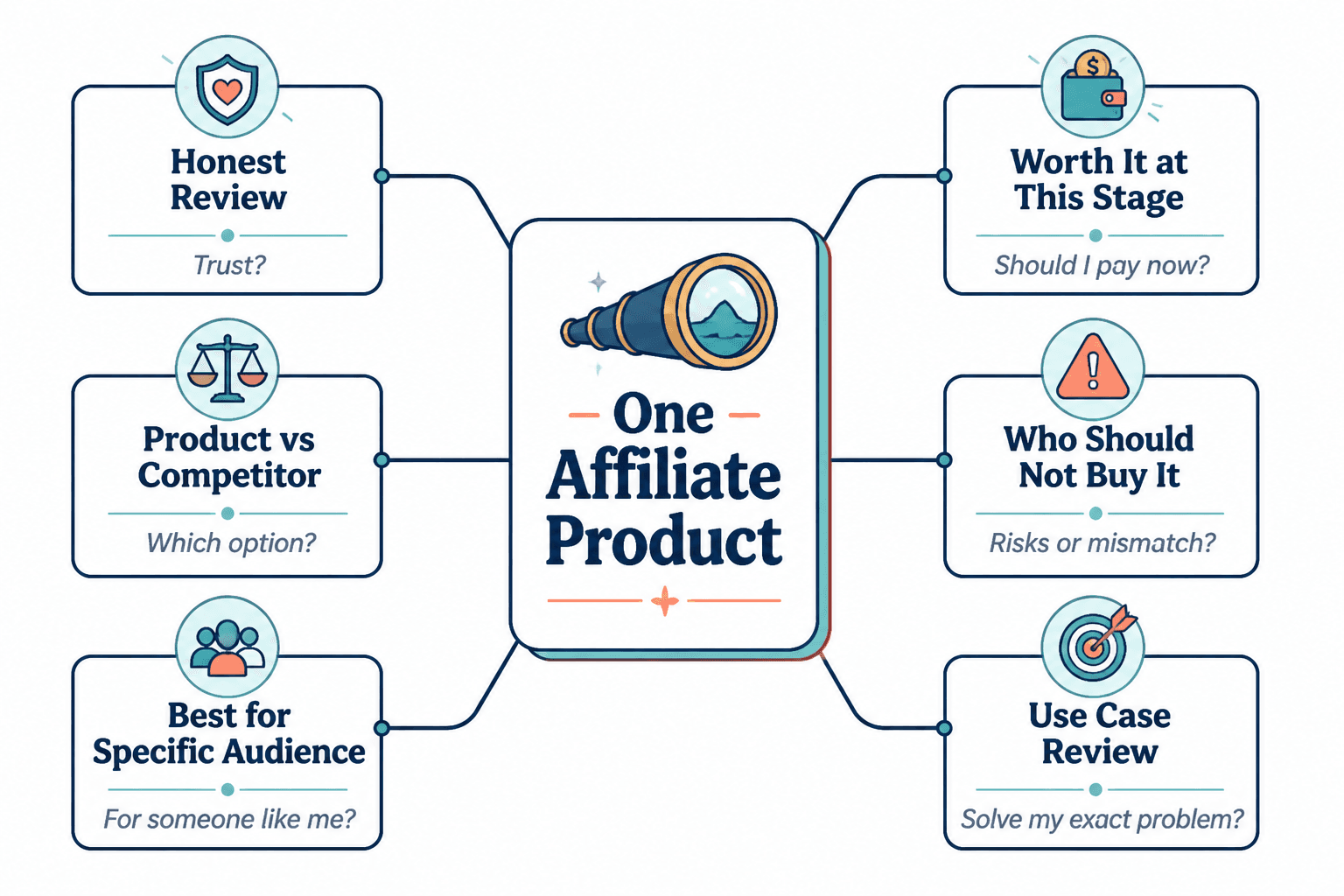
If the product is relevant to your audience, you can often build several articles around different intents without repeating yourself. The trick is to change the decision being answered.
| Article angle | Reader intent | Best use |
|---|---|---|
| Honest review | Can I trust this product? | Core authority piece |
| Product vs competitor | Which option should I choose? | Decision-stage traffic |
| Best for specific audience | Is this made for someone like me? | Niche relevance |
| Worth it at this stage | Should I pay for this now? | Budget-conscious readers |
| Who should not buy it | What are the risks or mismatches? | Trust building |
| Use case review | Can this solve my exact problem? | High-intent searchers |
That gives you a small content cluster around one offer instead of one lonely article trying to do every job badly.
A simple structure for affiliate review articles that do not sound salesy
If you have the right angle, the structure gets easier. Here is a clean format that works for most affiliate review posts.
- Lead with the decision
Open with the real question: who this is for, what problem it solves, or what choice the reader is trying to make. - State the short verdict early
Do not bury your opinion under six paragraphs of throat-clearing. Tell the reader the main takeaway fast. - Explain the context
Who is this review written for? How are you evaluating it? What use case matters here? - Break down the strengths
Focus on meaningful benefits, not every shiny feature. - Cover the limitations honestly
Real cons increase trust. - Compare where needed
If readers are likely choosing between options, help them do that clearly. - Recommend based on fit
Say who should buy it, who should skip it, and what to do next.
That structure works because it respects the reader’s time. It also keeps the review from morphing into a vague product essay with a commission link duct-taped to the bottom.
If your affiliate content still feels too polished, stiff, or synthetic, read how to write affiliate articles without sounding salesy or robotic.
Quick before-and-after angle upgrades
Sometimes the easiest way to improve a review is not rewriting the whole article. It is choosing a less lazy angle.
Weak: Generic review
This is my review of Tool X. It has many features for creators and businesses. In this article I will cover pricing, pros, cons, and whether I recommend it.
Better: Specific reader fit
Tool X is strong for solo creators who need fast content repurposing, but it is probably overkill if you only publish occasionally and still do most things manually.
Weak: Bland comparison opener
There are many tools on the market, so choosing the right one can be difficult.
Better: Decision-focused opener
If you are choosing between Tool A and Tool B, the real split is simple: Tool A is easier to start with, while Tool B gives you more control once your workflow gets more serious.
Weak: Fake-balanced conclusion
Overall, this tool has some strengths and weaknesses, so it depends on your needs.
Better: Useful recommendation
If you want speed and simplicity, it is a solid buy. If you need deep customization or enterprise-level reporting, skip it and look elsewhere.
See the difference? The stronger version actually helps someone decide. That is the whole job.
Common mistakes that weaken affiliate review angles
- Trying to sound neutral at all costs. You can be fair without becoming vague mush.
- Using fake honesty. “Brutally honest review” is often a warning sign, not a trust signal.
- Reviewing the category instead of the product fit. Readers do not need a history lesson on email software.
- Listing features without judgment. Features matter only when tied to outcomes, friction, or fit.
- Ignoring the wrong-fit buyer. Not everyone should buy the thing. Say that plainly.
- Copying the same article frame across every affiliate post. That is how your content starts sounding factory-made.
If you need more examples tailored to expertise-driven brands, affiliate articles examples for coaches consultants and personal brands will help.
Fast angle templates you can adapt today
Use these as starting points, not sacred scripts.
Template 1: Best for a specific audience
Best for creators who need clear tradeoffs, not just hype.
Template 2: Best for a specific use case
Best if you need [result] without [common downside].
These angles work because they help the reader self-select. A review becomes more persuasive when the article makes it easier to tell who a product is actually for and who should skip it.