Most people asking how long newsletter subject lines should be in 2026 are looking for a magic number.
For the broader learning path, visit our parent guide.
That would be convenient. It would also be a little lazy.
The real answer is that subject line length is not a rule. It is a tradeoff. Too short, and you can end up vague, clever, and forgettable. Too long, and your strongest idea gets buried under extra words that nobody needed. The best length depends on what you are sending, who you are sending it to, and what the first few words actually do.
So if you want a practical answer to How Long Should Newsletter Subject Lines Be in 2026?, here it is: usually shorter than you think, sometimes longer than the internet keeps yelling, and almost always tighter than what you drafted first.
This article will help you choose the right subject line length for different kinds of newsletters, avoid the common length mistakes, and write lines that earn opens without sounding like they were assembled by a frantic growth intern with access to too many emojis.
Here is the useful short answer
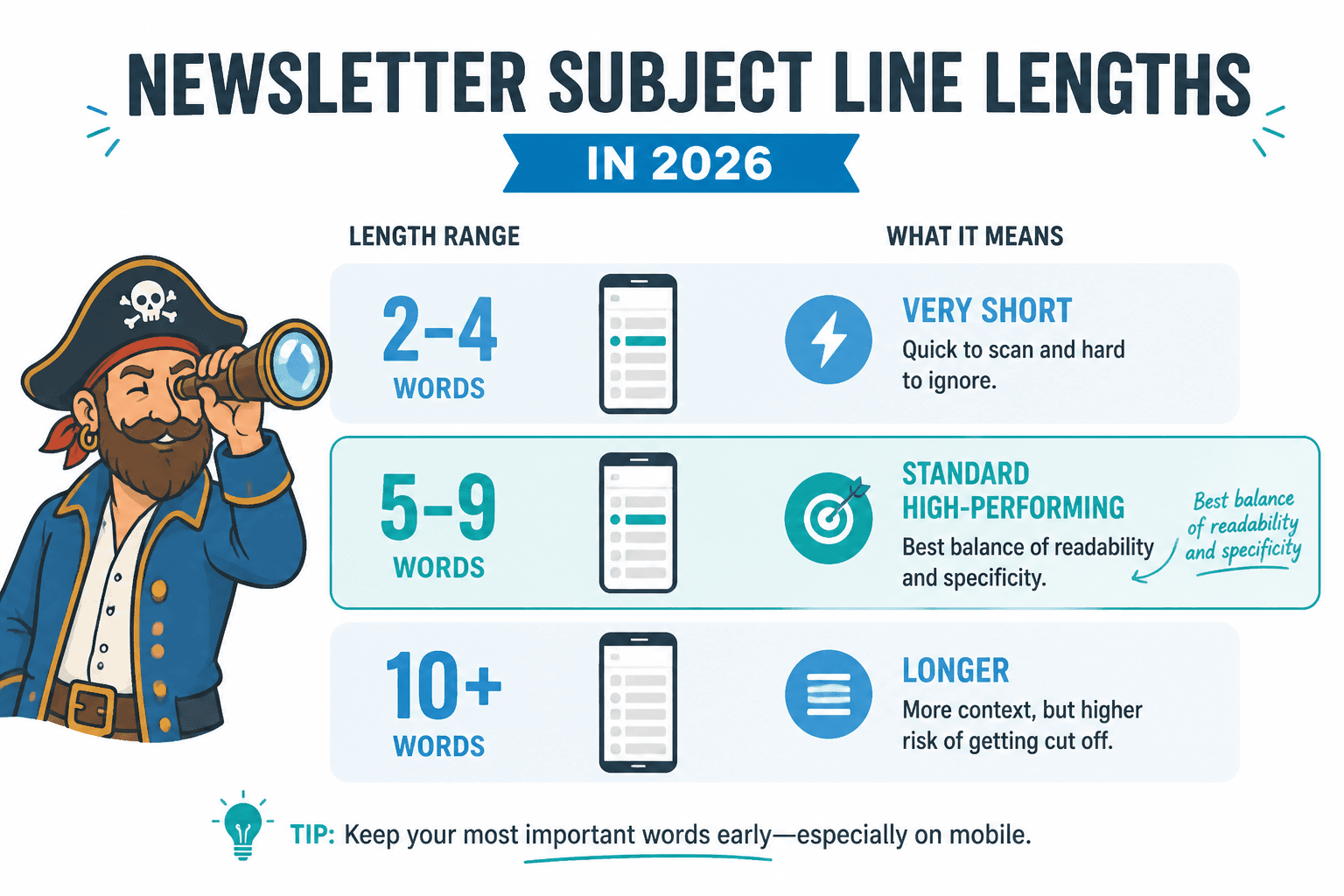
For most newsletters in 2026, a strong working range is 30 to 60 characters or roughly 5 to 9 words.
That range is long enough to communicate a real idea and short enough to stay readable across many inbox views, especially on mobile. But that is a guideline, not a law carved into email-marketing stone tablets.
- Very short subject lines often land around 2 to 4 words
- Standard high-performing subject lines often land around 5 to 9 words
- Longer subject lines can work well when specificity matters more than punch
If you remember one thing, remember this: readability beats raw length. A 7-word subject line with a clear point will usually beat a 4-word subject line trying too hard to be intriguing.
And a 10-word subject line with sharp specificity can absolutely beat a short one that says almost nothing.
Why subject line length still matters in 2026
It matters for one boring but unavoidable reason: people do not read subject lines in perfect conditions.
They scan them on mobile. They skim them while busy. They compare them against dozens of other emails. They glance at the sender name, the subject line, and maybe the preview text if you did not waste it. That means your opening words carry most of the load.
Length affects three things:
- Visibility: shorter subject lines are less likely to get cut off
- Clarity: tighter lines often force you to say the actual point faster
- Curiosity: the right amount of incompleteness can create interest, but too much just creates confusion
Still, people obsess over truncation a bit too much. Yes, mobile matters. No, that does not mean every subject line must be clipped into a tiny mystery nugget. If the first 30 to 40 characters already communicate the point, a slightly longer line can work just fine.
How Long Should Newsletter Subject Lines Be in 2026? The real framework
Instead of chasing one ideal character count, use this framework:
- Lead with the important words
- Match the length to the email’s purpose
- Cut anything that does not sharpen the promise
- Test short versus specific, not just short versus long
1. Lead with the important words
Your strongest words should appear early. Not because every inbox shows the same number of characters, but because readers are not politely waiting for your payoff in word eleven.
Bad: A few thoughts on what I learned from rewriting our welcome email
Better: We rewrote our welcome email. Open rates jumped.
The second one is not better because it is shorter. It is better because the useful part arrives sooner.
2. Match the length to the email’s purpose
Different newsletter emails want different things.
- Weekly creator newsletters: often benefit from concise, curiosity-plus-value subject lines
- Educational emails: can run slightly longer if specificity improves trust
- Sales emails: usually work better when they are direct, not bloated
- Personal brand newsletters: often do well with clear, human phrasing over polished cleverness
- Digest emails: may need a few more words to signal what is inside
A newsletter subject line for a thoughtful essay can be different from one pushing a workshop, a case study, or a curated weekly roundup. Same inbox. Different job.
3. Cut anything that does not sharpen the promise
Subject lines get too long for a simple reason: writers include setup words that feel useful while drafting and do absolutely nothing once the email is real.
Common fluff:
- Just wanted to share
- A quick note about
- Some thoughts on
- What I have been thinking about lately
- A few ideas for
These phrases are soft, polite, and mostly dead weight. Email is not improved by extra throat-clearing.
4. Test short versus specific, not just short versus long
A lot of subject line advice turns into a weird little cult around brevity. But short is not inherently better. Specific is often better. Clear is often better. Relevant is almost always better.
If you test anything, do not test this:
- Version A: 38 characters
- Version B: 49 characters
That tells you almost nothing.
Test this instead:
- Version A: shorter and more curiosity-driven
- Version B: longer and more specific
That gives you a real strategic comparison. If you want tools for that, this guide on email testing tools and newsletter software for subject lines can help.
Best subject line length by newsletter type
| Newsletter type | Recommended range | What usually works best |
|---|---|---|
| Weekly personal newsletter | 4 to 8 words | Clear angle, light curiosity, human tone |
| Educational email | 5 to 10 words | Specific promise or lesson |
| Sales or promo email | 3 to 8 words | Direct offer, urgency without drama |
| Curated roundup | 6 to 12 words | Signal what is inside |
| Story-led newsletter | 4 to 9 words | Interesting idea, not fake mystery |
| Launch sequence email | 3 to 7 words | Focused message, one clear point |
Again, these are ranges, not commandments. But they are a lot more useful than pretending every email in every niche should fit into one tiny character box.
When short subject lines beat long ones
Short subject lines tend to work best when the idea is already strong and the context carries some weight.
- You have an audience that knows your voice
- The email has one clear point
- The subject line creates immediate interest without becoming vague mush
- You are sending something timely, punchy, or opinion-driven
Examples:
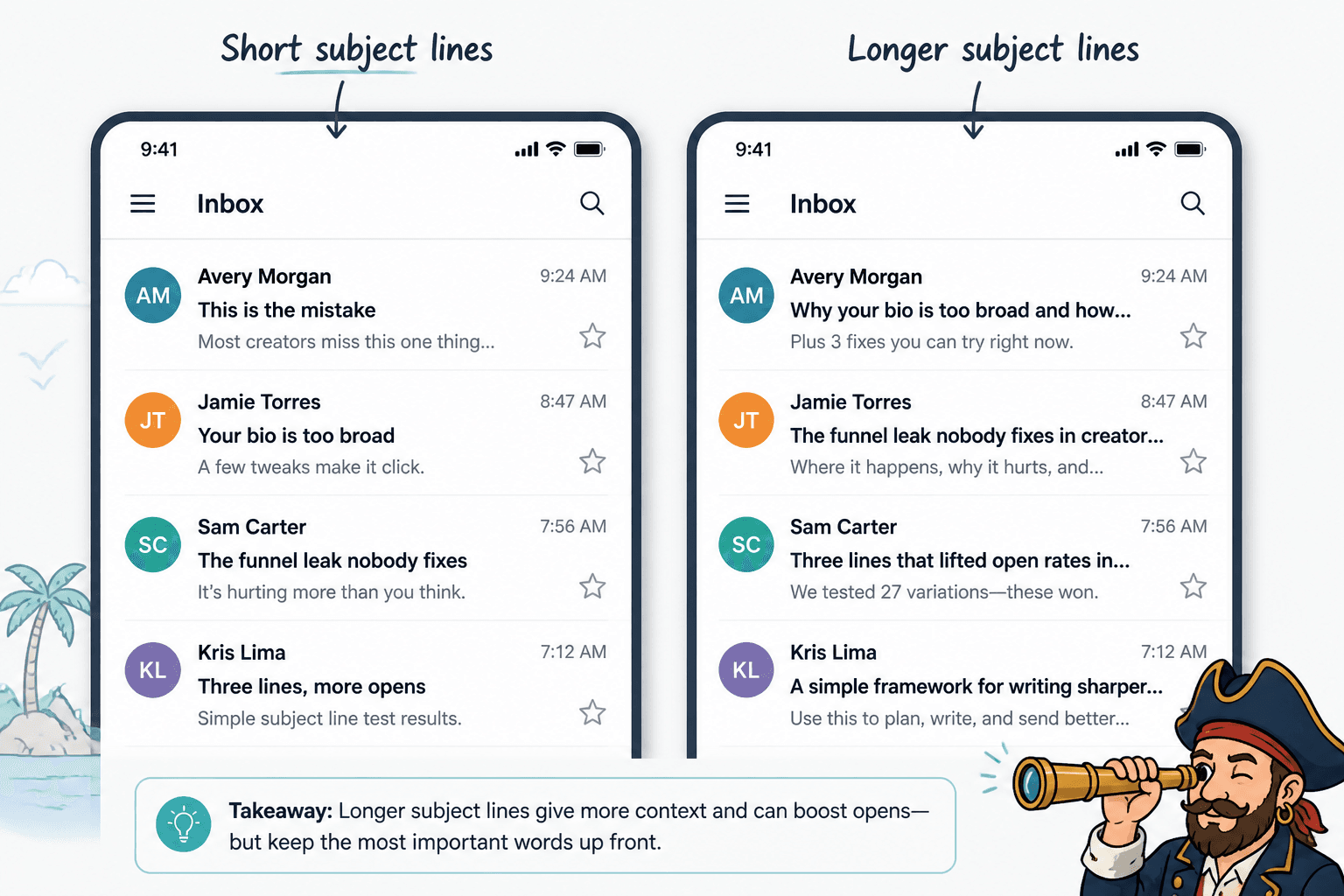
- This is the mistake
- Your bio is too broad
- The funnel leak nobody fixes
- Three lines, more opens
Short works beautifully when the line feels intentional. It fails when it looks like you gave up halfway through the thought. If you want a deeper breakdown, read when short newsletter subject lines beat long ones.
When longer subject lines actually work better
Longer subject lines can win when they earn their length.
That means they add clarity, specificity, or a stronger reason to open. Not more fluff. Not theatrical suspense. Not “you will not believe what happened next” energy, because this is still email, not a cursed content farm from 2014.
Longer subject lines often help when:
- You are teaching something concrete
- The topic is niche and specificity builds trust
- The email includes a practical resource, framework, or breakdown
- Your audience responds better to utility than intrigue
Examples:
- How I cut our newsletter unsubscribe rate in 2 weeks
- 5 subject line fixes if your emails are getting ignored
- The welcome email rewrite that improved clicks without more hype
These are longer, but they still get to the point. That is the difference.
The biggest mistakes people make with subject line length
They optimize for truncation instead of meaning
Yes, inboxes cut things off. But some people react by writing microscopic subject lines that reveal nothing. You do not get points for fitting inside a tiny space if the result is bland.
They confuse curiosity with vagueness
This changed everything is short. It is also tired and unhelpful.
Curiosity works when there is still a real signal underneath it.
They bury the best words at the end
If the useful part of your subject line appears after six soft words, do not blame mobile when performance suffers.
They write for formulas instead of readers
There is no sacred 41-character sweet spot that absolves you from having a point. A weak idea in the perfect length is still a weak idea.
They never test style differences
If every subject line you send follows the exact same structure, you are not learning much. You are just repeating your own habits with increasing confidence.
A simple process for choosing the right subject line length
- Write the clearest possible version first. Ignore character count for a minute.
- Highlight the strongest words. These need to appear early.
- Cut the setup. Remove phrases that soften or stall the point.
- Create two versions. One tighter, one more specific.
- Check mobile readability. Not to worship it. Just to avoid obvious mess.
- Pair it with preview text. Sometimes the subject line can stay shorter because the preview does useful supporting work.
This process works better than staring at a character counter and hoping inspiration arrives.
Before-and-after subject line rewrites
Example 1: too long and padded
Before: A few thoughts on what creators should probably do differently with their newsletter subject lines this year
After: What creators should fix in subject lines
Same topic. Less wandering around the block before reaching the door.
Example 2: too short and vague
Before: A quick update
After: I changed the newsletter format
Still short. Much more informative.
Example 3: short but flat
Before: Subject lines
After: Why your subject lines get ignored