
Most weak Facebook hooks are not too short, too long, or too bold.
They are too familiar.
They sound like something a content template coughed up after reading 400 mediocre posts about storytelling, authenticity, and “starting the conversation.” So people scroll past them with the speed and indifference they usually reserve for ads about passive income and mystery gut supplements.
If you want to know how to improve Facebook engagement hooks without sounding generic, the fix is not making your opening louder. It is making it more specific, more human, and more worth responding to.
Facebook is a conversational platform. The best hooks there do not feel like stiff thought leadership intros or recycled copywriting tricks wearing a friendlier hat. They feel like someone saying something interesting enough to stop the scroll and natural enough to invite a reaction.
Here’s how to write hooks that get more comments, more reads, and better responses without sounding like you borrowed your personality from a content calendar.
To see how this fits into the wider strategy, open the parent guide.
Why most Facebook hooks feel generic in the first place
Generic hooks usually fail for one of three reasons:
- They say something broad that could apply to anyone
- They imitate LinkedIn-style “value post” openings
- They try to manufacture curiosity without saying anything real
That is how you end up with openings like:
- “A lot of people need to hear this…”
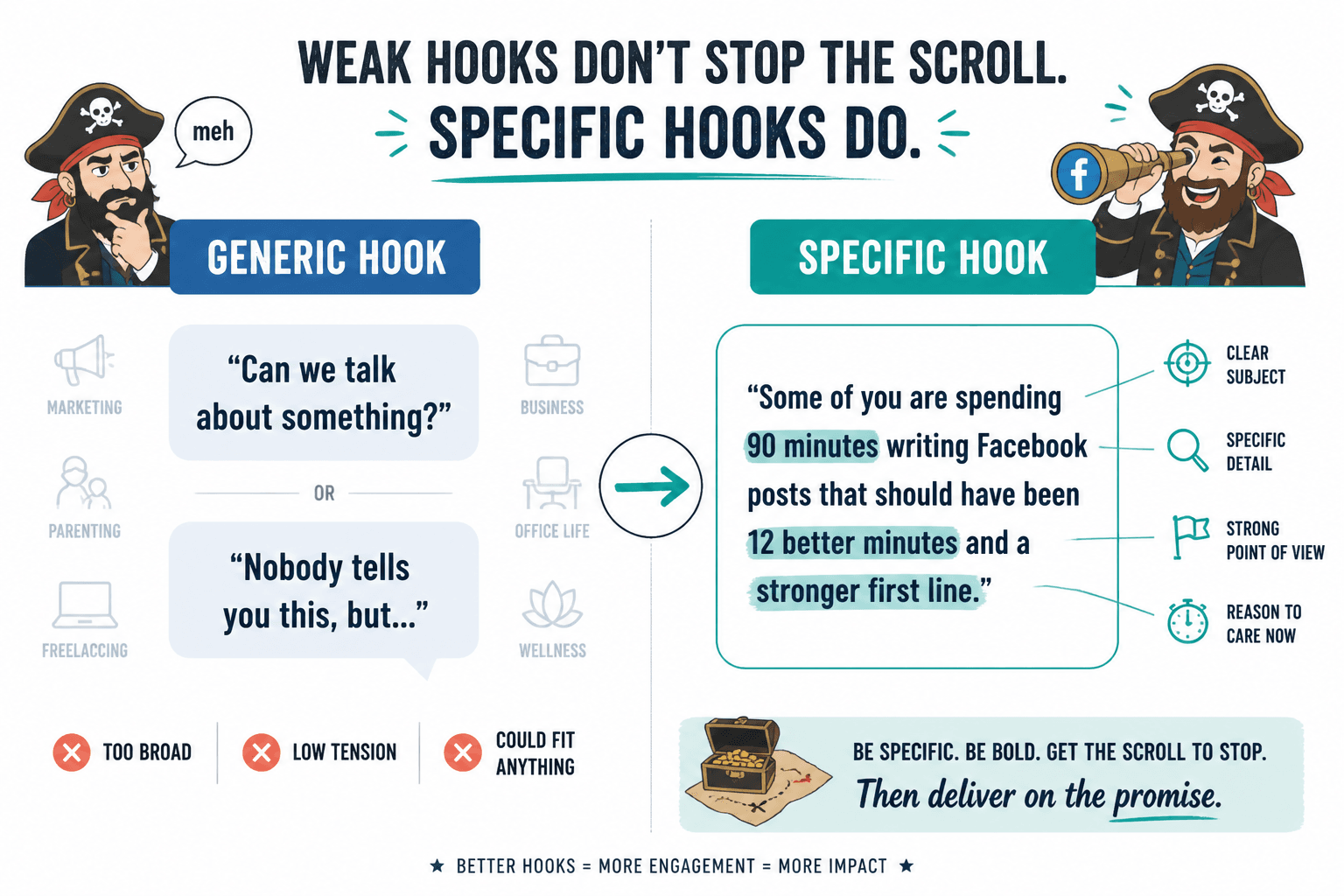
- “Can we talk about something?”
- “Unpopular opinion…”
- “I’ve been thinking about this lately…”
- “Nobody tells you this, but…”
None of those are automatically bad. They are just weak on their own because they do not carry enough tension, detail, or personality to earn attention.
A Facebook hook works when it gives people a reason to care quickly. Not in a manipulative way. Just in a clear one. It should create a little spark: recognition, disagreement, curiosity, amusement, irritation, relief, or “oh good, someone finally said it properly.”
If your hook could open a post about marketing, parenting, freelancing, burnout, diet culture, and office politics all at once, it is probably too vague.
What a strong Facebook engagement hook actually needs
You do not need a magic formula. You need a few ingredients that make people feel like there is an actual person and an actual point behind the post.
1. Specificity
Specific beats broad almost every time.
Instead of saying:
- “People are making content way too complicated”
Say:
- “Some of you are spending 90 minutes writing Facebook posts that should have been 12 better minutes and a stronger first line”
The second line has texture. It sounds observed. It gives the reader something they can see, not just agree with politely.
2. A point of view
People engage with posts that feel like they stand for something. Not necessarily something dramatic. Just something clear.
Weak hook:
- “Content matters more than ever”
Stronger hook:
- “Most ‘valuable’ Facebook posts are ignored for one simple reason: they are informative, but not interesting”
That gives people something to react to. Agreement. Disagreement. Curiosity. Those are all useful.
3. Natural language
If your hook sounds like it was polished until all human texture disappeared, it will struggle on Facebook.
Facebook usually rewards posts that feel like someone talking, not presenting. There is room for strategy, structure, and clarity, but the voice still has to sound lived-in.
That means using phrasing you would actually say, or at least something adjacent to how you naturally speak when you are being clear on purpose.
4. Emotional or conversational tension
A hook should create a small open loop. It should make the reader feel there is something here worth following.
That tension might come from:
- A sharp observation
- A relatable frustration
- A contrast between what people do and what works
- A confession that feels real, not theatrical
- A question that does not sound lazy
Not every hook needs drama. It does need a pulse.
The easiest way to improve Facebook hooks: stop writing “topic openings”
A topic opening introduces the subject. A good hook introduces the tension.
That distinction matters more than most people realize.
For example, if your post is about inconsistent posting, a topic opening looks like this:
- “Let’s talk about consistency on Facebook.”
That is technically relevant. It is also sleepy.
A tension-based opening sounds more like:
- “Most people do not have a consistency problem. They have a ‘I made posting feel miserable so now I avoid it’ problem.”
Now there is movement. A point. A hint of relief. A reason to keep reading.
This is also why Facebook posts often perform better when they feel a little more conversational and less like mini blog intros. If you want more on that broader style shift, this guide on writing Facebook posts without sounding salesy or robotic pairs nicely with hook work.
7 hook styles that work on Facebook without sounding canned
You do not need to use all of these. In fact, please do not. The point is to give yourself better options than “here’s something I’ve been thinking about.”
1. The sharp observation hook
This starts with something noticed, not announced.
Examples:
- “A lot of Facebook posts ask for engagement when what they really need is a reason to exist”
- “Some of the nicest posts on Facebook are also the easiest to ignore”
- “People say they want authentic content, then write captions that sound like a legal disclaimer with feelings”
This works because it feels lived, not manufactured.
2. The specific frustration hook
Call out a real annoyance your reader already feels.
Examples:
- “If your Facebook posts keep getting polite little likes but no comments, your hook is probably too safe”
- “Writing a decent post and then opening with ‘Just wanted to share this’ is content self-sabotage in one sentence”
- “The worst time to realize your hook is weak is after you’ve written 600 words underneath it”
Useful because it meets the reader inside a problem they already recognize.
3. The contrast hook
Set up what people think versus what actually helps.
Examples:
- “A Facebook hook does not need to be dramatic. It needs to be worth reacting to.”
- “The problem is not that your opening is too short. It is that it says nothing specific with confidence.”
- “Good Facebook hooks do not tease the topic. They frame the tension.”
Contrast is one of the cleanest ways to create interest fast.
4. The conversational opinion hook
This one works well on Facebook because it invites people into a view rather than delivering a lecture.
Examples:
- “I think a lot of ‘engaging’ hooks are actually just dressed-up emptiness”
- “I’m pretty convinced that most weak hooks come from trying to sound universally relevant”
- “Honestly, I’d rather read a slightly messy real opening than another clean generic one”
This style works best when the opinion leads somewhere useful, not just moody.
5. The mini-story hook
If you have a story, start late. Not with backstory. Not with weather. Not with “a few years ago.” Start where the tension begins.
Examples:
- “I watched someone bury a strong post this morning with the opening line: ‘Happy Tuesday, friends.’ Rough scene.”
- “A client showed me a post that got three likes. The advice was solid. The first line was basically a sleeping pill.”
- “Yesterday I rewrote one Facebook hook, not the whole post, and the entire thing suddenly had a pulse”
Story hooks work when they move quickly and point toward something bigger.
6. The non-lazy question hook
Questions can work. Most are just terribly underwritten.
Bad:
- “Does anyone else struggle with content?”
Better:
- “Have you ever written a post you knew was useful, then ruined its chances with a first line that sounded painfully polite?”
- “What kind of Facebook hook makes you stop: blunt, funny, specific, or a little confrontational?”
A good question is concrete enough to answer and interesting enough to bother.
7. The anti-template hook
This is where you deliberately avoid polished content-language and say the thing more plainly.
Examples:
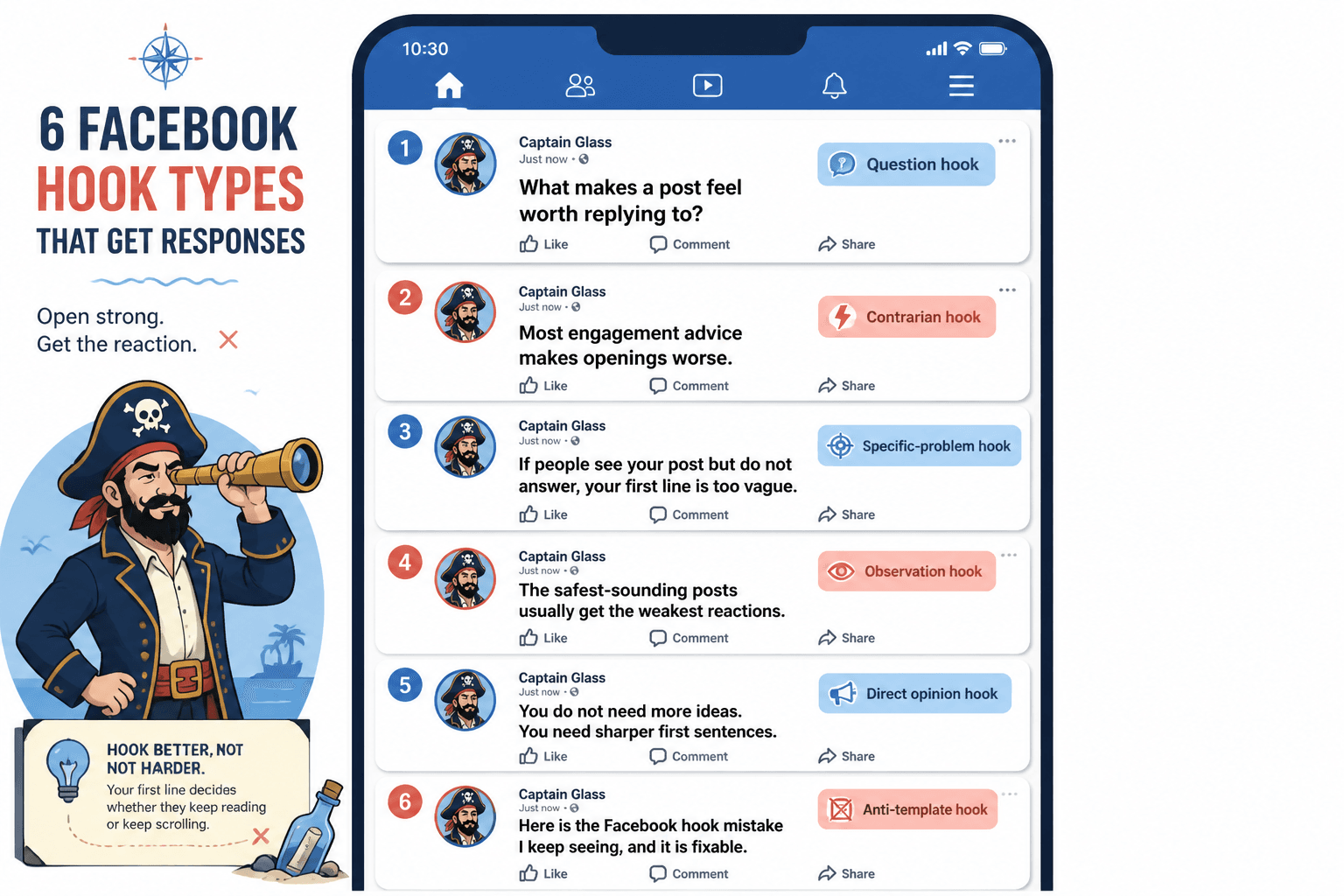
- “Here is the Facebook hook mistake I keep seeing, and it is incredibly fixable”
- “Quick content opinion: if your opening could fit any post, it is weakening this one”
- “Some of you do not need better post ideas. You need less bland first sentences”
It sounds refreshingly direct because it is.
Before-and-after hook rewrites
Sometimes the fastest way to learn this is to see what changes.
| Weak hook | Stronger rewrite | Why it works better |
|---|---|---|
| “I wanted to share some thoughts on content engagement.” | “If your post gets seen but not answered, your opening probably sounds too careful.” | Specific problem, stronger tension, more conversational |
| “Unpopular opinion: authenticity matters.” | “A lot of ‘authentic’ Facebook posts are just vague oversharing with no point.” | Sharper claim, more precise, invites reaction |
| “Can we talk about Facebook posting for a minute?” | “Facebook rewards posts that feel discussable, not just publishable.” | States an idea instead of asking permission |
| “I’ve been reflecting on why some posts perform better than others.” | “The difference between ignored posts and discussed posts is often one line at the top.” | Faster, cleaner, more interesting |
| “Does anyone else find it hard to get engagement these days?” | “What kills engagement faster: a boring hook, an obvious opinion, or a post that takes 9 lines to get started?” | Question becomes specific and answerable |
If you want more examples like this at the full-post level, this piece on rewriting boring Facebook posts is worth bookmarking.
A simple process for writing better Facebook hooks
When your opening feels generic, do not keep tweaking random words. Use a cleaner process.
The bigger point is simple: clearer structure and clearer writing make the piece more useful. That is usually what makes the ending land better too.