Most creator funnels are not broken because they are too short or too long. They are broken because they ask for too much trust too fast, or drag people through six polite little steps when two would have done the job.
That is the real question behind How Long Should Creator Funnels Be in 2026? Not “what is the ideal number of steps?” but “how much friction can this audience tolerate before they leave, ignore you, or quietly decide you are one more person turning content into a weird little maze?”
In 2026, shorter is often better, but only when the offer is clear, the audience is warm enough, and the next step feels obvious. Longer funnels still have a place, especially for higher-trust offers, complex services, and buyers who need proof before they move. The trick is not chasing minimalism for the aesthetic. It is matching funnel length to trust, price, complexity, and attention span.
Here is how to figure out the right funnel length for your business, what to avoid, and when a “simple funnel” is actually just an underbuilt one wearing confidence as a costume.
To see how this fits into the wider strategy, open the parent guide.
Short answer: most creator funnels should be shorter than they used to be
A lot of creators do not need a giant nurture labyrinth.
If you sell a clear service, a focused offer, a paid consult, a workshop, a low-ticket product, or a straightforward digital resource, your funnel can usually be pretty lean. People have less patience for bloated funnels now, and honestly, they should. Nobody wants to read nine emails, click three pages, and sit through a mini identity crisis just to book a call.
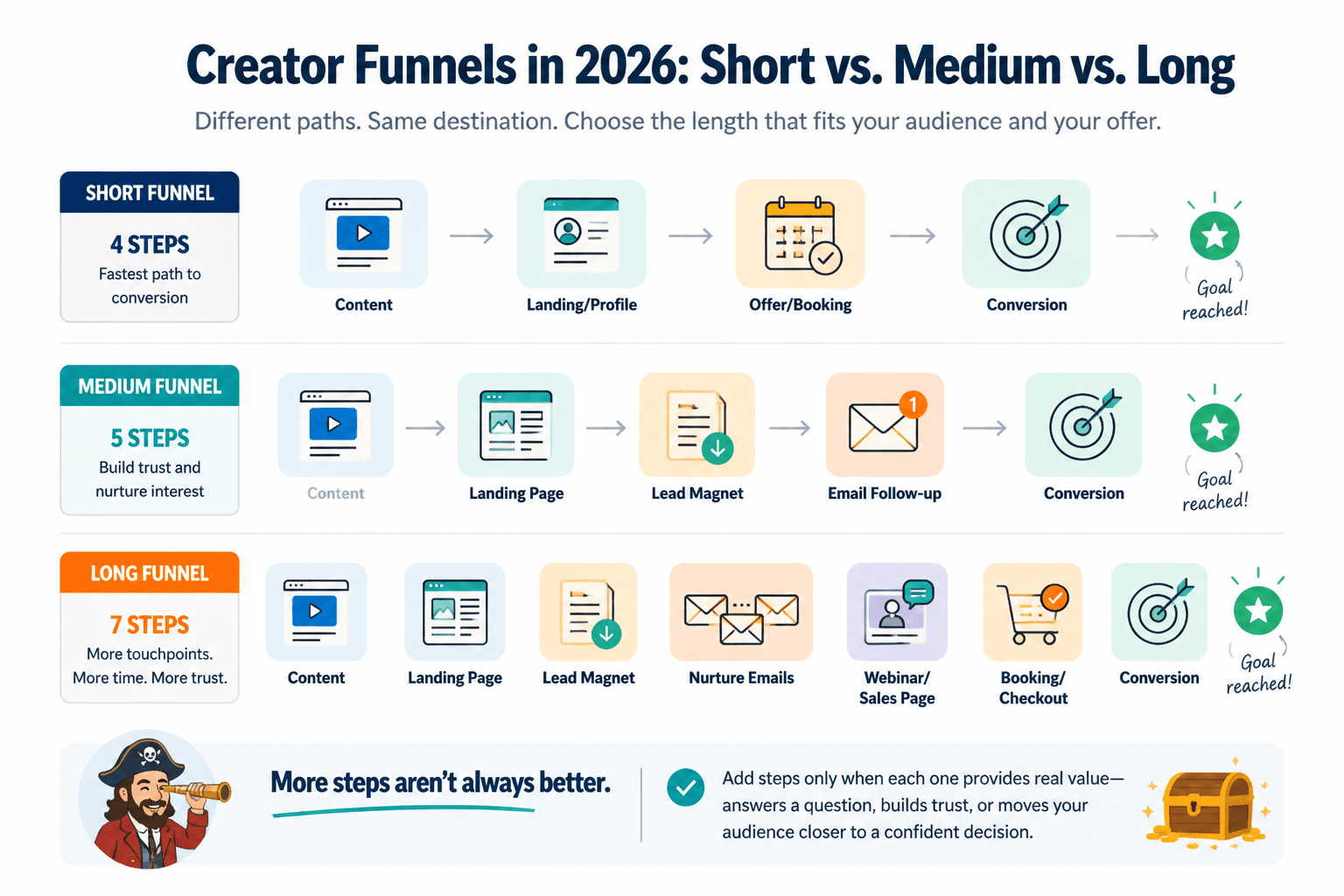
For many creator businesses, the strongest funnel is something like this:
- Content
- Profile or landing page
- Clear offer or lead magnet
- Email follow-up or booking page
- Conversion
That is enough for a lot of people. Not because funnels do not matter, but because extra steps only help when each step earns its place.
If you want a broader foundation for this, the main creator funnels guide is worth reading alongside this one.
What actually determines funnel length
There is no magic number. There is only fit.
The ideal funnel length depends on five things more than anything else: trust, offer complexity, price, urgency, and audience intent. If you get those right, the funnel length usually becomes obvious. If you ignore them, you end up copying someone else’s setup and wondering why your own leads keep evaporating.
1. Trust level
The colder the audience, the more proof and context they usually need.
If someone finds you through a random post and has never heard of you, asking them to book a high-ticket sales call immediately can work sometimes, but it is rarely your safest bet. On the other hand, if they have read your posts for months, opened your emails, and already understand what you do, a short path can convert beautifully.
Cold trust usually needs more steps. Warm trust usually needs fewer.
2. Offer complexity
Simple offer, shorter funnel. Complex offer, longer funnel.
A $29 template pack does not need a five-part nurture sequence and a webinar replay. A brand strategy engagement, group program, consulting package, or done-for-you service often needs more explanation. Not because people are slow, but because buying something nuanced requires understanding the outcome, process, fit, and difference.
3. Price point
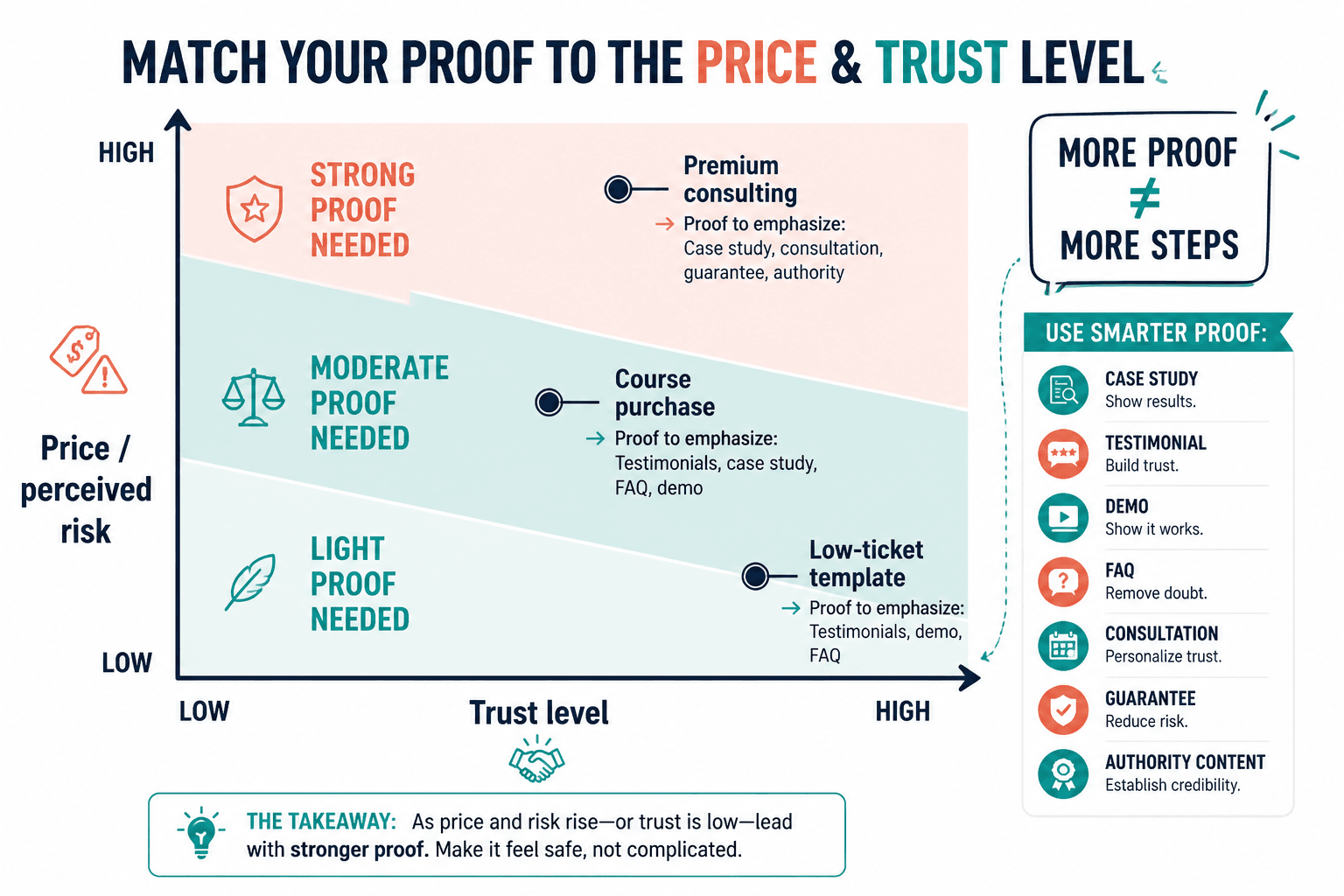
Higher prices usually need more confidence, not necessarily more pages.
This matters. A lot of people hear “high ticket” and immediately build a 14-step funnel like they are assembling a suspiciously expensive IKEA shelf. But high-ticket buyers do not always want more steps. They want stronger evidence. Sometimes that means a short funnel with sharper proof. Sometimes it means a longer one with case studies, objections handled well, and a smarter sales process.
4. Buyer intent
Intent changes everything.
If someone is actively looking for your solution, you can move faster. If they are just browsing, learning, or vaguely curious, they usually need a gentler path. This is why the same creator can have one short funnel for inbound warm leads and one longer funnel for content-driven audience building.
5. Platform and traffic source
Not all attention arrives with the same level of readiness.
A referral, newsletter click, podcast guest appearance, or direct profile visit usually carries more intent than a casual scroll from social. Social content can absolutely convert, but the path often needs to account for weaker intent and lower context. That means your funnel may need one extra trust-building step, even if the final structure is still pretty lean.
Practical funnel length guidelines for creators in 2026
If you want rough ranges instead of theory, here they are. These are guidelines, not laws carved into a webinar slide.
| Offer type | Typical funnel length | What usually works |
|---|---|---|
| Low-ticket digital product | 2 to 4 steps | Content → sales page → checkout, or content → lead magnet → short email pitch |
| Paid workshop or mini offer | 3 to 5 steps | Content → landing page → email reminders → buy |
| Newsletter growth funnel | 2 to 4 steps | Content → opt-in page → welcome email → nurture |
| Service business lead funnel | 3 to 6 steps | Content → profile/site → case study or lead magnet → booking page → consult |
| High-ticket consulting or coaching | 4 to 7 steps | Content → lead magnet or authority page → nurture → proof → call/application |
| Evergreen audience nurture for premium offers | 5 to 8 steps | Content → opt-in → nurture emails → case study → CTA → consult or sale |
Notice what is missing: absurdly long funnels for average offers. Most creators do not need ten layers of pre-suasion, urgency stacking, and “just checking in” emails written like a camp counselor trying to sell software.
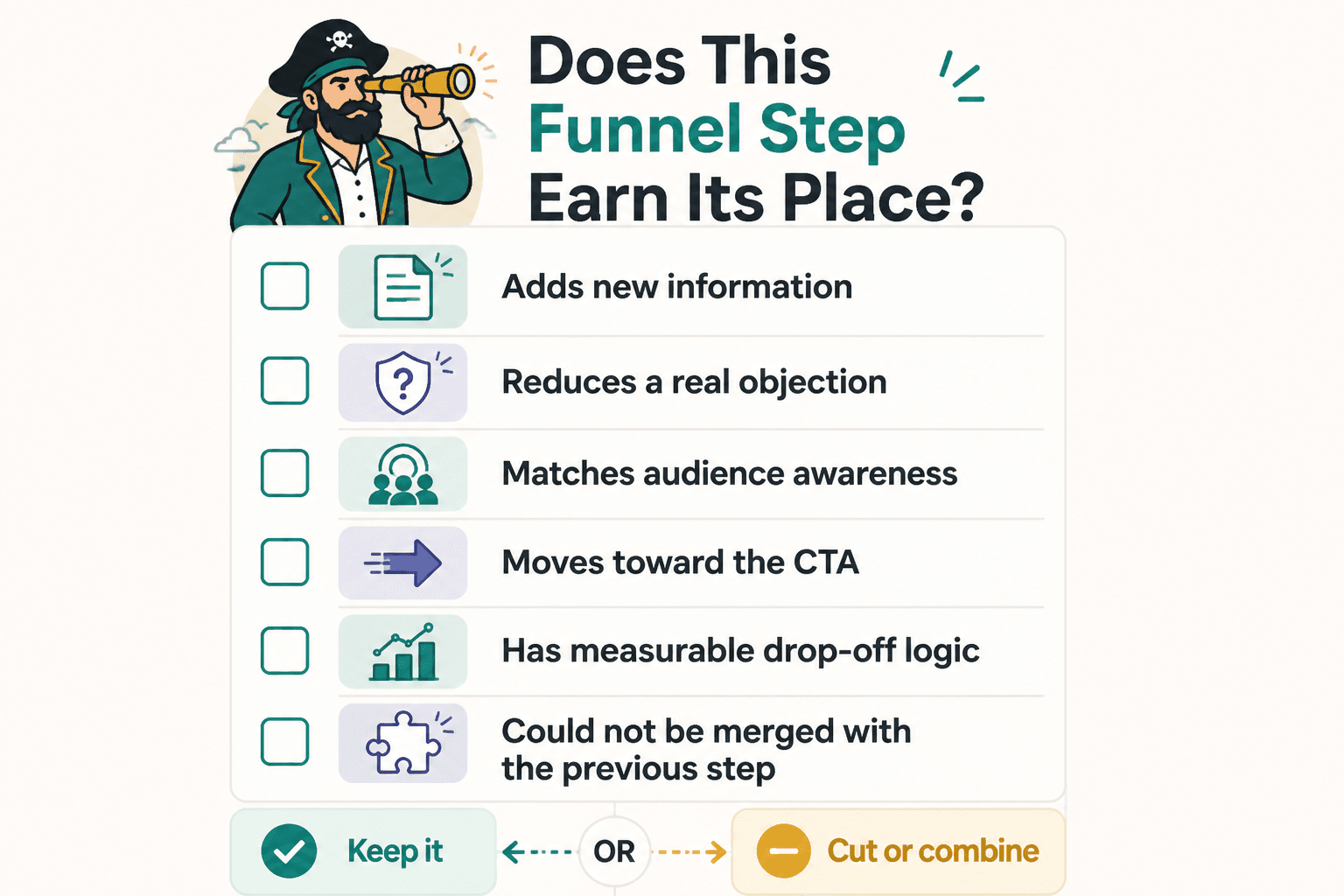
If your funnel is getting long, every step should answer a real question:
- Does this step build trust?
- Does it clarify the offer?
- Does it reduce friction?
- Does it handle a serious objection?
- Does it improve conversion enough to justify the extra drop-off risk?
If not, it is probably decoration.
When short creator funnels work best
Short funnels win when the audience already gets what you do and the next step feels natural.
This is why some creators make sales from a single post, a clean profile, and a booking page. They are not cheating the system. They have already done the heavy lifting through positioning, trust, repeated exposure, and message clarity. The funnel looks short because the trust-building happened upstream.
Short funnels usually work best when:
- Your audience is warm
- Your offer is easy to understand
- The price is low to moderate
- You have strong social proof or authority
- The audience already knows the problem is worth solving
- Your CTA is direct and low-friction
A few examples:
- LinkedIn post → profile → book a strategy call
- X thread → lead magnet → 3-email sequence → product sale
- Newsletter mention → sales page → checkout
- Case study post → application page → consult
If you want a deeper breakdown, read when short creator funnels beat long ones.
When longer funnels still make sense
Longer funnels are not dead. Bad longer funnels should be, but that is a different issue.
A longer funnel makes sense when the buyer needs more time, more confidence, or more context before they act. That does not mean burying them in content until they forget their own name. It means designing a path that earns trust step by step.
Longer funnels tend to make sense when:
- You sell higher-ticket offers
- The service is customized or nuanced
- The audience is cold
- The problem is important but not urgent
- Your market is skeptical and proof-hungry
- You need to qualify leads before a call or sale
For example, a premium consulting funnel might look like this:
- Audience sees useful content
- Clicks to a lead magnet or authority article
- Gets a welcome sequence
- Reads a case study
- Receives a direct invitation to apply or book
- Completes an application
- Books a qualified sales call
That is longer, yes. But each step has a job. It warms, qualifies, and filters. It is not long just to feel sophisticated.
There is also a less obvious reason some funnels need more length: risk. If hiring you feels expensive, visible, or career-affecting for the buyer, they need reassurance. The funnel should help them feel smart for saying yes, not rushed into it.
The biggest mistake: confusing more nurture with more effectiveness
A lot of creators build long funnels because they are scared to ask.
So they keep adding “value.” Another email. Another freebie. Another educational post. Another soft CTA. Another little trust exercise. At some point, this stops being nurture and starts becoming stalling with branding.
People do need trust. They do not need endless preambles.
If your funnel is long because:
- you are unclear about the offer
- you are attracting the wrong audience
- your content is too vague to pre-sell properly
- your CTA feels abrupt because your positioning is weak
- your landing page does not answer obvious questions
then adding more steps will not save you. It will just spread the confusion across more assets.
This is where creators get trapped. They think the funnel has a length problem when it actually has a clarity problem. Different disease. Same symptoms. Worse spreadsheet.
How to decide the right funnel length for your offer
Here is the simplest useful way to decide.
Step 1: Map the trust gap
Ask: how far is this person from being ready to buy when they first meet me?
If the answer is “not far,” keep the funnel short. If the answer is “pretty far,” you probably need an intermediate step like a lead magnet, email sequence, proof page, or case study.
Step 2: Identify the minimum necessary proof
What does this buyer need to believe before saying yes?
- That you understand their problem
- That your method makes sense
- That you have done this before
- That this offer is for people like them
- That the next step is worth their time
Build only enough funnel to prove those things clearly.
Step 3: Remove any step that only exists because someone online said funnels need it
This cuts a shocking amount of fluff.
You do not automatically need a webinar. You do not automatically need a quiz. You do not automatically need an application form longer than a tax return. If a step does not improve trust, segmentation, or conversion in a measurable way, it should be under suspicion.
Step 4: Test the shortest credible version first
Start lean. Then extend only where people actually stall.
If traffic reaches the page but does not convert, maybe the page needs stronger proof. If leads join the email list but do not book, maybe the nurture is too weak or too vague. If calls are full of unqualified people, maybe you need a better filter step. Length should be earned by evidence, not added by anxiety.
Step 5: Match the funnel to your content style
If your content already does a strong job of educating, framing the problem, and showing proof, your funnel can stay shorter. If your content is broad, top-of-funnel, or more entertainment-driven, the funnel may need more structure to do the selling work later.
That is also why improving the content around the funnel often matters more than obsessing over the funnel itself. If you need help there, read how to write better creator funnels, how to start creator funnels without a weak opening, and how to improve creator funnels without sounding generic.
A simple rule of thumb by funnel stage
If you are overthinking length, this framework helps.
| Stage | Keep it short when… | Add depth when… |
|---|---|---|
| Content | Your message is specific and audience-fit | Your audience needs more education or problem awareness |
| Profile or landing page | The offer is obvious and low-friction | The offer needs explanation, proof, or differentiation |
| Email nurture | The lead is warm and intent is high | The lead is cold, skeptical, or comparing options |
| Sales page | The product is simple and low-ticket | The product is pricier or has more objections |
| Call or application | Fit is easy to assess and intent is strong | You need qualification, filtering, or expectation-setting |
The point is not to make every stage tiny. The point is to avoid bloating stages that do not need more words, more clicks, or more waiting.
What funnel length trends are actually showing up in 2026
A few clear patterns are shaping this now.
- Shorter paths are outperforming bloated ones when the creator has strong positioning and good audience fit.
- Proof matters more than polish. Case studies, examples, and clear outcomes beat elaborate funnel theatrics.
- Email sequences are getting tighter. Fewer emails, more relevance, less fake nurturing.
- Content is doing more of the preselling work. Good content reduces how much explanation the funnel needs later.
- Application friction is under more scrutiny. If your form is long, it needs a real reason.
- Multi-step funnels still work for complex sales, but they need cleaner logic and less recycled persuasion fluff.
This is why asking “How Long Should Creator Funnels Be in 2026?” is useful, but only if you ask the second question too: what is each step doing that the step before it could not do well enough?
Signs your funnel is too long
- You lose people at every stage and cannot explain why each stage exists
- Your emails repeat the same point in slightly different outfits
- Your CTA takes too long to show up
- Your landing page explains everything except why the person should care now
- Your application form asks for a personal memoir before a discovery call
- Your sales process feels heavier than the actual offer
If people need a map, snacks, and emotional support just to reach your booking link, trim the thing.
Signs your funnel is too short
- You get clicks but very few conversions
- Leads say they are interested but disappear
- Your calls are full of people who do not understand the offer
- You keep hearing basic objections that should have been handled earlier
- Your audience likes your content but does not see you as the obvious next step
A short funnel is not automatically efficient. Sometimes it is just missing the trust bridge.
FAQ
How many steps should a creator funnel have?
Usually 2 to 6 for most creator businesses. Simpler offers tend to sit at the lower end. Higher-trust or higher-ticket offers often need more.
Are long email nurture sequences still worth it in 2026?
Sometimes, but they should earn their length. A short, sharp sequence often works better than a long generic one.
Should I send people straight from content to a sales page?
Yes, if the audience is warm and the offer is clear. If trust is low or the offer needs context, add an intermediate step.
Do high-ticket offers always need longer funnels?
No. They need stronger proof and better qualification. That can mean a longer funnel, but not always.
What matters more: funnel length or funnel quality?
Quality, easily. A short bad funnel fails quickly. A long bad funnel fails slowly and wastes more of your week.
Build the shortest funnel that can still do the job well
That is the cleanest answer to How Long Should Creator Funnels Be in 2026?
Not as short as possible. Not as long as tradition says. Just long enough to create clarity, trust, and movement.
If a step earns its place, keep it. If it exists because you are afraid to ask, afraid to simplify, or trying to imitate a funnel built for a totally different business, cut it. Most creators do not need more funnel. They need a more credible path.
Creator funnels get better when the path feels simpler and the writing makes each next step obvious. A cleaner message usually fixes more than extra funnel complexity ever will.