
For the main guide behind this topic, visit the parent guide.
Common mistakes that break simple creator funnels
Creator funnels get better when the path feels simpler and the writing makes each next step obvious. A cleaner message usually fixes more than extra funnel complexity ever will.
Creator funnels get better when the path feels simpler and the writing makes each next step obvious. A cleaner message usually fixes more than extra funnel complexity ever will.
Most creator funnels do not fail because they are missing one clever automation. They fail because the path makes no sense.
Someone sees a post. They click your profile. They find three offers, two vague links, one old freebie, and a booking page asking for a commitment they absolutely do not want to make yet. Then you wonder why the content “isn’t converting.”
That is not a traffic problem. That is a path problem.
Simple Creator Funnel Offer Path Templates for Busy Creators is really about fixing that mess. You do not need a giant funnel stack, six lead magnets, or a nurture sequence that sounds like it was assembled by a polite robot in a blazer. You need a clear next step that matches the stage your audience is actually in.
Here’s how to build simple creator funnels that guide people from attention to trust to action, without making your business feel like a pop-up ad with a Canva logo.
What a creator funnel actually is
A creator funnel is not some mystical internet machine. It is just the path people take from discovering you to doing something useful for your business.
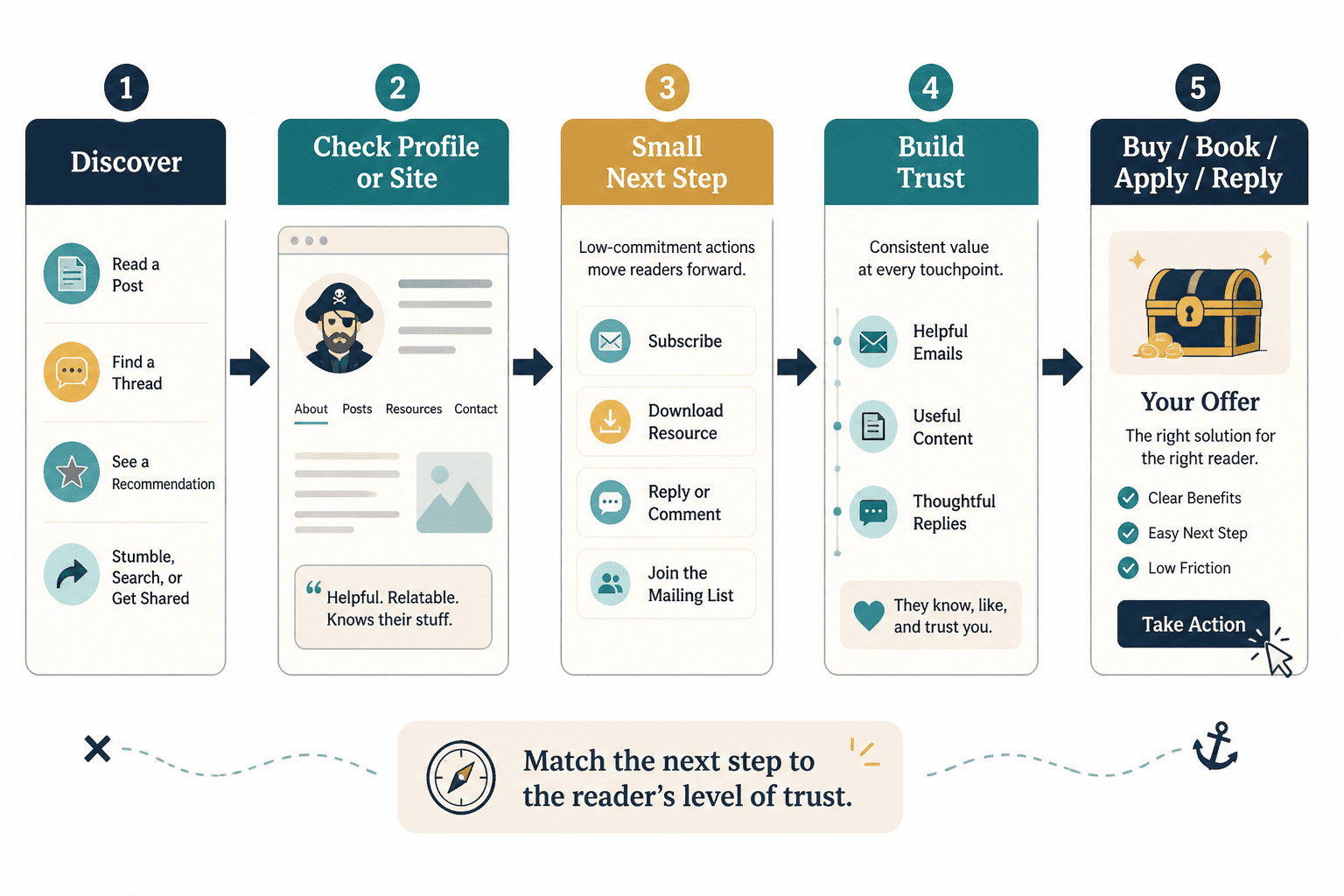
Usually that path looks something like this:
- They see a post, article, thread, comment, or recommendation
- They check your profile, site, or offer page
- They take a small next step
- You keep building trust
- Some of them eventually buy, book, apply, or reply
That is it. A funnel is just a path with some logic behind it.
The problem is that a lot of creators build paths backward. They start with the thing they want to sell, then try to shove cold people into it immediately. That works if you have huge authority, a warm audience, or a very low-friction offer. For most busy creators, it mostly creates silence.
A better approach is simpler: match the next step to the reader’s level of trust.
Why simple funnels usually beat complicated ones
Busy creators love the idea of automation. Fair enough. But complexity gets sold as sophistication, and usually it is just clutter with tags.
Simple funnels work better because they are easier to understand, easier to maintain, and much easier to improve. If you only have one clear audience, one useful promise, and one obvious next step, you can actually see what is working and what is broken.
Complicated funnels tend to create a few predictable problems:
- Too many choices
- No clear offer path
- Weak positioning between stages
- Lead magnets that attract the wrong people
- Email sequences with no real point
- Offers that appear too early
If your content is solid but your funnel feels messy, your audience is not “confused by your genius.” They are just confused.
The three basic stages of a simple creator funnel
You can keep this clean by thinking in three stages.
1. Attention
This is where people first notice you. Posts, threads, short videos, comments, guest appearances, podcast clips, and articles all sit here.
The goal is not to explain your whole business. It is to make the right person think, “That’s relevant to me.”
2. Trust
This is where people get more context. They read more of your work, join your list, look at your profile, download a resource, or spend time with a stronger piece of content.
The goal here is not hard conversion. It is belief. You are helping them believe:
- You understand their problem
- You have a useful approach
- You are credible enough to pay attention to
- Your offer is likely worth considering later
3. Action
Now they book, buy, reply, apply, subscribe, or request details.
Notice that “action” does not always mean “purchase right now.” For many creators, the smart action is a smaller move first:
- Join the newsletter
- Request the guide
- Reply to a post
- Book a short consult
- Watch a case-study breakdown
- Visit a service page
That softer middle step matters more than people think. It is often the difference between a funnel that feels natural and one that feels like getting proposed to during appetizers.
How to choose the right offer path
Your offer path is the sequence that moves someone from content to the right kind of conversion. Not every creator needs the same one.
Pick your path based on four things:
- Audience temperature: Are these cold strangers, warm followers, or people already considering you?
- Offer price and friction: A $29 template pack and a $3,000 consulting offer should not use the same path.
- Business model: Are you selling services, digital products, coaching, retainers, memberships, or something else?
- Time capacity: If you are busy, do not build a funnel that requires endless custom DMs and hand-holding.
That last point gets ignored a lot. A funnel should fit your energy, not just your ambition. If your path only works when you manually babysit every lead, it is not a system. It is a second job wearing the hat of a system.
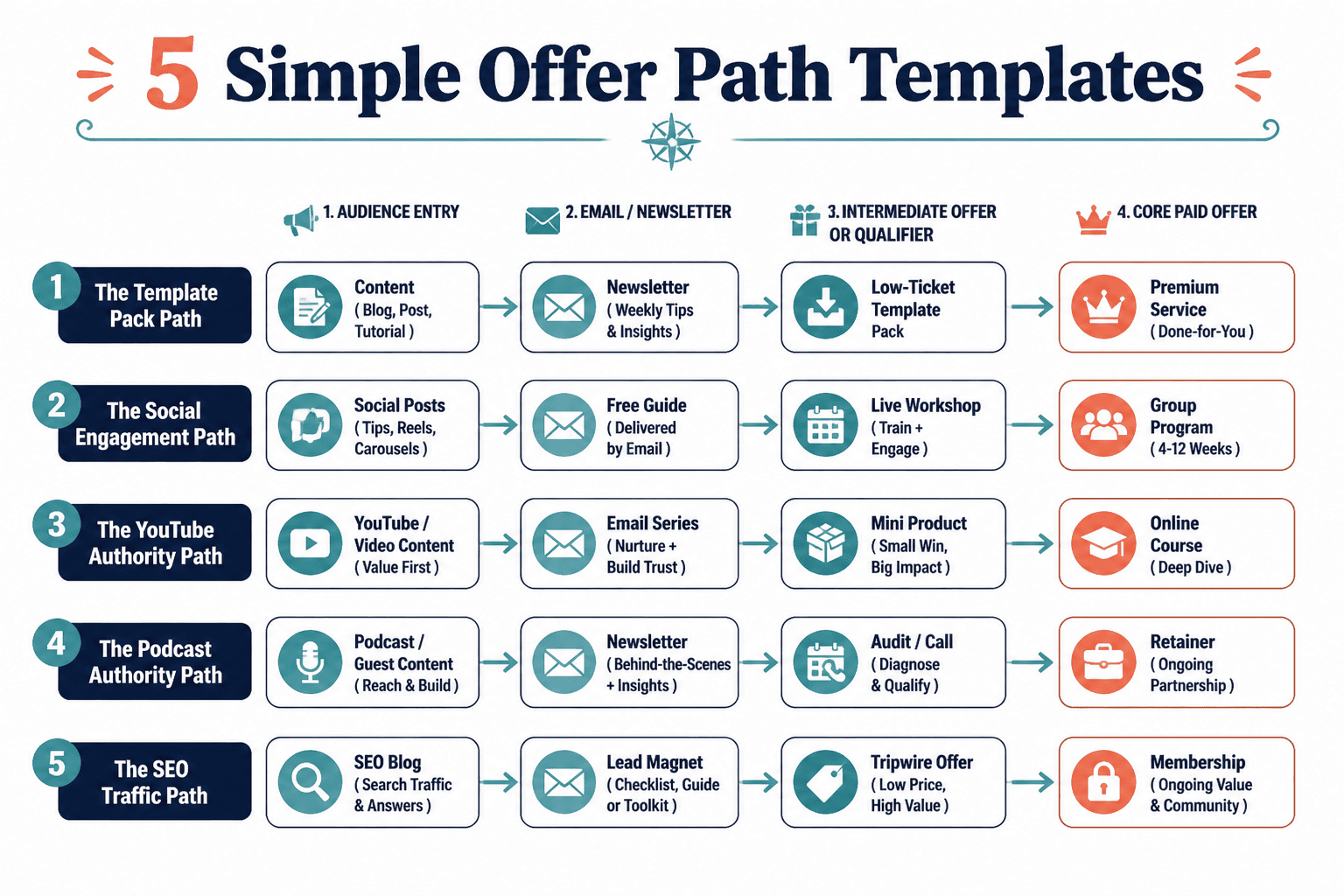
5 simple creator funnel offer path templates
These templates are built for creators, coaches, consultants, writers, and solo service businesses that want clearer paths without a week-long funnel-building spiral.
Template 1: Post → free resource → email sequence → paid offer
This is one of the most practical simple creator funnels for busy creators because it scales without getting too weird.
Best for: coaches, consultants, service providers, educators, and creators selling a focused offer
How it works:
- You publish content around a specific problem
- The CTA offers a relevant free resource
- The resource solves one small part of the problem
- A short email sequence builds trust and points toward the paid offer
Example path:
LinkedIn post about weak profile CTAs → free profile audit checklist → 4-email sequence with examples → offer for profile rewrite service
Why it works: the free resource filters for people with actual interest, and the email sequence gives you room to prove you know what you are doing.
What people mess up: the lead magnet is too broad, the emails ramble, or the offer appears with all the subtlety of a guy selling cologne in a mall kiosk.
Template 2: Post → profile → booking page
This is lean, direct, and ideal when your audience is already pretty warm or your offer solves an obvious urgent problem.
Best for: freelancers, consultants, ghostwriters, strategists, and specialists with clear service positioning
How it works:
- Your content demonstrates expertise and relevance
- Your profile makes your offer clear
- Your CTA points to a booking page or inquiry page
Example path:
X thread on newsletter growth mistakes → profile bio with clear positioning → booking link for newsletter strategy consult
Why it works: there is almost no friction between interest and action.
What people mess up: they skip the trust layer. If your content is vague and your profile is fluffy, sending people straight to “book a call” is optimistic in the least useful way.
Template 3: Article → related upgrade → nurture → consultation or course
This path works well when your audience needs more context before taking action. Articles can carry more authority than short posts, especially when the topic is strategic, nuanced, or expensive.
Best for: consultants, educators, B2B creators, personal brands with deeper expertise
How it works:
- You publish a useful article around a search-driven or authority topic
- You offer a tightly matched resource or next step
- The nurture sequence deepens the point and directs toward a higher-trust offer
Example path:
Article on creator funnel mistakes → downloadable funnel planning worksheet → case-study emails → consultation offer or paid workshop
This is also where internal content ecosystems help. If you are building out your funnel content library, it makes sense to connect readers to related pieces like this guide for creators who want better funnel results and these templates and tools for creator funnels.
Template 4: Social post → DM prompt → soft qualification → offer
This one can work beautifully, but only if you keep it human.
Best for: creators with engaged audiences, niche service offers, and offers that benefit from conversation before conversion
How it works:
- You post about a problem with a clear angle
- You invite people to comment or DM for a relevant resource or answer
- You respond like a person, not a sequence pretending to be a person
- You point qualified people toward the right next step
Example path:
Facebook post on why most lead magnets attract freebie hunters → “message me ‘funnel’ if you want the checklist” → short conversation → strategy session offer for qualified leads
What people mess up: they bait comments just to harvest leads, then reply with copy-paste nonsense. People can smell that from orbit.
Template 5: Content series → newsletter → low-ticket offer → core offer
If you have multiple offers or a slightly longer sales cycle, this path is often more stable than trying to force a high-ticket offer too early.
Best for: multi-offer creators, educators, personal brands, coaches, and founders building a layered business
How it works:
- A recurring content theme attracts the right audience
- The newsletter becomes the trust hub
- A low-ticket offer helps qualify buyers
- The core offer becomes easier to sell to people already in motion
Example path:
Weekly posts on creator positioning → newsletter signup → $39 messaging template pack → premium messaging strategy service
This is a good option if you want a stronger bridge between audience-building and revenue without turning every public post into a pitch parade.
How to map your offer path in 15 minutes
You do not need a whiteboard session with twelve colored arrows. Use this quick process instead.
Step 1: Pick one audience segment
Not “creators.” Not “business owners.” Be more specific.
Better examples:
- Consultants trying to get better leads from LinkedIn
- Coaches who need a clearer bio and profile CTA
- Writers selling ghostwriting retainers
Step 2: Define the first small win
What useful outcome can you help them get before they buy?
- Clarify their offer
- Fix a weak CTA
- Spot funnel leaks
- Improve profile conversion
Step 3: Match that win to a next step
Choose the most natural bridge:
- Checklist
- Guide
- Email series
- Workshop
- Mini audit
- Consultation
Step 4: Make the offer path obvious
If someone lands on your profile or offer page, can they tell what to do next in five seconds?
If not, fix that before touching your automation.
Step 5: Build one path before building more
One working funnel is more valuable than four half-built “ecosystems.” People love saying ecosystem when they mean pile.
A simple table for choosing the right funnel path
| Situation | Best next step | Good funnel path |
|---|---|---|
| Cold audience, service offer | Free resource | Post → resource → emails → booking |
| Warm audience, clear urgent problem | Booking page | Post → profile → booking |
| Complex topic, higher trust needed | Article upgrade | Article → resource → nurture → consult |
| Engaged audience, conversational sales style | DM prompt | Post → DM → qualify → offer |
| Multi-offer business | Newsletter | Content series → newsletter → low-ticket → core offer |
Common mistakes that break simple creator funnels
Creator funnels get better when the path feels simpler and the writing makes each next step obvious. A cleaner message usually fixes more than extra funnel complexity ever will.
Creator funnels get better when the path feels simpler and the writing makes each next step obvious. A cleaner message usually fixes more than extra funnel complexity ever will.