
Most people do not have a lead magnet problem. They have a delivery problem, a follow-up problem, or a “my funnel is held together by vibes and five forgotten tabs” problem.
A decent checklist, guide, template, or mini resource can absolutely bring in leads. But if the email tool is clunky, the opt-in flow is messy, the automation is weak, or the handoff to your offer feels like a sudden shove down a staircase, the lead magnet will underperform no matter how useful it is.
That is where the best email tools and funnel tools for Lead Magnets actually matter. Not because tools are magic. They are not. But the right stack makes it much easier to capture the lead, deliver the thing fast, follow up like a competent adult, and move people toward a logical next step without sounding like a desperate webinar bot from 2018.
This guide will help you choose tools based on what you actually need: email capture, landing pages, automation, segmentation, lead magnet delivery, funnel building, and simple conversion tracking. If you are a creator, coach, consultant, solo founder, or service business, you probably do not need the most “powerful” stack. You need one you will actually use well.
If you are still shaping the actual offer, it is worth reading our lead magnets guide alongside this. Tools help distribution. They do not fix a weak lead magnet or a vague promise.
For the full path around this topic, head to the parent guide.
What the best email tools and funnel tools for Lead Magnets should actually do
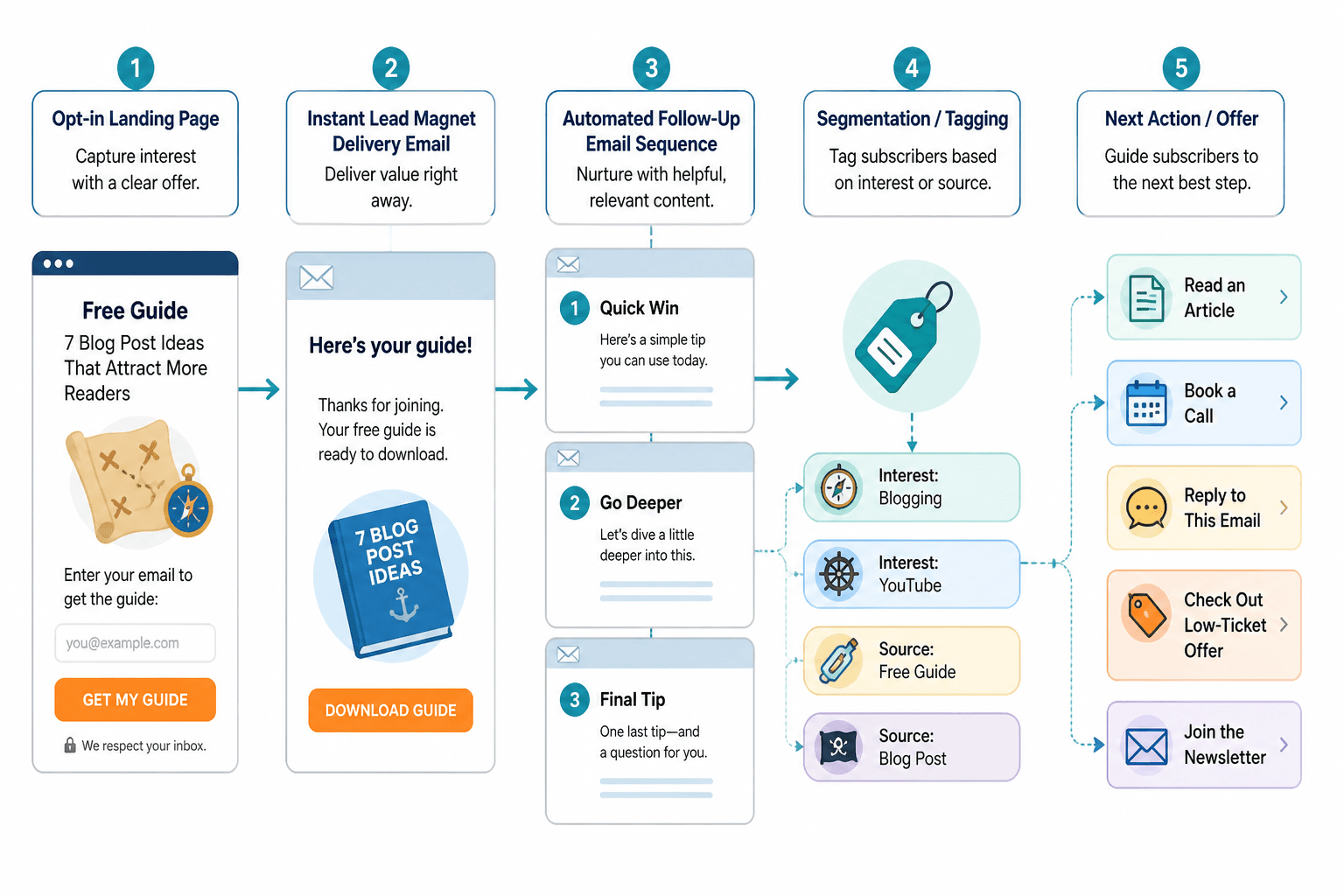
Before talking categories, let’s make one thing clear: you do not need a giant “marketing ecosystem.” You need a tool setup that handles five jobs well.
- Capture the email address cleanly
- Deliver the lead magnet immediately
- Send a short follow-up sequence
- Segment people based on interest or source
- Move them toward the next useful action
That next action might be reading an article, booking a call, replying to an email, buying a low-ticket offer, or joining your newsletter. It should feel like a sensible continuation, not a trapdoor into a sales tunnel.
The best tools make that path easier. The wrong ones add friction, complexity, and a weird amount of silent failure. You know, the kind where people sign up and then apparently vanish into the drywall.
The 4 tool categories that matter most
You can mix these categories, or use one platform that covers most of them. What matters is understanding what each one is supposed to do.
1. Email marketing tools
These manage your subscribers, automations, broadcasts, tags, and sequences. If your lead magnet is part of a long-term content and trust strategy, your email tool matters more than your page builder.
Good for:
- Welcome sequences
- Lead magnet delivery emails
- Segmentation and tagging
- Nurture emails
- Simple sales sequences
2. Landing page and opt-in tools
These tools handle the front end: the page where someone says yes. Some email platforms include this already. Others do not. A good landing page tool should make it easy to publish fast, test headlines, and keep the page focused on one decision.
Good for:
- Standalone lead magnet pages
- Embedded forms
- Simple thank-you pages
- Conversion-focused layouts
3. Funnel builders
These connect the opt-in, thank-you page, email sequence, upsell, booking flow, or product offer. Some are overkill for creators with one free PDF and a newsletter. Others are genuinely useful if your lead magnet feeds into offers, calls, workshops, or products.
Good for:
- Multi-step flows
- One-click upsells
- Sales pages tied to opt-ins
- Offer-specific funnel logic
4. Automation and integration tools
These pass information between tools. They are useful when your stack is spread out across forms, email software, CRMs, scheduling apps, and payment tools. But if your setup is still small, do not start here. “Automating everything” is a fantastic way to create a machine you no longer understand.
Best email tools for lead magnets
There is no one best platform for everyone. The right choice depends on your business model, your tolerance for setup, and how much automation you really need. Here is the practical breakdown.
Best for simple creator email funnels
If your lead magnet feeds a newsletter, a short nurture sequence, and occasional offers, you want an email tool that feels clean and fast. The essentials here are:
- Easy form creation
- Basic automation
- Tagging or simple segmentation
- Decent templates without looking like corporate soup
- Easy sequence building
This type of setup is ideal for writers, creators, consultants, and coaches who mainly want to turn attention into subscribers and subscribers into trust.
If that is you, favor tools that reduce friction. Do not buy “enterprise flexibility” when what you really need is “send useful emails consistently and not hate the interface.”
Best for service businesses and consultants
If your lead magnet is designed to book calls, qualify leads, or warm up prospects for higher-ticket services, your email tool should support slightly more structure.
- Behavior-based automation
- Strong tagging
- CRM-lite functionality or integrations
- Booking links and follow-up sequence support
- Lead source visibility
In this case, the lead magnet is not just content. It is a filter. You want to know what they signed up for, what they clicked, and what kind of problem they are likely trying to solve.
Best for productized offers or paid funnels
If your lead magnet is tied to a workshop, mini course, product, paid newsletter, or low-ticket offer, your email tool needs to play nicely with checkout, sales pages, and post-purchase automation.
Now you are not just delivering a free resource. You are managing a buyer journey. That does not need to sound dramatic. It just means your system has to handle more than one next step.
What to look for in any email tool
- Fast automation setup: You should be able to build a welcome sequence without needing a whiteboard and two aspirin.
- Tagging or segmentation: You want different lead magnets to lead to different follow-ups.
- Good deliverability basics: Not magic. Just competent sending infrastructure and sensible list hygiene tools.
- Form and landing page options: Helpful if you want fewer tools.
- Usable reporting: Enough to see signups, opens, clicks, and sequence performance.
- Scalability: Not because you need huge complexity today, but because migration later is annoying.
Best funnel tools for lead magnets
Funnel tools matter when your lead magnet is part of a bigger conversion path. If all you need is opt-in page → email delivery → newsletter, your email platform may be enough. But if you need more moving parts, this category starts earning its keep.
When a dedicated funnel tool makes sense
- You want a thank-you page with a strong next step
- You want to route leads to different offers
- You sell digital products, workshops, or calls
- You need order pages or upsells
- You want one place to build the journey visually
A dedicated funnel tool is usually more useful when your business has clear offer paths. If your offers are still fuzzy, a fancy funnel builder will just help you scale confusion more efficiently.
What a good funnel tool should handle
- Landing pages and forms
- Thank-you pages
- Email handoff or built-in email
- Simple branching logic
- Product or booking integrations
- Basic analytics
- Mobile-friendly pages that do not look cursed
When not to use one
If your audience is still small, your lead magnet is simple, and your main goal is building trust, a full funnel platform can be more distraction than leverage. That is not anti-tool snobbery. It is just reality. Plenty of people build a six-piece system for a free guide that gets 14 signups a month.
A cleaner setup often wins:
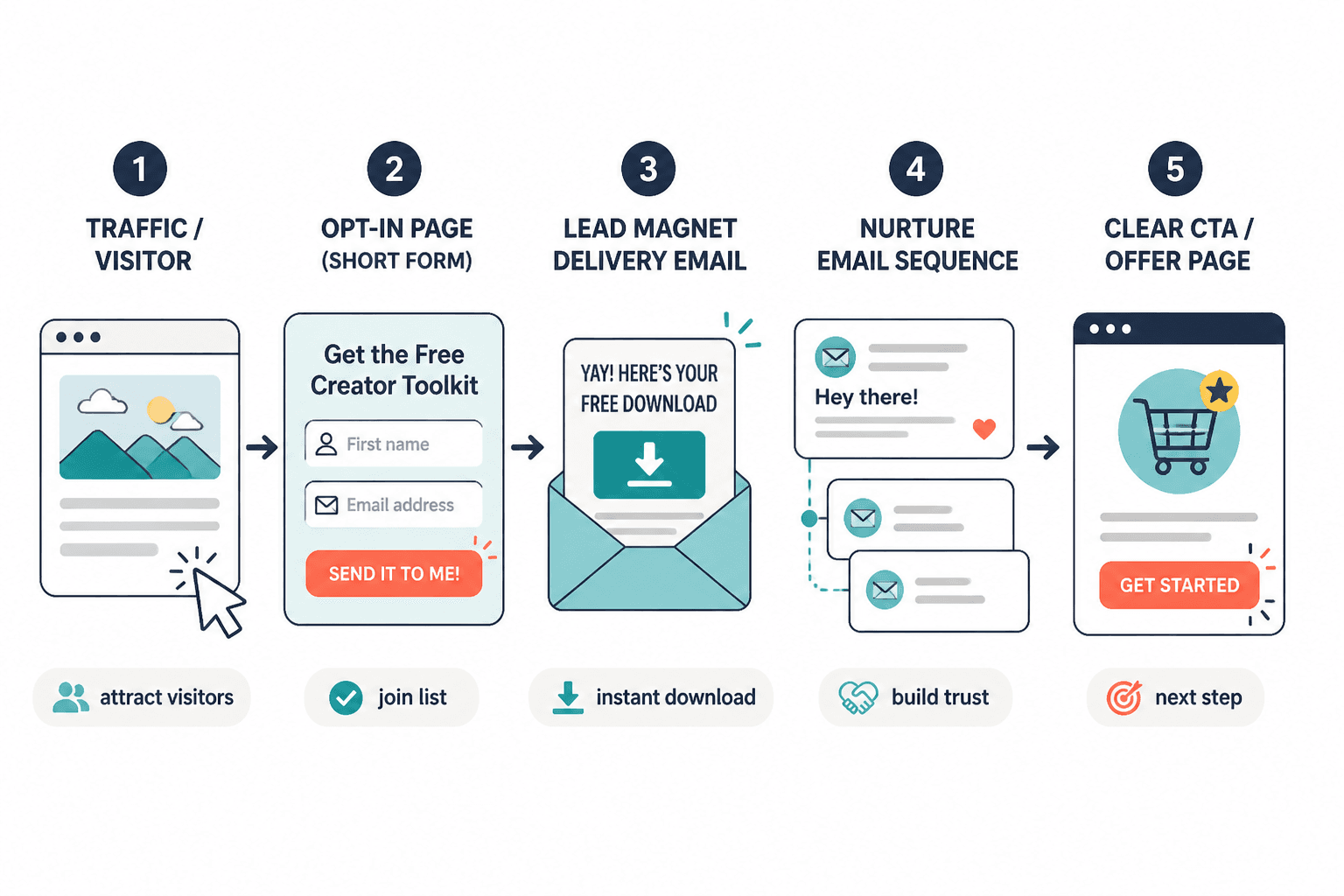
- One landing page
- One form
- One delivery email
- One 3–5 email nurture sequence
- One clear CTA
Simple is underrated because it is less fun to brag about. It is also easier to fix when something breaks.
All-in-one vs separate tools
This is where a lot of people get stuck. Should you use one platform that does email, pages, and automation? Or separate best-in-class tools stitched together?
Here is the blunt answer: if you are a solo operator or small business, all-in-one usually wins until it clearly does not.
| Approach | Best for | Pros | Cons |
|---|---|---|---|
| All-in-one platform | Creators, coaches, consultants, small teams | Less setup, fewer integrations, easier maintenance | May be less flexible or polished in one area |
| Separate tools | More advanced funnels, custom workflows, product businesses | More control, better specialization, stronger customization | More complexity, more breakpoints, more admin |
If your lead magnet strategy is still being proven, start simpler. Once you know what converts, where people drop off, and what follow-up actually leads to revenue, then you can justify a more tailored stack.
That order matters. Strategy first. Tool sophistication second. The internet keeps trying to reverse that.
A practical tool stack by business type
You do not need a giant menu of software. You need a stack that fits your actual business.
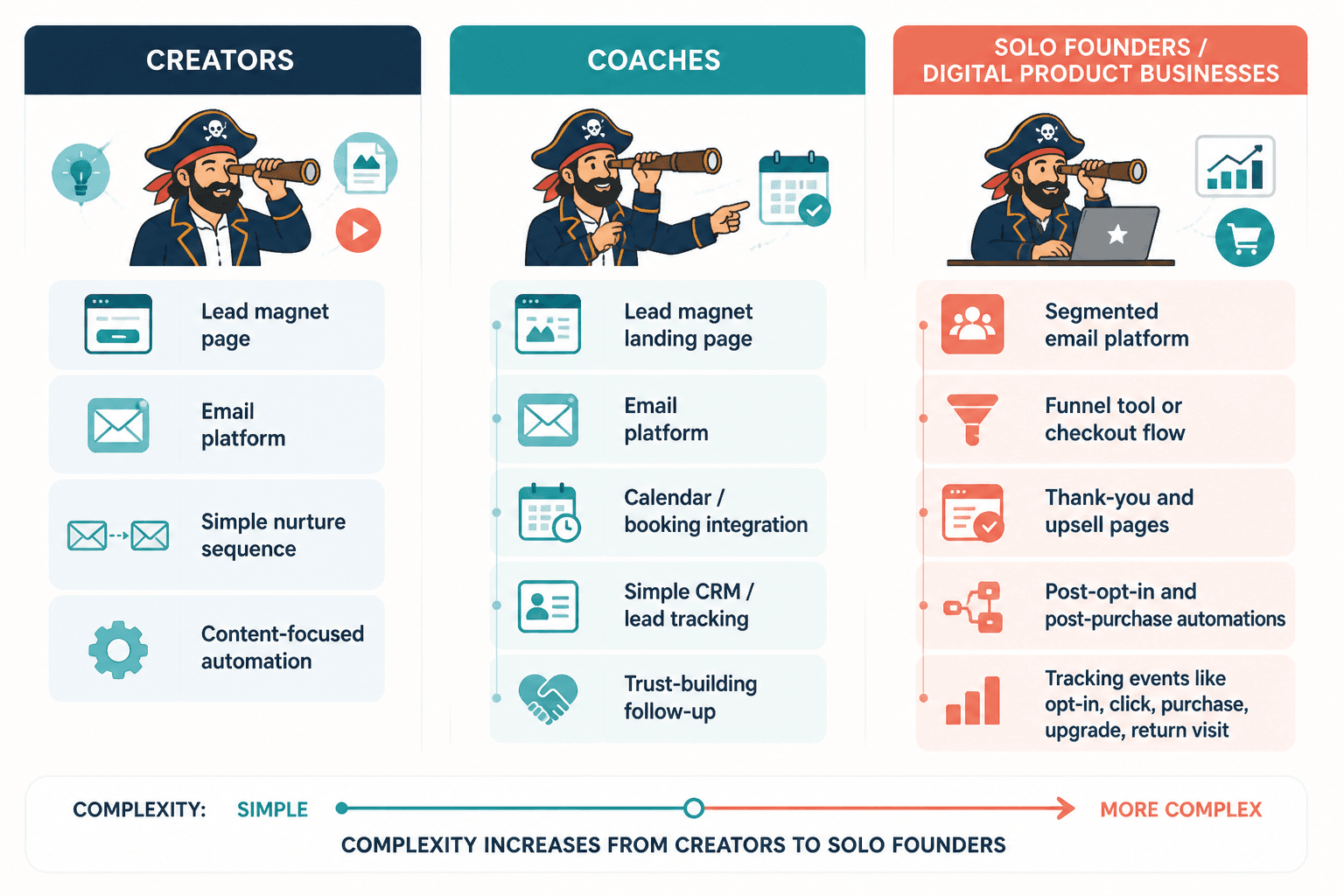
For creators and writers
- Email platform with forms and sequences
- Simple landing page builder
- Newsletter archive or content hub
- Optional lightweight automation
Your goal is usually subscriber growth, trust, and gentle offer progression. Keep the system lean.
For coaches and consultants
- Email platform with tagging and sequence branching
- Lead magnet landing pages
- Calendar or booking integration
- Simple CRM or lead tracking
Your funnel should help identify fit, build trust, and move qualified people toward a conversation. If your lead magnet attracts the wrong people, the problem is often positioning, not software.
For solo founders or digital product businesses
- Email platform tied to product segments
- Funnel tool or checkout flow
- Thank-you and upsell pages
- Post-opt-in and post-purchase automations
This kind of setup benefits more from funnel logic because there are often multiple actions worth tracking: opt-in, click, purchase, upgrade, and return visit.
Features that matter more than people admit
Tool reviews often obsess over giant feature lists. In practice, a few boring capabilities matter more.
Good form handling
If the form is ugly, slow, awkward on mobile, or hard to place where you need it, your conversion rate suffers before the lead magnet even gets a chance. The opt-in moment is fragile. Do not clutter it.
Fast delivery
People expect the thing they requested right away. Not in ten minutes. Not after a confusing double-step unless compliance absolutely requires it. Fast delivery increases trust and engagement with the first follow-up email.
Tagging based on intent
Someone who downloads a lead magnet about pricing is not identical to someone who downloads one about content planning. Treating them the same is lazy. Basic tagging lets you tailor follow-up without building a ridiculous automation maze.
Usable automation
Not advanced. Usable. There is a difference. You need enough logic to send the right emails to the right people at the right time. If the builder is so messy that you avoid touching it, the feature does not count.
Clear analytics
You should be able to answer basic questions quickly:
- Which lead magnet gets the most signups?
- Which page converts best?
- Which sequence gets clicks?
- Which CTA moves people toward the next step?
If the reporting makes you feel like you are filing airport taxes, it is probably not helping much.
What tools cannot do for your lead magnet funnel
This part matters because people buy software to solve strategy problems all the time.
- Tools cannot make a boring lead magnet desirable.
- Tools cannot fix weak positioning.
- Tools cannot write a persuasive landing page by themselves.
- Tools cannot turn the wrong audience into buyers.
- Tools cannot save an offer that does not lead anywhere useful.
A better funnel on top of a weak lead magnet is just a more efficient way to disappoint people.
If you need help refining the asset itself, this guide to templates and tools for lead magnets is a useful next step. If you are using AI to speed up parts of the process, this article on AI tools for lead magnets can help you use it without producing generic sludge.
How to choose the right stack without overcomplicating it
Here is a simple decision framework.
Choose based on your next 6 to 12 months, not your fantasy empire
You do not need software for twelve offers if you currently have one lead magnet and one service. Buy for the business you are actually running.
Map the path before the tools
- Where will people find the lead magnet?
- Where will they opt in?
- What do they receive first?
- What happens over the next few emails?
- What is the next action you want from qualified leads?
If you cannot answer those five questions, do not start comparing software pricing pages yet.
Prefer tools that reduce maintenance
A lead magnet funnel should not require constant babysitting. Favor tools that are easy to edit, easy to troubleshoot, and easy to understand later when Future You has forgotten why Past You made that bizarre automation rule.
Make sure the stack supports your actual CTA
If your goal is newsletter growth, optimize for simple subscription and nurture. If your goal is booked calls, optimize for segmentation and qualification. If your goal is digital product sales, optimize for offer flow and purchase follow-up.
The tool stack should match the business action, not just the opt-in event.
A simple lead magnet funnel that works for most people
If you want something practical and clean, start here:
- One landing page with one clear promise
- One email form
- Immediate delivery email
- Three to five follow-up emails
- One CTA tied to the problem the lead magnet introduced
- Light tagging based on signup source or topic
That is enough to build a real system. Not a toy. Not a giant funnel circus. A real system.
Want ideas for what comes after the opt-in? Read best funnel ideas to pair with lead magnets. Want to improve conversion after people join? Read how to turn lead magnets into more leads or sales.
And if you want the broader context around monetization paths, the main monetization and funnel resources can help connect the dots.
Common mistakes when choosing email and funnel tools
- Choosing based on hype: Popular does not mean right for your business.
- Overbuying automation: Most people do not need twelve-branch logic on day one.
- Ignoring the delivery experience: The first email matters more than your dashboard aesthetic.
- Using too many tools too early: More moving parts means more weird failures.
- Not connecting the lead magnet to an actual offer path: Freebie first, confusion second, silence forever is not a funnel.
The best email tools and funnel tools for Lead Magnets are the ones that help you build trust, deliver value, and move the right people forward with less friction. That is the job. Not impressing other marketers with screenshots of your automation map.
How to make your tools work better once you have them
Even a basic stack performs better when the follow-up is thoughtful. A few upgrades make a disproportionate difference.
- Write a sharper opt-in promise
- Personalize the delivery email subject line
- Use the thank-you page for one relevant next step
- Segment by topic, source, or offer interest
- Keep the nurture sequence tight and useful
- Ask for a reply sometimes if conversation matters to your business
This is where tools become useful instead of ornamental. A good lead magnet funnel does not feel “optimized.” It feels coherent.
FAQ
Do I need a separate funnel tool if I already have an email platform?
Not always. If your email platform handles forms, landing pages, and automations well enough, that may be plenty for a simple lead magnet funnel.
What matters more: the email tool or the landing page tool?
If you are building long-term trust and follow-up, the email tool usually matters more. The landing page matters at the conversion point, but the email system carries more of the business value over time.
Should I use an all-in-one platform?
Usually yes, if you are solo or small and want less complexity. Move to separate tools when you have a clear reason, not just software envy.
How many emails should follow a lead magnet?
For most businesses, three to five useful follow-up emails is a strong starting point. Enough to build context and trust, not enough to become background noise.
Can AI tools replace funnel setup work?
No. They can help draft copy, suggest ideas, and speed up production. They cannot decide your positioning, your offer logic, or what your audience actually needs next.
Final thought
Lead magnets work best when they solve one real problem cleanly and make the next step feel natural. The clearer the bridge from free value to real offer, the stronger the whole system gets.