
Most old content does not become a good lead magnet just because you slap a PDF cover on it and call it a “free resource.” That is how you get a dusty download no one reads, no one remembers, and no one associates with your actual offer.
If you want to know how to turn old content into better lead magnets, the real job is not recycling. It is upgrading. You are taking something that already has useful bones and reshaping it into something more focused, more actionable, and more connected to the next step in your funnel.
That means less “collection of past thoughts,” more “specific tool that helps the right person make a decision, get a result, or spot a problem they need help solving.” A good lead magnet earns trust. A lazy repackaging job just adds to the internet’s growing pile of polite clutter.
Here’s how to find old content worth reusing, how to reshape it so it actually feels valuable, and how to turn it into a lead magnet that helps your audience and supports your business at the same time.
If you want the bigger picture, start with the parent guide.
Why old content is usually the best place to start
Creating a lead magnet from scratch sounds productive. Sometimes it is. A lot of the time, though, it just means you are reinventing material you have already tested in public.
Old content gives you clues. You can see what people saved, responded to, clicked on, asked follow-up questions about, or kept bringing up in calls and DMs. That is useful data. Much more useful than sitting there trying to force a “10-page guide” into existence because some funnel bro said every business needs one.
Your past posts, emails, articles, threads, videos, workshops, and client explanations already contain the raw material. The trick is choosing content with enough demand and enough depth to become a resource people actually want.
What makes old content worth turning into a lead magnet
Not all old content deserves a second life. Some of it was fine as a post and should remain a post. Some of it was mediocre the first time. Recycling weak content does not make it stronger. It just gives the weakness a cover page.
Look for old content that does at least one of these things well:
- Explains a specific problem clearly
- Gets repeated engagement or questions
- Helps readers make a decision
- Breaks down a process or framework
- Includes examples, templates, or steps
- Connects naturally to a service, offer, or next action
- Speaks to a problem your best-fit clients already know they have
That last one matters more than people think. A lead magnet should not just be useful in the abstract. It should attract people who are likely to benefit from your paid work later. If your freebie solves a random problem your actual offer does not touch, congrats, you built yourself a distraction machine.
For a broader view of where this fits in your funnel, the main lead magnets guide is a good companion read.
Start with the right source material
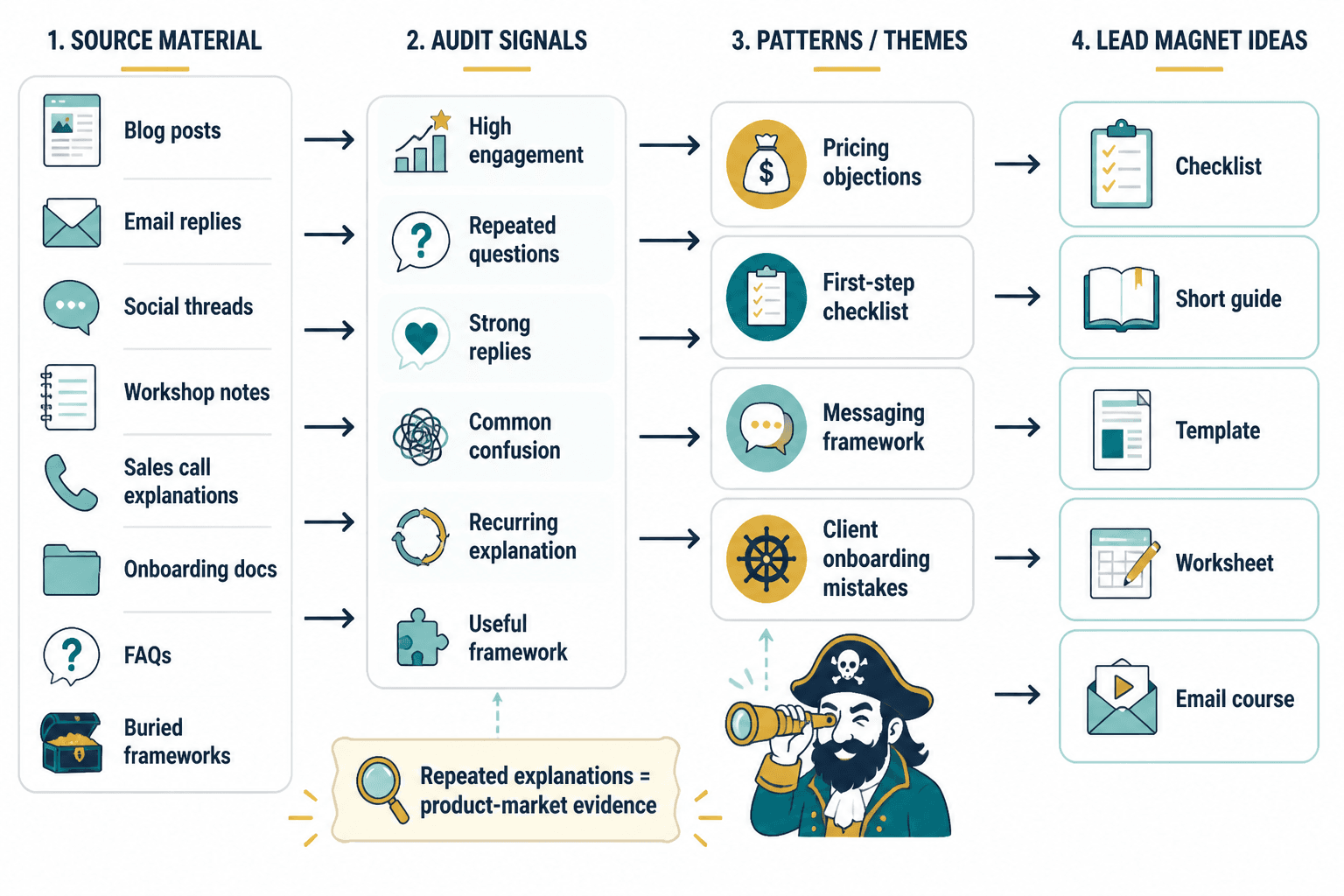
Good source material usually comes from content that already proved it could hold attention. That does not always mean viral. Sometimes your best lead magnet starts as a post that got modest numbers but sparked high-quality replies from the exact people you want to work with.
Here are strong places to look:
- High-performing blog posts or articles
- Email newsletters people replied to
- LinkedIn or X posts that triggered useful discussion
- Workshop outlines or webinar teaching notes
- Sales call explanations you repeat constantly
- Client onboarding documents
- FAQ answers you keep typing from scratch
- Frameworks buried inside long-form content
If you keep explaining the same thing over and over, that is not just repetition. That is product-market evidence. It means the issue is common, the need is real, and a cleaner resource could save you time while building trust.
Do not repurpose by format alone
This is where a lot of people go wrong. They take five old posts, paste them into a doc, add a Canva cover, and call it a lead magnet. Technically, yes, it is downloadable. Functionally, it is still five posts wearing a fake mustache.
Format change is not transformation. Better lead magnets need a sharper promise than the original content had.
Instead of asking, “How can I package this?” ask:
- What exact result should this help the reader get?
- What question should this answer better than a random post can?
- What confusion should it remove?
- What decision should it make easier?
- What action should it help them take today?
That shift changes everything. You stop building content bundles and start building tools.
Choose a better lead magnet format for the material
Different old content wants to become different things. Not every idea should become an ebook. Honestly, most should not.
| Old content type | Better lead magnet format | Why it works |
|---|---|---|
| Long article with solid strategy | Condensed guide or action plan | Turns reading into implementation |
| Short posts with strong tips | Checklist or swipe file | Makes scattered ideas easy to use |
| Training or webinar | Summary worksheet or framework PDF | Extracts the useful parts without the fluff |
| Repeated client advice | FAQ guide or decision tree | Solves a known friction point quickly |
| Case study notes | Breakdown template or teardown | Gives proof plus a repeatable structure |
| Post series on one topic | Email mini-course | Creates sequence and momentum |
If your old content is tactical, make the lead magnet tactical. If the content helps someone diagnose a problem, build a self-assessment. If it helps them write better, create a template pack. Match the shape of the resource to the job it needs to do.
How to turn old content into better lead magnets, step by step
1. Find the strongest core idea
Do not start by collecting everything you have ever said on the topic. Start by finding the one central idea that matters most.
For example, if you have ten posts about weak content CTAs, the lead magnet is probably not “10 posts about CTAs.” It might be:
- A CTA cheat sheet for service businesses
- A list of low-pressure CTAs by funnel stage
- A mini guide to fixing salesy calls to action
Same material. Better promise. Better use case.
2. Cut everything that does not support that promise
Old content often includes context, side comments, platform-specific phrasing, and little detours that worked fine in the original format. A lead magnet usually needs less wandering and more structure.
Cut:
- Repeated points
- Off-topic examples
- Throat-clearing intros
- Generic filler advice
- Anything written just to boost post length
This is where many freebies get bloated. People confuse “more pages” with “more value.” Readers do not. They can smell padding from space.
3. Add what the original content was missing
This part matters. A stronger lead magnet is not just a trimmed version of old content. It usually needs a few upgrades the original never had.
Add things like:
- A clearer outcome
- A more useful sequence
- Step-by-step instructions
- Examples or before-and-after rewrites
- A worksheet, checklist, or template
- A short “what to do next” section
This is the difference between content people consume and resources people keep. Consumption is easy. Application is what makes the lead magnet feel worth exchanging an email address for.
4. Rewrite it for clarity, not for your ego
Plenty of old content sounds smart but is annoying to use. Tighten it. Simplify the language. Make section headings clearer. Replace vague claims with specific guidance.
If the original content was written in a too-polished, too-performative voice, fix that too. Lead magnets should sound credible and human, not like a webinar landing page learned to type.
If you need help cleaning up stiff, padded resources, this guide on how to rewrite boring lead magnets will help.
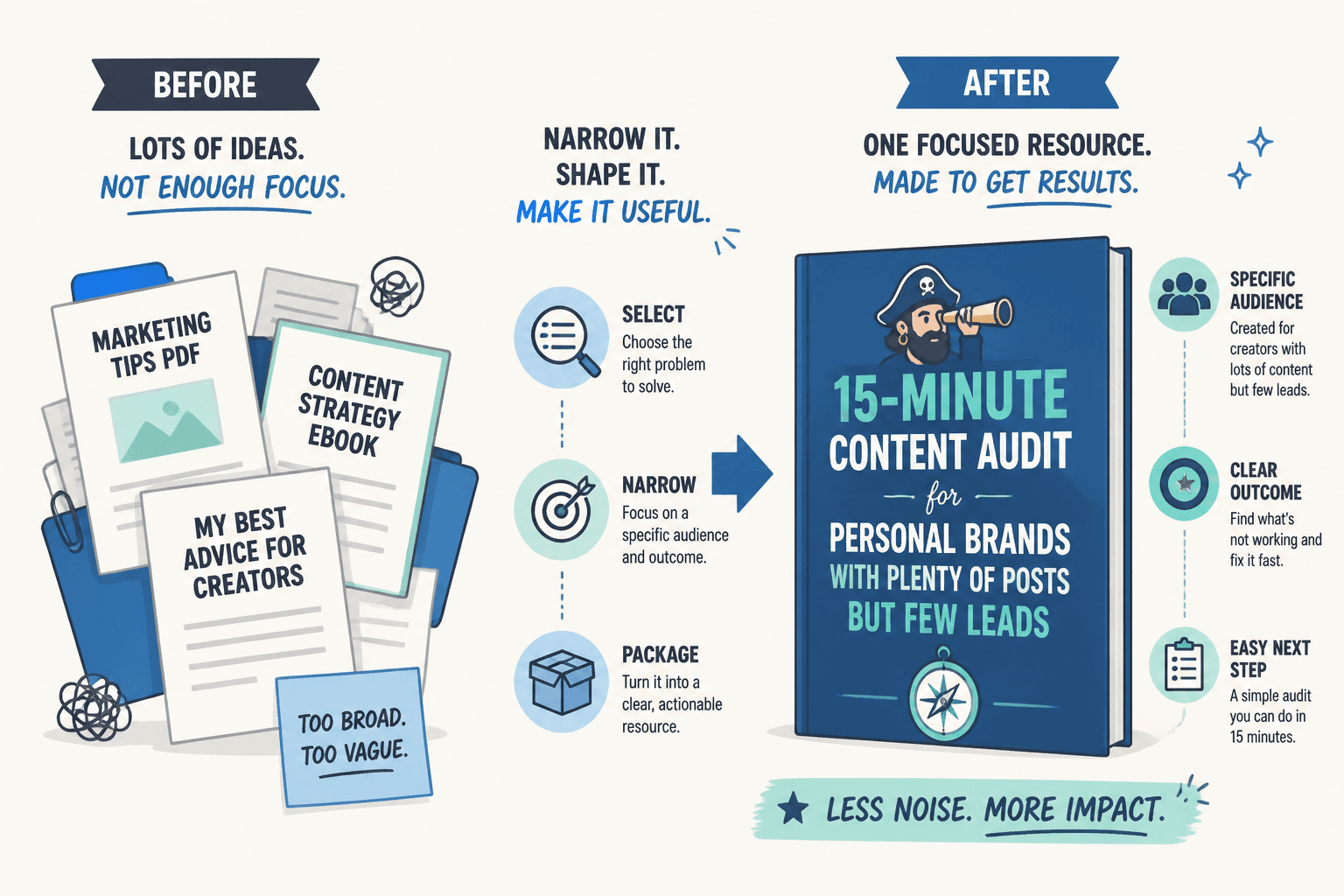
5. Give it a specific title and promise
A weak lead magnet title kills interest fast. “My Content Guide” is not a title. It is a folder name.
A better title says what it is, who it helps, and sometimes what outcome it supports.
Weak:
- Marketing Tips PDF
- Content Strategy Ebook
- My Best Advice for Creators
Better:
- 12 Lead Magnet Ideas for Coaches Who Hate Writing Long PDFs
- The Simple CTA Guide for Consultants Who Want More Replies, Not Eye Rolls
- A 15-Minute Content Audit for Personal Brands With Plenty of Posts but Few Leads
Specificity does a lot of sales work before the reader even clicks.
Three simple ways to upgrade old content into something people actually want
Turn scattered advice into a decision tool
If your old content includes lots of tips, observations, or mini-lessons, combine them into something the reader can use to assess where they are.
Examples:
- Content audit checklist
- Profile review scorecard
- Lead magnet self-assessment
- Offer-message alignment worksheet
Decision tools work well because they create clarity fast. They also naturally reveal gaps your paid offer can help solve without needing a hard sell.
Turn educational content into a shortcut
If your old content teaches a process, condense it into a format that saves people time. That could mean templates, scripts, prompts, swipe copy, or step-by-step action sheets.
People love shortcuts when they still preserve quality. They do not love 27 pages of theory when what they actually needed was a one-page framework.
Turn opinion content into a clearer framework
Strong opinion posts can make great lead magnets if you extract the underlying structure. If you keep talking about why most lead magnets fail, for example, that could become:
- A “fix these five mistakes” guide
- A teardown of weak versus strong lead magnet offers
- A framework for matching freebies to paid offers
Opinion alone is not enough. Framework plus opinion? Much stronger.
Make the lead magnet lead somewhere
A better lead magnet is not just more helpful. It is more strategically connected. The reader should finish it knowing what the next logical step is.
That next step might be:
- Reading a related article
- Joining your newsletter
- Booking a consultation
- Replying to an email
- Checking out a low-ticket offer
- Using another resource in the same funnel
This is why random topic selection backfires. If you turn old content into a freebie that does not connect to anything you sell, you may get subscribers, but not much business value.
For example, if your lead magnet helps consultants diagnose weak nurture content, the next step could point them toward a service, workshop, or email sequence offer that solves that exact issue. Smooth. Logical. Not needy.
If you want that handoff to work better, read how to turn lead magnets into more leads or sales and best funnel ideas to pair with lead magnets.
Before-and-after examples
Example 1: Old blog post to useful checklist
Old content: A 1,800-word article on common mistakes in email welcome sequences.
Weak repurpose: “Free PDF version of my article.”
Better lead magnet: “Welcome Email Audit Checklist: 15 Fixes for Sequences That Get Opened but Do Not Convert.”
Why it is better: It gives the reader a faster way to apply the advice, frames the problem in a practical way, and tees up a conversion-focused service naturally.
Example 2: Old social posts to swipe file
Old content: A series of short LinkedIn posts about better calls to action.
Weak repurpose: “20 CTA Ideas.”
Better lead magnet: “36 Low-Pressure CTAs for Experts Who Want More Replies Without Sounding Like a Funnel Goblin.”
Why it is better: It speaks to a specific pain point, keeps the tone human, and turns scattered advice into a usable resource.
Example 3: Webinar to framework guide
Old content: A 45-minute workshop on lead magnet strategy.
Weak repurpose: Full replay plus transcript.
Better lead magnet: “The Lead Magnet Match Framework: Pick the Right Freebie for Your Offer in 20 Minutes.”
Why it is better: It removes the time burden, sharpens the outcome, and focuses on the most actionable part of the training.
Common mistakes when repurposing old content into lead magnets
- Using weak source content. If it was vague before, it will still be vague in PDF form.
- Keeping the original structure. Social posts, articles, and trainings often need a full reorganization.
- Making it too broad. “Everything I know about content” is not helpful. It is exhausting.
- Forgetting the reader’s stage of awareness. A beginner resource and a buyer-readiness resource are not the same thing.
- No next step. If the freebie helps but goes nowhere, you lose momentum.
- Sounding robotic or over-polished. People trust resources that feel useful and real, not weirdly corporate.
If your lead magnet sounds stiff, overproduced, or suspiciously “optimized,” this piece on writing lead magnets without sounding salesy or robotic is worth your time.
Repurposing works best when the borrowed material still feels current, specific, and easy to use. If the old idea already proved it mattered, your job is to shape it into something sharper, not just recycle it lazily.