
Most affiliate articles fail for a very boring reason: they do all the work to earn attention, then send that attention straight off a cliff.
The article ranks, or gets shared, or pulls in a decent trickle of readers. People click. Some skim. A few buy. Most leave. No email captured. No relationship started. No second offer. No follow-up. Just a little commission and a lot of wasted traffic.
That is why the best funnel ideas to pair with affiliate articles are not about getting more clever with links. They are about giving the reader a next step that actually makes sense. A good affiliate article should not act like a dead-end product shelf. It should work more like a guided path: useful article, relevant next action, stronger trust, better conversion.
If you write affiliate content as a creator, coach, consultant, freelancer, or niche expert, this matters more than people admit. You do not need a 14-step funnel stitched together with popups and false urgency. You need a simple system that turns interest into something more valuable than one stray click.
Here’s how to pair affiliate articles with funnels that feel natural, convert better, and do not make your content smell like a damp sales script.
For the full path around this topic, head to the parent guide.
Why affiliate articles need a funnel in the first place
An affiliate article usually sits in the middle of the buyer journey, not at the end.
Some readers are ready to click and buy. Great. But many are still comparing options, figuring out what they need, or trying to trust the person recommending the thing. If your only plan is “insert affiliate link and hope,” you are depending on immediate buyer intent from people who often are not there yet.
A funnel fixes that by giving different readers different ways to keep moving.
- Ready buyers can click through to the product.
- Interested but hesitant readers can join your email list.
- Readers with a more complex problem can book a call or explore your service.
- Warm prospects can move into a resource, case study, or nurture sequence.
That is the real job here. Not squeezing every reader into the same action, but giving them the right next step based on what they need.
If you need the bigger picture on how affiliate content fits into monetization strategy, start with affiliate articles and then explore the wider monetization funnels and money content hub. That context helps, because affiliate content works a lot better when it is part of a system instead of a random side hustle stapled onto your blog.
What makes a good funnel match for an affiliate article
Not every funnel belongs behind every article. A terrible match feels forced. A good one feels like the obvious next move.
Before we get into specific funnel ideas, use these four filters:
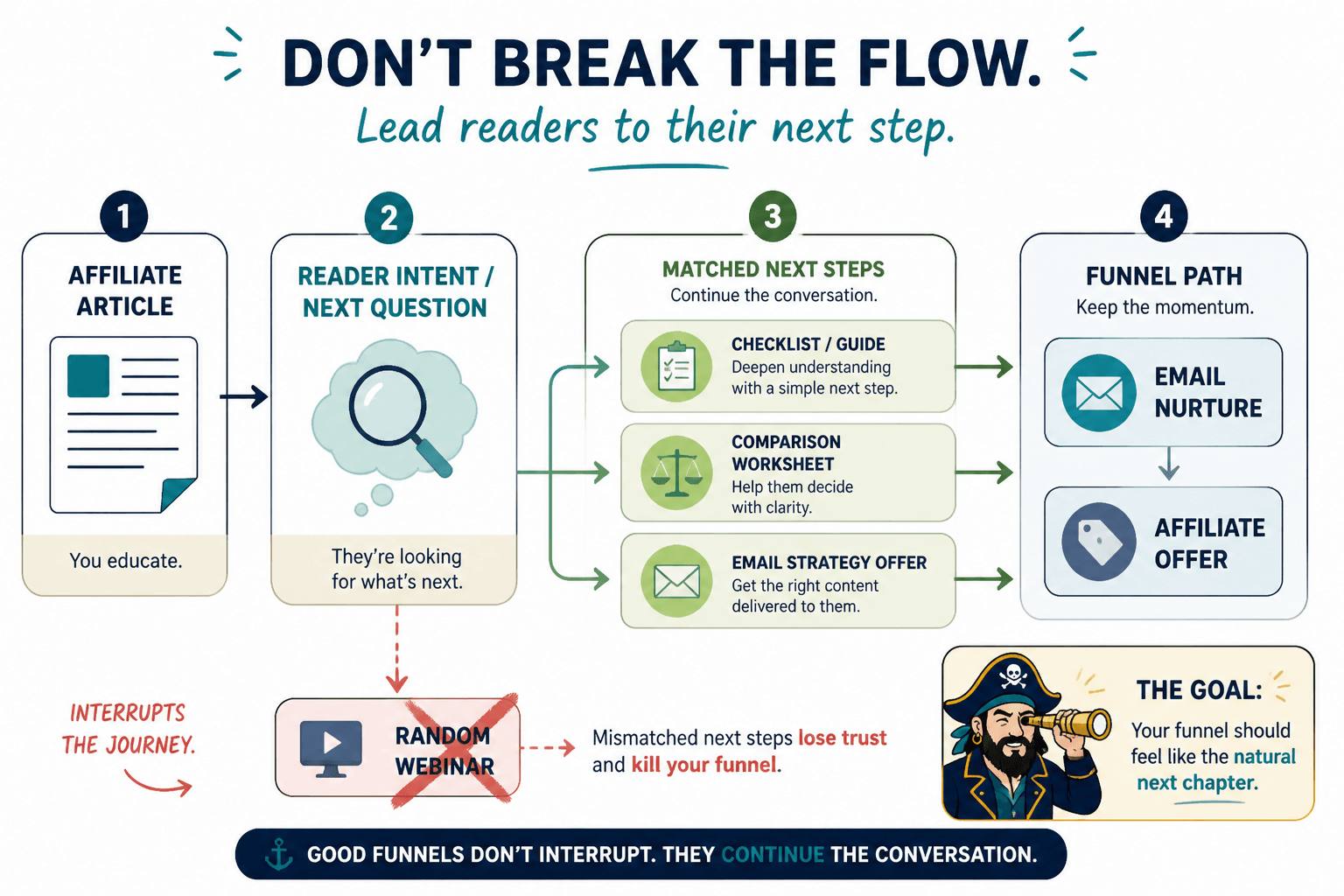
- The next step should match the reader’s intent. If the article is “best email platforms for coaches,” a checklist, comparison worksheet, or email strategy offer makes sense. A random webinar on mindset does not.
- The funnel should continue the article, not interrupt it. Your CTA should feel like a helpful extension of the topic, not an ambush.
- The value should increase as the commitment increases. Do not ask for a consultation call from someone who barely knows you unless the article naturally qualifies them for that step.
- The article and funnel should share the same promise. If the article helps people choose a tool, the funnel should help them use it, compare it, implement it, or get better results from it.
Simple rule: the best funnel ideas to pair with affiliate articles are usually the ones that answer the reader’s next question.
Best funnel ideas to pair with affiliate articles
These are the funnel types that tend to work best because they respect reader intent, build trust, and give you more than one shot at conversion.
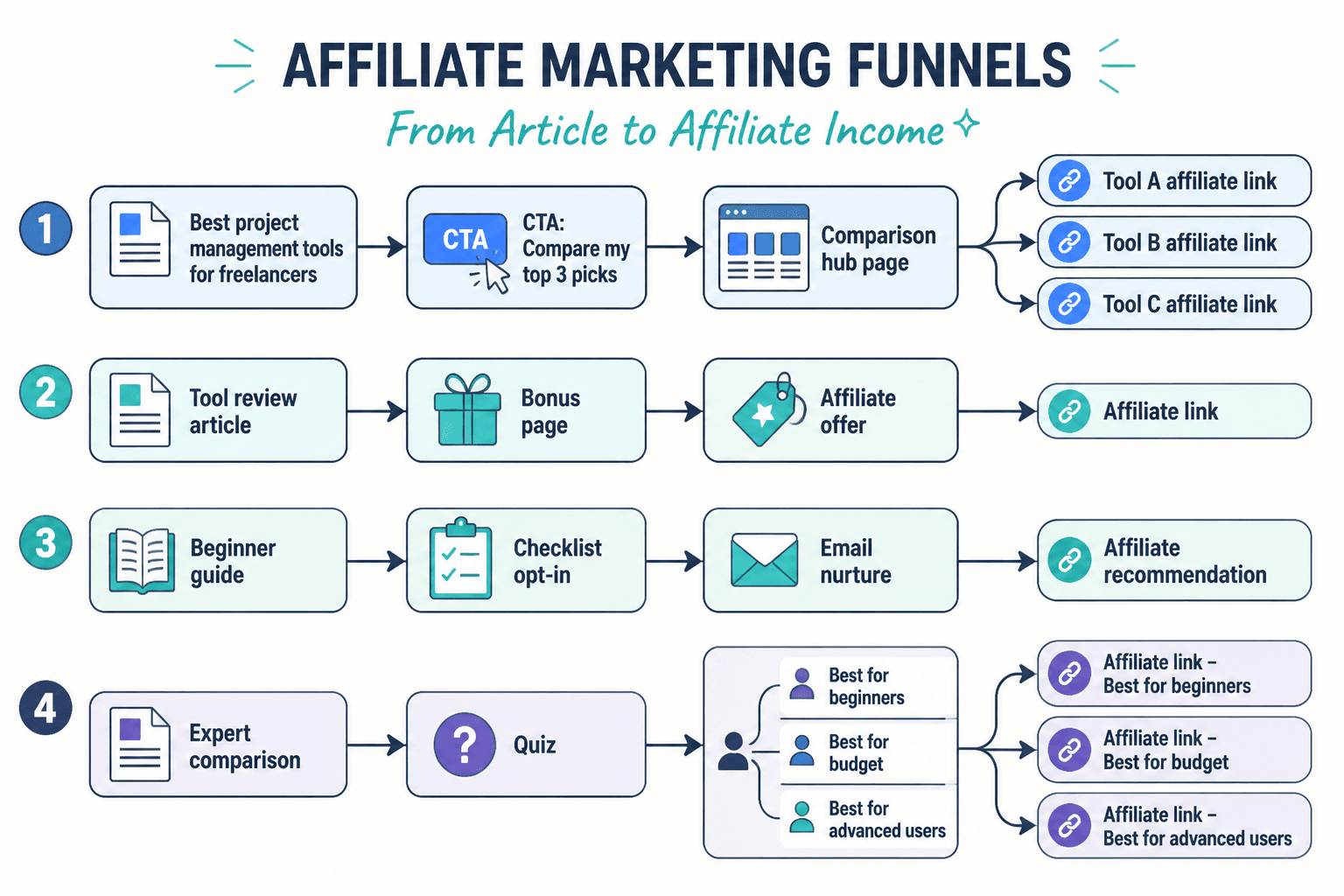
1. Article to lead magnet to email nurture to affiliate offer
This is the classic one for a reason. It works.
If someone reads your affiliate article but is not ready to buy yet, a relevant lead magnet gives you a second chance. Then your email sequence can educate, compare options, handle objections, and recommend the affiliate product more naturally.
Best for:
- Tool comparison articles
- “Best X for Y” posts
- Beginner decision-making content
- Articles where readers need time to choose
Strong lead magnet ideas:
- Comparison checklist
- Buyer’s guide PDF
- Setup checklist
- Template pack
- Decision worksheet
- “Which tool fits you?” self-assessment
Example flow:
- Article: Best course platforms for creators
- CTA: Download the platform comparison worksheet
- Email 1: Best picks by creator type
- Email 2: Common mistakes when choosing a platform
- Email 3: Why you may want platform A over platform B
- Email 4: Affiliate recommendation with context and bonus
This funnel works especially well when your article pulls top-of-funnel search traffic. Instead of begging for a sale immediately, you keep the relationship alive. Much more useful. Much less desperate.
2. Article to product recommendation to bonus page
This is one of the smartest funnel ideas when the affiliate product has some setup friction or competition. Instead of sending readers straight through the affiliate link with no reason to choose your recommendation, you offer a bonus that makes your path more attractive.
Best for:
- Software tools
- Courses
- Memberships
- Products with multiple affiliates promoting them
Bonus examples:
- Implementation template
- Quick-start guide
- Private walkthrough
- Email examples
- Swipe file
- Mini training
The key is that the bonus has to help people get value from the product faster. Not random fluff. Nobody needs another bonus PDF with 38 pages of recycled motivation and one screenshot.
Your article can mention the bonus in the CTA:
If you end up choosing Tool X, I put together a simple setup checklist and onboarding guide so you can get it running without wasting half your afternoon clicking the wrong settings.
3. Article to newsletter to recurring affiliate recommendations
This is less flashy and often more profitable over time.
If your niche naturally includes tools, books, software, gear, templates, or platforms, a newsletter is one of the best long-term funnels to pair with affiliate articles. The article earns search traffic or social traffic. The newsletter keeps attention. Then you can recommend affiliate products over time as part of useful content, not one isolated article.
Best for:
- Creators with multiple related affiliate offers
- Niche publishers
- Experts with ongoing recommendations
- People building media-style businesses
Good newsletter angles:
- Weekly tool breakdowns
- Creator workflow tips
- What I’m testing this month
- Best resources for a specific niche
- Short practical lessons with recommended tools
This works because the newsletter is not just a monetization device. It is a trust machine. That matters if you care about affiliate income that lasts longer than one lucky month.
If your goal is to connect affiliate content to broader lead and revenue paths, read how to turn affiliate articles into more leads or sales. That article pairs well with this one because it helps you think beyond clicks.
4. Article to quiz or self-assessment to segmented recommendations
This one is underrated.
Some affiliate articles cover categories where the best option depends heavily on the person. In those cases, a quiz or self-assessment can outperform a generic CTA because it helps readers feel guided instead of dumped into a comparison swamp.
Best for:
- Tool comparisons
- Platform recommendations
- Productivity stacks
- Coaching, software, or education products with multiple use cases
Example:
- Article: Best CRMs for solo consultants
- CTA: Take the 2-minute CRM fit quiz
- Quiz result: Best choice for your business stage and sales style
- Follow-up: Segmented email sequence with recommendation, setup tips, and affiliate offer
This funnel adds a little friction up front, but often improves relevance. And relevance is usually doing more work than persuasion anyway.
5. Article to free resource to service offer
Not every affiliate article should only push affiliate revenue. Sometimes the smarter move is using affiliate content to attract qualified people for your actual business.
If you are a coach, consultant, strategist, or service provider, your affiliate article can pre-qualify readers around a problem you solve. Then the funnel moves them toward your own offer, with affiliate links acting as support rather than the main event.
Best for:
- Consultants recommending tools they implement
- Coaches recommending platforms they teach
- Strategists recommending systems they build
- Freelancers recommending software they use in delivery
Example flow:
- Article: Best email marketing tools for creators
- CTA: Download my welcome-sequence planning template
- Follow-up: Helpful email sequence about setup, segmentation, and content
- Next offer: Book an email strategy session
- Affiliate links: Included naturally in the emails and article where relevant
This is often the highest-value funnel on the list because the affiliate article becomes both a monetization asset and a lead generation asset. Neat little overachiever.
6. Article to case study to consultation or offer
If your affiliate article touches a bigger business problem, a case study is a strong middle step.
Readers often do not just want to know what tool is “best.” They want to know what happened when someone used it well. A case study gives proof, reduces skepticism, and creates a natural path to your paid help.
Best for:
- B2B tools
- Higher-ticket software
- Complex decisions
- Consulting, agency, or coaching businesses
Example flow:
- Article: Best scheduling tools for consultants
- CTA: See how I used Tool X to streamline onboarding
- Case study: Workflow before, workflow after, lessons learned
- Offer: Book a systems audit or workflow consult
This works because proof closes more gaps than enthusiasm. People trust a grounded example more than a loud recommendation.
7. Article to low-ticket product to affiliate upsell
This one is less common, but very effective in the right niche.
If you have a small digital product that helps people implement what the affiliate product enables, the article can feed both. The reader buys your low-ticket thing, gets results, and sees the affiliate product as the logical companion.
Best for:
- Template sellers
- Course creators
- Workflow educators
- Niche experts with practical mini-products
Example:
- Article: Best Notion templates and tools for content planning
- CTA: Grab my content planning starter pack
- Inside product: Practical use cases and setup guidance
- Affiliate upsell: Recommended Notion tools or related software
This only works if your product is genuinely useful on its own. If it exists purely to herd people into an affiliate link, readers will notice. They are not confused. Just busy.
8. Article to comparison page hub to multiple affiliate paths
Sometimes the right funnel is not a lead capture at all. Sometimes it is a smarter content path.
If your affiliate site or creator brand covers many tools in one category, you can send readers from a broad article into a deeper comparison hub. That gives them more useful context and increases the odds they choose a product through one of your links.
Best for:
- Sites with multiple affiliate articles
- Niche review content
- Brands building topical authority
- Readers who need more comparison depth before buying
Example flow:
- Article: Best project management tools for freelancers
- CTA: Compare my top 3 picks side by side
- Hub page: Pricing, ideal use cases, pros, limitations, recommendation notes
- Paths: Different affiliate links based on reader fit
This is especially useful if your affiliate content strategy includes many related posts. If you need ideas for those content types, see best affiliate articles ideas and examples for creators and affiliate articles guide for creators who want better results.
How to choose the best funnel for your affiliate article
You do not need all eight. You need the one that fits the article, audience, and business model.
| Article type | Best funnel match | Why it works |
|---|---|---|
| Best X for Y | Lead magnet to email nurture | Readers often need more time and comparison help |
| Tool review | Bonus page | Adds a reason to buy through your link |
| Beginner guide | Newsletter or checklist | Builds trust before recommending products |
| Expert comparison | Quiz or segmented path | Helps readers choose based on fit |
| Implementation article | Service offer funnel | Attracts people who want help doing it right |
| Business workflow article | Case study to consult | Turns tool interest into paid help |
| Niche content library | Comparison hub | Keeps readers in your ecosystem longer |
Here is the simplest way to decide:
- Ask what the reader wants immediately after reading the article.
- Ask whether they are likely ready to buy, or still evaluating.
- Ask whether the affiliate product connects naturally to your own offer.
- Choose the next step with the least friction that still creates business value.
That last part matters. People love building ambitious funnels they will never maintain. A simple funnel that gets used beats a sophisticated funnel abandoned behind a login screen.
Where to place funnel CTAs inside affiliate articles
A good funnel paired with a bad CTA placement still underperforms.
You do not need to turn the article into a pop-up carnival. You just need to place relevant CTAs where intent is strongest.
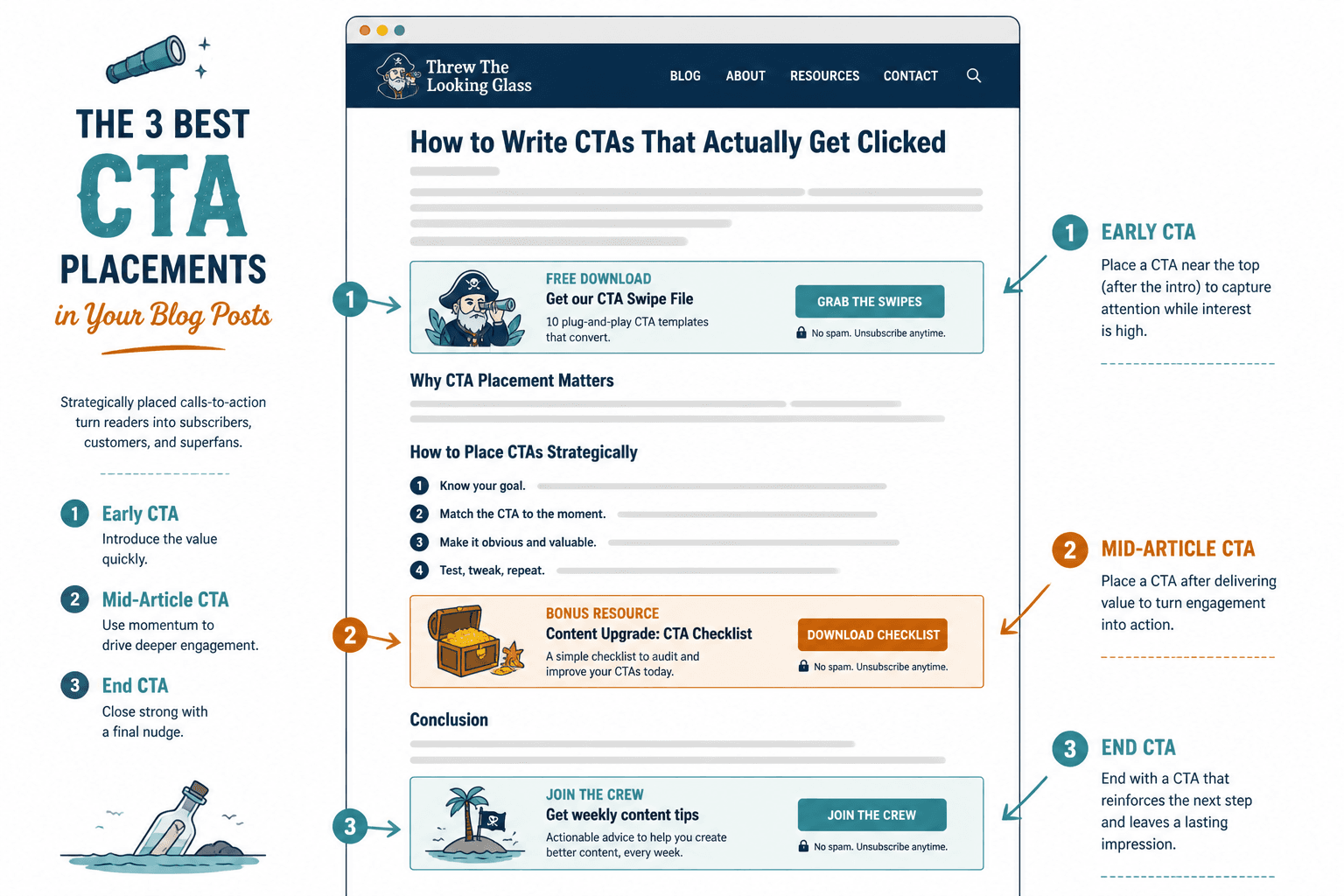
Use three CTA zones
- Early CTA: For highly relevant resources after the intro or first major section
- Mid-article CTA: After a comparison, recommendation, or objection-handling section
- End CTA: For the strongest next step once the reader has context
Different readers act at different moments. Some are ready fast. Others need the full case. Give both types a clean path.
Keep CTA copy specific
Weak CTA:
Click here to learn more.
Better CTA:
Want help choosing the right option? Grab the 1-page comparison sheet I use to sort tools by price, ease, and actual fit.
The second one tells the reader what they get and why it matters. Very revolutionary stuff, apparently.
Mistakes that quietly ruin affiliate article funnels
A funnel does not need to be aggressive to be bad. Sometimes it just needs to be mismatched, vague, or lazy.
- Offering a generic lead magnet. If your article is specific and your freebie is broad, conversions drop.
- Sending every reader to the same CTA. Different articles often need different funnel paths.
- Pushing your offer too early. Trust first. Especially if the article came from search.
- Using affiliate articles with no audience capture plan. You paid for the traffic in effort. Stop wasting it.
- Making the funnel feel disconnected from the article. Readers should feel continuation, not redirection.
- Overcomplicating the setup. A lead magnet and four useful emails can outperform your majestic automation labyrinth.
- Writing CTA copy like a default plugin setting. Be clear. Be specific. Be normal.
If trust is the part you are trying not to wreck, read how to monetize affiliate articles without wrecking trust. That piece covers the line between useful monetization and obvious cash-grabbing, and yes, readers can tell the difference.
A simple funnel stack most creators can actually maintain
If you want a practical setup without building a giant machine, start here:
- Write an affiliate article around a clear problem or comparison.
- Add one relevant lead magnet or bonus CTA.
- Create a 3 to 5 email follow-up sequence.
- Include one or two contextual affiliate recommendations inside the emails.
- Add one soft path to your own offer if it fits.
That is enough to turn an affiliate article into a functioning funnel asset.
Not glamorous. Not wildly complicated. Just useful. Which is usually the thing that keeps making money after the people selling “secret funnel maps” have moved on to their next personality phase.
FAQ
Should every affiliate article have a lead magnet?
Not necessarily. If the article targets strong buying intent, a direct affiliate CTA or bonus page might work better. Use a lead magnet when readers need more time, trust, or comparison help.
What is the best funnel for beginner affiliate creators?
A simple article to lead magnet to email nurture funnel is usually the best place to start. It is manageable, useful, and gives you more than one chance to convert.
Can affiliate articles also sell my own services?
Yes, if the article naturally attracts people who may want implementation help, strategy, or done-for-you support. Just do not force the service pitch where it does not belong.
How many CTAs should an affiliate article include?
Usually one main next step, shown in a few smart places, is enough. Too many CTAs can make the article feel confused or pushy.
What if I do not have an email list yet?
Then build the simplest version first: article, relevant freebie, short email sequence. You do not need a huge list to benefit. You just need a way to stop losing interested readers immediately.
Use affiliate articles like assets, not one-off shots
The best funnel ideas to pair with affiliate articles all do one thing well: they respect the fact that attention is valuable and trust is fragile.
If someone reads your article, finds it useful, and still does not buy today, that is not failure. It just means the next step matters. A relevant lead magnet, newsletter, case study, service path, quiz, or bonus page can turn one useful article into a repeatable business asset instead of a one-click gamble.
So before you publish your next affiliate article, ask a better question than “where do I drop the link?” Ask what should happen after the read. That is where the money usually is.