
Most people looking for the best AI tools for affiliate articles are really looking for a shortcut.
Fair enough. Affiliate content can be slow, repetitive, and weirdly annoying to produce at scale. You need research, comparisons, structure, product context, decent copy, a clean CTA, and enough originality that the article doesn’t read like it was assembled by a sleepy robot in a coupon dungeon.
The problem is that most AI tool roundups oversell what the tools can do. They act like one app will magically spit out trustworthy, conversion-friendly affiliate articles while you go make coffee. It will not. AI can help you write faster, organize better, spot gaps, generate versions, and smooth out ugly drafts. It cannot replace judgment, positioning, first-hand insight, or basic taste.
Here’s the useful version: the best AI tools for affiliate articles are the ones that help with specific jobs inside the workflow. Research. Outlining. Drafting. rewriting. Optimization. Internal linking. Updating old posts. CTA testing. If you use them that way, they’re genuinely useful. If you expect them to manufacture trust from thin air, you’re going to publish a lot of polished nonsense.
This guide will help you pick the right categories of AI tools, understand what each one is actually good for, and build a cleaner workflow for writing affiliate articles that don’t feel generic. If you also need the broader strategy behind these posts, start with affiliate articles and then come back here for the tooling side.
Want the broader roadmap? Start with the parent guide.
What makes an AI tool actually useful for affiliate articles
A useful tool does at least one of these jobs well:
- Speeds up research without making things up
- Helps you organize product comparisons clearly
- Turns rough notes into decent first drafts
- Improves weak copy without sanding off your voice
- Finds content gaps or missing questions readers care about
- Makes updates easier when products, features, or pricing change
- Helps you create better titles, hooks, and CTAs
- Supports internal linking and content repurposing
A bad tool, or a badly used good one, usually does this instead:
- Writes generic intros that say nothing
- Invents product details
- Makes every comparison sound the same
- Produces fake certainty where nuance is needed
- Turns your article into SEO wallpaper
- Over-optimizes for keywords and under-optimizes for actual readers
That is the line to watch. Not “AI or no AI.” More like “Does this help me produce a more useful article, or is it just helping me publish faster garbage?”
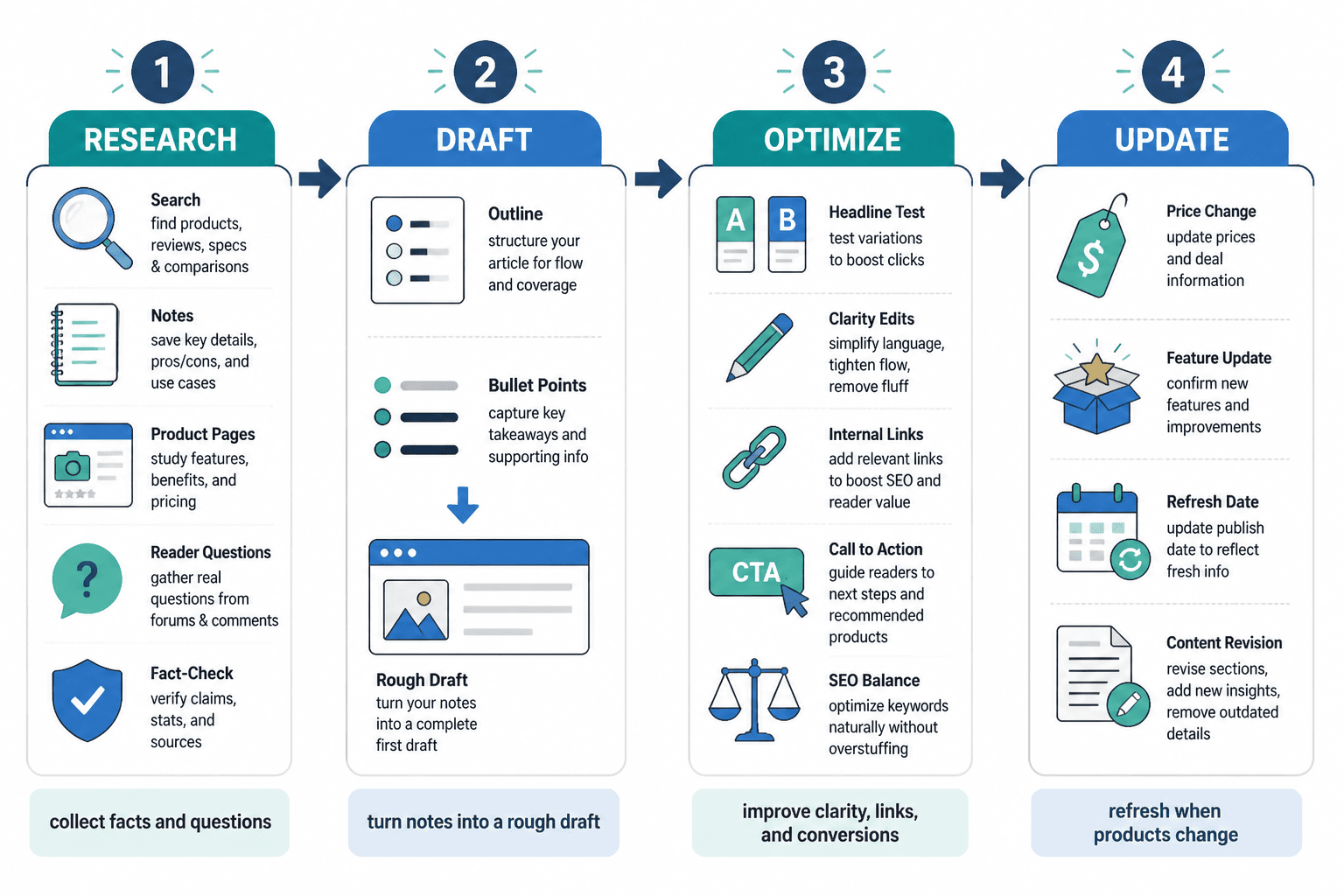
The best AI tools for affiliate articles by job, not hype
If you’re trying to choose one magic platform, you’re already making this harder than it needs to be. Different tools tend to be better at different parts of the workflow. That’s a lot more useful than pretending there is one perfect dashboard for everything.
1. AI writing assistants for rough drafting and rewrites
This is the most obvious category, and also the one people misuse the most.
A writing assistant is good for taking your messy notes, bullet points, product specs, opinions, and article structure and turning them into a workable draft. It is also good for rewriting clunky paragraphs, trimming repetitive sections, generating alternative openings, and helping you test a few ways to explain the same point.
It is not good at replacing expertise. If you ask it to write “Best email marketing tools for creators” with no point of view, no product context, and no criteria, you’ll get the exact kind of article readers bounce from instantly.
Use this category when you already have:
- A clear article angle
- Your product list
- Your evaluation criteria
- Real notes or source material
- A decent understanding of who the article is for
Best use cases:
- Turning comparison notes into paragraphs
- Rewriting repetitive sections
- Generating headline and subheading options
- Drafting product summaries from your own notes
- Creating first-pass conclusion and CTA variations
If you want the output to sound like you, feed the tool your voice and your judgments. Otherwise you get AI oatmeal: smooth, warm, and somehow still disappointing.
2. AI research tools for SERP mapping, question mining, and topic coverage
Affiliate articles live or die on usefulness. That means you need to know what readers are actually trying to figure out before they buy, compare, switch, or sign up. Research tools help with that.
The good ones can help you spot:
- Common comparison angles
- Reader questions people keep asking
- Missing subtopics in top-ranking articles
- Related search intent around alternatives, pricing, use cases, and pros and cons
- Patterns in how competing articles are structured
This does not mean you should clone the SERP. Please don’t. That’s how you end up with ten near-identical “best tools” posts that all sound like they were generated inside the same beige storage unit.
Instead, use AI research tools to understand what readers need covered, then add your own angle. Maybe your article is for beginners. Maybe it’s for coaches. Maybe it’s for creators on a budget. Maybe it’s specifically about tools with affiliate dashboards that are not a complete mess. That angle matters.
3. AI outlining tools for comparison posts and buyer-intent articles
A lot of affiliate content is structurally bad long before the writing fails. The article meanders. The criteria are unclear. The products are introduced in random order. The comparison section is half-baked. The CTA appears like it got lost and wandered into the article by accident.
Outlining tools are useful because they give shape before you burn time on prose.
For affiliate articles, a solid structure often looks something like this:
- Who this article is for
- How the tools were evaluated
- Quick comparison table
- Best overall or best by use case
- Individual tool breakdowns
- Who should choose what
- Common mistakes when picking a tool
- FAQ
- Final recommendation or next step
AI can help you build that skeleton quickly. Then you can focus your energy where it matters: adding nuance, examples, proof, and useful buying guidance.
4. AI optimization tools for clarity, on-page polish, and updates
This is where AI starts becoming genuinely profitable instead of merely convenient.
Affiliate articles get stale. Features change. Product positioning changes. Screenshots age badly. Competitors release new plans. Your recommendation order may need to shift. AI optimization tools can help you refresh older pieces without rewriting the whole thing from scratch.
Useful jobs here include:
- Finding outdated sections
- Suggesting internal links
- Tightening bloated paragraphs
- Improving title and meta options in your draft process
- Surfacing repeated language
- Flagging sections that need more detail or clearer headings
If you publish affiliate content regularly, update support matters more than people think. A decent article does not just need to be written. It needs to stay useful.
5. AI tools for CTA testing and conversion copy variants
Most affiliate CTAs are bad in one of two ways. They’re either flat and forgettable, or they sound like they were stolen from a sweaty sales page.
AI can help here by generating multiple CTA variants based on intent. For example:
- Low-friction CTA for comparison readers
- Stronger CTA for readers ready to choose
- Soft CTA for people who need a demo or trial first
- Contextual CTA based on product type or audience need
That said, the tool does not know your trust threshold. You do. If the article is informational, a softer CTA usually fits better. If the article is “ConvertKit vs MailerLite for creators,” the reader is closer to action, so a more direct CTA can make sense.
A good affiliate CTA feels like guidance. A bad one feels like the article was just a hallway leading to a checkout link.
How to choose the best AI tools for affiliate articles for your workflow
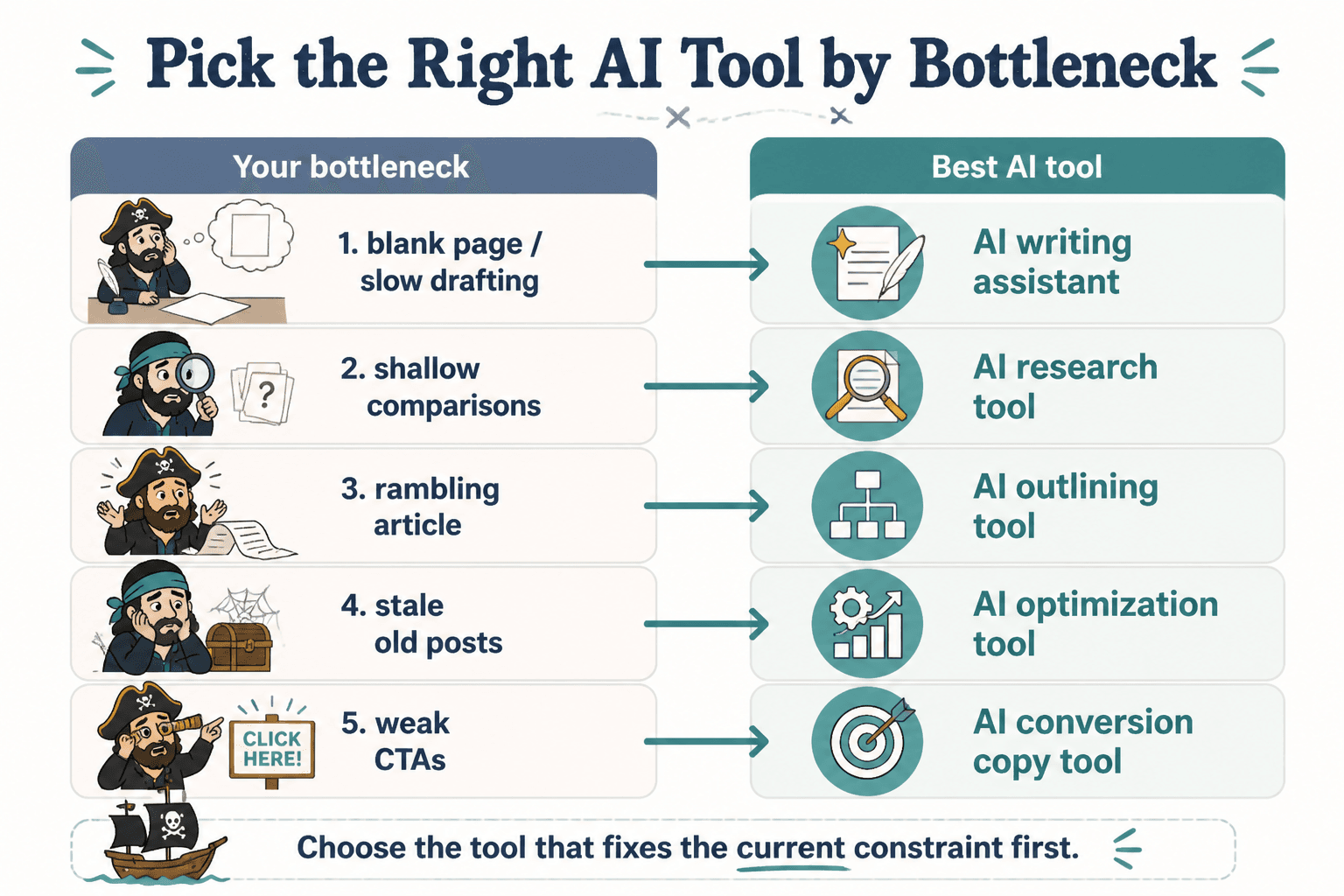
Do not choose tools by feature count. Choose them by bottleneck.
If drafting is easy for you but research is messy, get a research-focused tool. If you know your products well but struggle to turn notes into readable comparison copy, use a drafting assistant. If your archive is growing and old affiliate posts are starting to rot, choose something that helps with updates and optimization.
Here’s a cleaner way to decide:
| Problem | Best tool category | Why it helps |
|---|---|---|
| You stare at a blank page too long | AI writing assistant | Turns notes and prompts into rough drafts fast |
| Your comparisons feel shallow | AI research tool | Surfaces angles, questions, and missing subtopics |
| Your articles ramble | AI outlining tool | Gives shape before drafting |
| Old posts go stale | AI optimization tool | Makes updates and refreshes easier |
| Your CTAs underperform | AI conversion copy tool | Helps generate and test better CTA wording |
If you’re still building your process, pairing this with best templates and tools for affiliate articles will make the workflow much easier to repeat.
What AI tools can do well in affiliate content
There is a sensible, useful middle ground between “AI ruins content” and “AI writes my business now.” That middle ground is where most creators should be.
AI tools are genuinely strong at:
- Summarizing your product notes into draft-ready sections
- Creating multiple headline and subheading options
- Reformatting messy notes into cleaner comparisons
- Expanding thin drafts into fuller sections when you already know the point
- Compressing overlong sections that need tightening
- Generating FAQ ideas from article context
- Repurposing one article into emails, social posts, and snippets
- Refreshing older posts with new angles or updated phrasing
That last one matters more than it gets credit for. A good affiliate article often has more value over time than at launch, especially if the search intent is stable and the products remain relevant. AI can help you maintain that asset without turning every update into a weekend project.
What AI tools cannot do for affiliate articles
This is the part too many tool roundups politely mumble through.
AI tools cannot:
- Tell if a product is actually good from lived use
- Know which tradeoffs matter most to your audience without being told
- Create real trust if your content has no proof, no judgment, and no specificity
- Fix weak positioning
- Rescue an article built around a boring or lazy angle
- Guarantee rankings
- Guarantee clicks
- Replace editorial judgment
If your article says every tool is “powerful,” “seamless,” and “great for businesses of all sizes,” congratulations, you have written nothing. AI did not cause that alone, but it certainly makes that kind of emptiness easier to mass-produce.
Affiliate content works when readers feel guided by someone who understands the category, sees the tradeoffs clearly, and is trying to help them make a decent decision. Tools can support that. They cannot fake it convincingly for long.
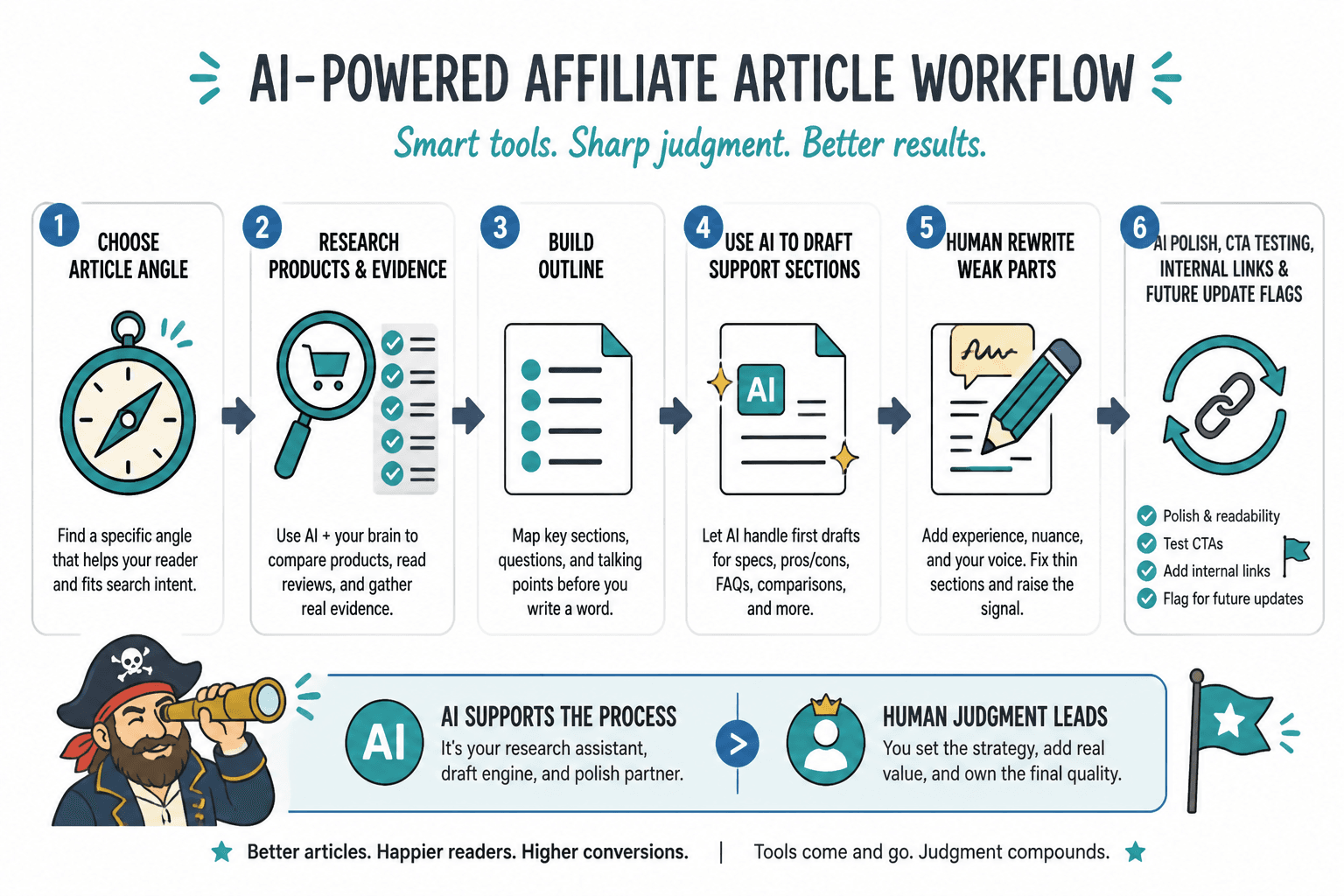
A practical AI workflow for writing affiliate articles
If you want a clean process, use AI across the workflow instead of forcing it to do everything at once.
Step 1: Define the article angle
Before any tool touches the piece, decide:
- Who the article is for
- What they are trying to choose
- What criteria matter most
- What your point of view is
Bad input creates boring output. Annoyingly simple, but true.
Step 2: Use research tools to map search intent and product questions
Pull common questions, competitor patterns, comparison angles, and decision-stage concerns. Then trim the fluff. Not every discovered keyword needs its own section.
Step 3: Build the structure first
Create the outline before drafting. This prevents the classic AI-assisted mess where every section repeats the same generic praise with slightly different wording.
Step 4: Draft from notes, not from nothing
Feed the AI your criteria, observations, comparisons, and intended tone. Ask it to draft sections from your material, not invent content from a vague prompt.
Step 5: Rewrite the weak bits yourself
This is where quality happens. Fix the intro. Sharpen the recommendations. Cut fake certainty. Add specific use cases. Make your CTA sound like a person, not a funnel intern.
Step 6: Use AI for polish and updates
After the article is solid, use AI to tighten sections, test CTA variants, improve internal linking, and flag update opportunities later.
If you want the writing side dialed in first, read how to write better affiliate articles. The tools help more when the underlying article strategy isn’t flimsy.
Common mistakes people make with AI affiliate article tools
Some of these are tool problems. Most are operator problems.
- Using AI before deciding the article angle. The result is usually broad, generic, and weirdly slippery.
- Publishing drafts with made-up details. If the tool invents features, pricing, or integrations, that is on you to catch.
- Copying the top-ranking article structure too closely. Research should inform your article, not flatten it.
- Letting the voice go fully synthetic. People can feel that sterile, over-smoothed tone.
- Overstuffing “best” articles with too many products. More options do not always make a better article. Sometimes they just make a muddier one.
- Using the same CTA under every product. Different products solve different needs. The CTA should reflect that.
- Forgetting maintenance. A stale affiliate article quietly loses value while you are busy publishing new ones.
If you’re also building the rest of the stack around these articles, best affiliate plugins and creator ops tools for affiliate articles is the next logical read.
The smartest setup is usually a small stack, not a giant one
You do not need nine dashboards and a paid subscription to every shiny writing app with “copilot” in the name.
For most creators, consultants, niche site owners, and personal brands, a solid setup is usually:
- One AI writing tool for drafting and rewrites
- One research or SERP analysis tool for topic coverage
- One optimization or editorial tool for updates and on-page cleanup
- Your normal publishing stack for links, formatting, and tracking
That’s enough to materially improve speed and consistency without making your process ridiculous. The more complex your stack gets, the more likely you are to spend half your time managing the system instead of publishing useful work.
If your affiliate content overlaps heavily with product reviews, you may also want to read best tool reviews tools for creators in 2026 since review workflows and affiliate workflows overlap a lot, even if the article intent is slightly different.
Where these tools fit inside a monetization system
Affiliate articles are not just isolated SEO pieces. At least, they shouldn’t be.
Used well, they sit inside a broader content and monetization system. Someone finds a comparison article, gets a useful answer, clicks through to a tool, maybe joins your email list, reads a related review, and starts seeing you as a credible guide instead of just another person shoving links into the internet.
That’s why tooling matters, but only in context. AI helps you produce and maintain the content asset. It does not replace the asset strategy. If you’re mapping that bigger picture, browse the broader monetization funnels and money content paths around affiliate articles too.
Quick FAQ
Can AI write affiliate articles by itself?
It can produce a draft by itself. That is not the same as producing a trustworthy, useful, conversion-friendly article.
Are AI-written affiliate articles bad for SEO?
Bad affiliate articles are bad for SEO. AI does not save thin content, and it does not automatically ruin strong content either.
What is the best AI tool for affiliate articles?
Usually, the best one is the one that solves your biggest bottleneck: research, outlining, drafting, optimization, or updates.
Should I use one tool or several?
A small stack usually works better than a bloated one. One drafting tool plus one research or optimization tool is enough for most people.
Can AI help update old affiliate content?
Yes. That’s one of the better uses for it, especially for refreshing comparisons, improving structure, and tightening copy.
Best AI tools for affiliate articles only help if your judgment is doing the steering
The best AI tools for affiliate articles are not the ones that promise full automation. They’re the ones that help you think more clearly, draft faster, structure better, and maintain useful content without burning hours on avoidable busywork.
That’s the real win here. Not “publish 100 articles by Friday.” More like: publish stronger articles, keep them updated, and make better recommendations with less friction.
If the tool helps you say something useful more efficiently, great. If it just helps you flood the internet with interchangeable affiliate sludge, maybe close the tab and reconsider your life choices for a minute.