
Most old content is not useless. It is just unfinished.
A lot of creators, consultants, and niche site owners already have posts, newsletters, tutorials, reviews, opinion pieces, and half-forgotten resource guides sitting around doing absolutely nothing. Then they decide they want affiliate income and assume they need to start from scratch. Usually, they do not.
How to Turn Old Content Into Better Affiliate Articles is mostly a matter of editing with intent. You are not taking a random post and stapling links onto it like a desperate side hustle raccoon. You are finding content that already has relevance, trust, or search potential, then reshaping it into something more useful, more commercial, and still worth reading.
Done well, this gives you three wins at once: faster publishing, better monetization, and stronger articles than the thin affiliate fluff people keep pumping out because they think “best tools” is a personality.
This guide will show you how to spot old content worth repurposing, how to rebuild it into affiliate-friendly articles without wrecking trust, and how to make the finished piece more likely to earn clicks, leads, or sales.
For the full path around this topic, head to the parent guide.
Start with content that already has a buying angle
Not every old piece should become an affiliate article. Some content is informational but has no natural bridge to a product. Some is too broad. Some is so outdated it belongs in a digital museum.
The best candidates usually have one of these traits:
- They solve a specific problem
- They mention tools, platforms, software, books, gear, or services
- They compare options or methods
- They attract readers who are already evaluating what to use
- They rank or could rank for practical search terms
- They get traffic, saves, shares, or replies because they are genuinely useful
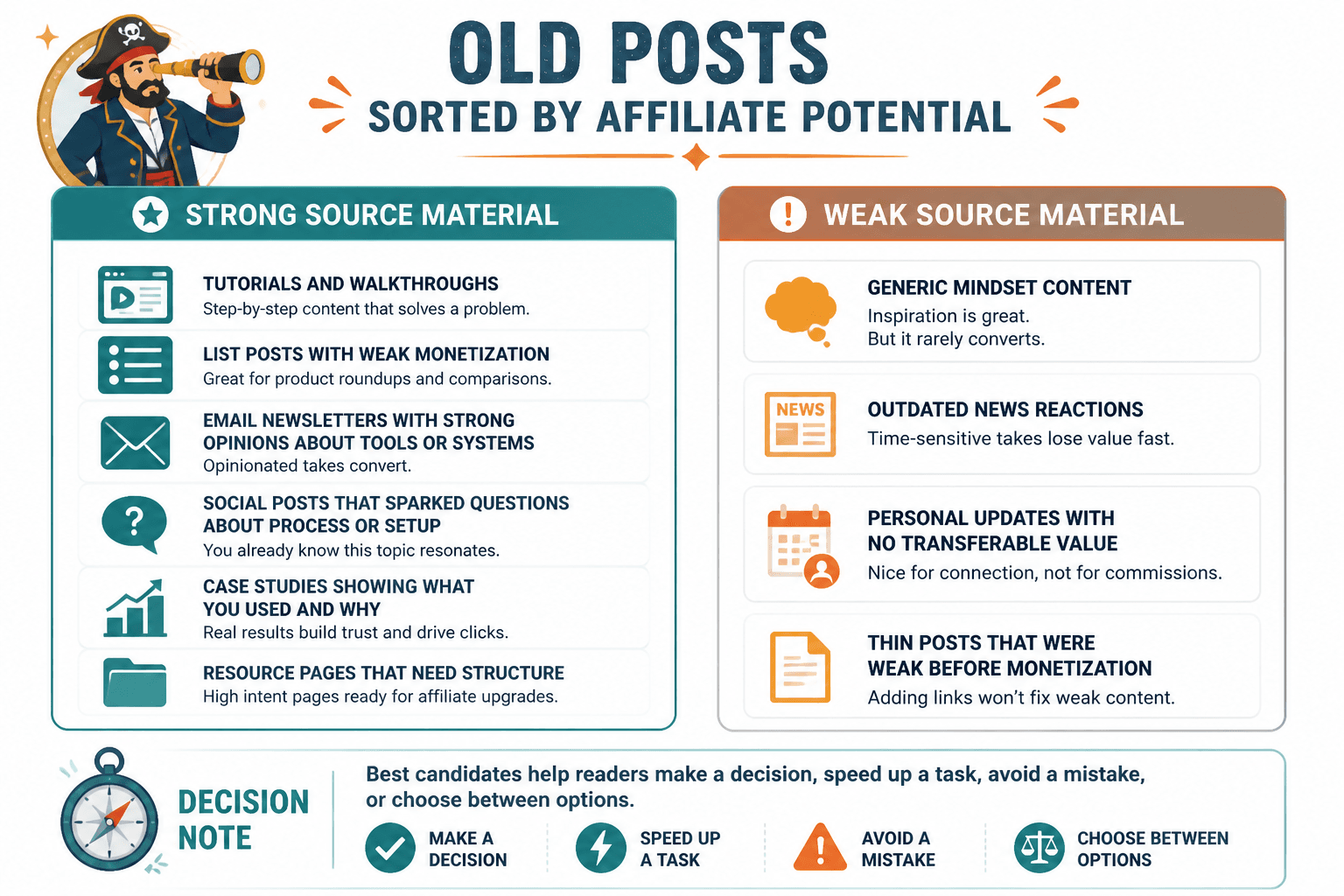
Good source material includes:
- Old how-to blog posts
- Tutorials and walkthroughs
- List posts with weak monetization
- Email newsletters with strong opinions about tools or systems
- Social posts that sparked questions about process or setup
- Case studies showing what you used and why
- Resource pages that need structure
Bad source material usually looks like this:
- Generic mindset content with no clear commercial relevance
- News reactions that aged badly
- Personal updates with no transferable value
- Thin posts that were weak before monetization entered the chat
If the old piece already helps someone make a decision, speed up a task, avoid a mistake, or pick between options, you have something to work with.
Do not “convert” old content until you know the article type
This is where people get sloppy. They decide to “make it affiliate” without deciding what kind of affiliate article they are actually writing.
That matters because a tutorial article, a comparison article, and a product roundup need different structure, different reader intent, and different calls to action.
Common affiliate article types include:
- Tool-in-use tutorial: shows how to do something using a product
- Comparison article: helps readers choose between two or more options
- Best-of roundup: curates options for a specific use case
- Problem-solution article: starts with the pain point, then introduces products as part of the answer
- Review article: gives a detailed take on one tool or product
- Stack or workflow article: explains how several tools work together
An old blog post called “How I Organize Client Work” might become:
- A tutorial on using one project management tool
- A comparison of three tools for consultants
- A roundup of the best systems for managing client delivery
- A workflow article on the software stack behind your business
Same raw material. Very different final article.
If you skip this step, the rewrite usually turns into a mushy hybrid. It sort of teaches, sort of reviews, sort of compares, and fully convinces nobody.
Find the useful core before you touch the monetization
Before adding affiliate links, find the actual point of the original piece.
Ask:
- What problem does this content help solve?
- What decision is the reader trying to make?
- What part still feels useful?
- What is vague, outdated, or padded?
- What products are already implied but not properly integrated?
Then strip away everything that does not support that core outcome.
Old content often has too much throat-clearing, old references, weak examples, and broad advice that made sense when you were just trying to hit publish. Affiliate articles need more precision than that. They have to help the reader move closer to a decision.
That does not mean every paragraph needs to sell. It means every section should help the reader understand the problem, the options, the tradeoffs, or the next step.
A simple extraction process
- Read the old piece and highlight the parts still worth keeping.
- Write one sentence explaining what the new article should help the reader decide or do.
- List the most relevant products, tools, or resources for that outcome.
- Rebuild the structure around the reader’s intent, not the old draft’s order.
- Only then start rewriting.
If you need help tightening weak material before monetizing it, this is a good place to connect it to how to rewrite boring affiliate articles.
Rebuild the article around decision-making, not just information
This is the big shift.
Old informational content often explains things. Better affiliate articles help readers choose. That means your structure should reduce confusion, answer objections, and make the buying path easier without turning the whole thing into a greasy sales page.
A stronger affiliate structure often looks like this:
- Clear intro naming the problem and who the article is for
- Quick context on what matters when choosing
- Recommended options with honest pros, cons, and fit
- Examples or scenarios showing who each option suits
- Practical guidance on what to pick first
- A simple CTA or next step
Notice what is missing: filler definitions, giant history lessons, and vague “top picks” with identical descriptions copied from product landing pages.
Before and after: weak conversion vs better affiliate structure
Before: “Here are some tools I like for writing, planning, editing, and running my business.”
After: “If you need a simple content workflow for solo client work, these are the three tools I’d start with, what each one is actually good at, and where people waste money choosing the wrong setup.”
The second version gives the reader a use case, a filter, and some tension. That is what makes it more clickable and more monetizable.
For broader strategy around stronger affiliate writing, naturally link readers to how to write better affiliate articles.
Add affiliate recommendations where they genuinely help
A better affiliate article is not one with the most links. It is one where the recommendations make sense.
That means products should appear at points where the reader is likely asking one of these questions:
- What should I use for this?
- Which option is better for my situation?
- Is there a simpler way to do this?
- What do you actually recommend?
- What are the tradeoffs?
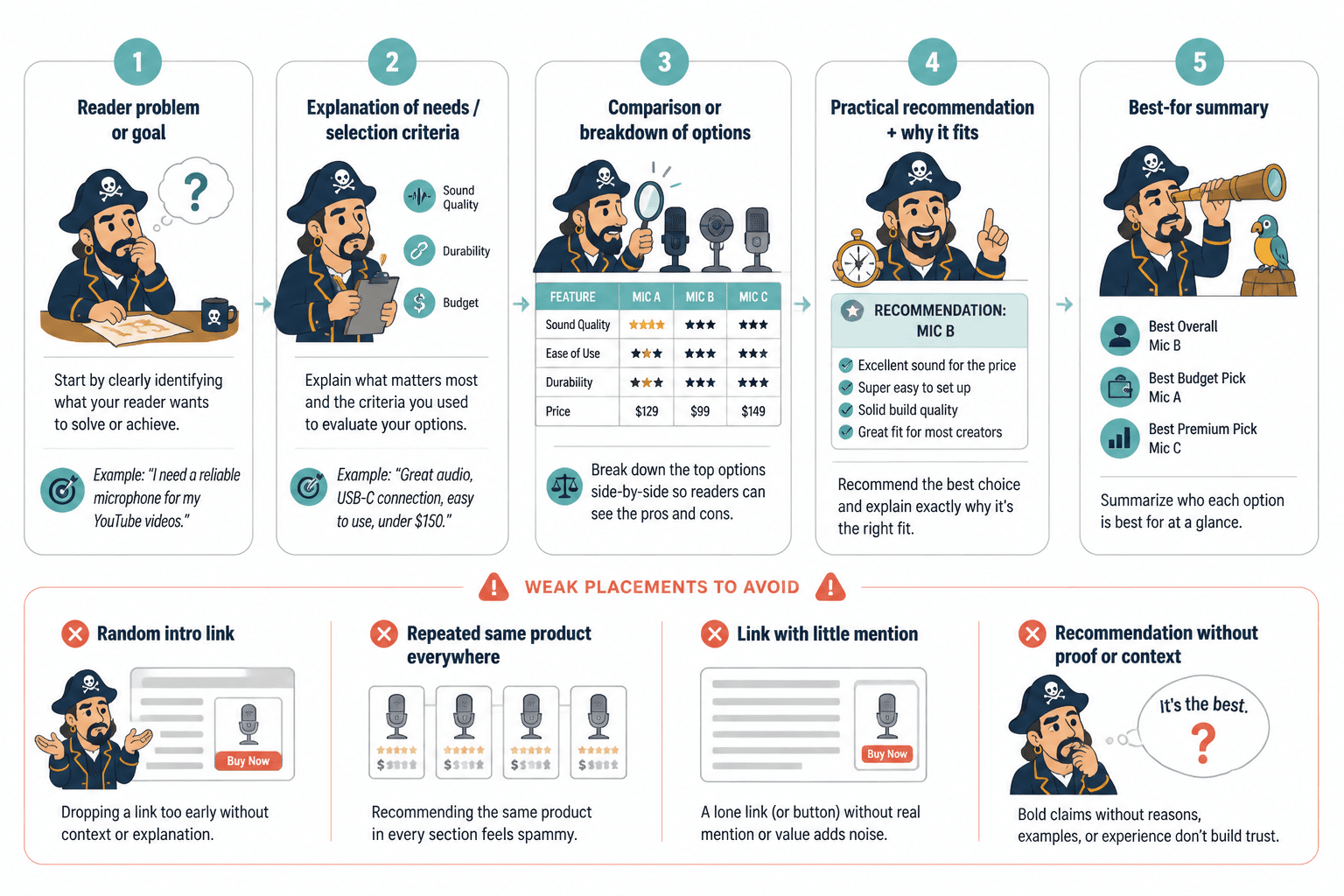
Natural placements include:
- Inside a tutorial step where a tool is needed
- In a comparison table or breakdown section
- After explaining selection criteria
- At the point of a practical recommendation
- In a final “best for” summary
Weak placements include:
- Random links in the intro before trust is built
- Stuffing the same product into every section
- Adding links to tools you barely mention
- Using a recommendation with no explanation, proof, or context
If a tool is worth recommending, explain why. Briefly is fine. But do not act like a blue button and a referral link are the same thing as insight.
Readers are not allergic to affiliate links. They are allergic to lazy recommendations.
Upgrade weak sections with proof, specifics, and fit
Most old content needs stronger detail before it deserves to monetize.
Three upgrades make the biggest difference:
1. Add fit, not just praise
“This is a great tool” is nearly useless.
“This works well if you are a solo creator who wants simple scheduling without a bloated team dashboard” is much better.
Readers need to know who the recommendation is for, who it is not for, and what kind of situation it fits.
2. Add tradeoffs
Honest affiliate articles convert better because they sound like someone with standards wrote them.
Include things like:
- Better for beginners than power users
- More affordable, but less flexible
- Strong reporting, weaker UX
- Great for one-person businesses, overkill for casual use
That kind of specificity helps readers trust the recommendation. It also helps them self-select instead of clicking, bouncing, and regretting it.
3. Add real selection criteria
Do not just list products. Show what actually matters when choosing.
Depending on the niche, that could include:
- Ease of use
- Price and scaling costs
- Features that matter for the use case
- Support and reliability
- Learning curve
- Integrations
- Speed
- Content quality or output quality
This is one reason comparison and roundup posts often beat generic reviews. They help readers make sense of options instead of just hearing you describe one thing in isolation.
Refresh the SEO angle without turning the article into keyword soup
If an old piece already has traffic, be careful. If it has none, you still want a clearer search angle than “my favorite resources.”
Look at the article and ask:
- What is the actual search intent here?
- Is the title too broad?
- Would a reader search for this as a how-to, review, comparison, or best-of term?
- Do the headings match the questions people would ask before buying?
A weak old title might be:
My Favorite Tools for Online Business
A better affiliate-focused angle might be:
- Best Content Planning Tools for Solo Creators
- Notion vs Trello for Freelancers Managing Client Work
- How to Build a Simple Content Workflow With 3 Affordable Tools
More specific angle. Clearer audience. Better buying intent.
If you are updating older reviews or rankings-sensitive posts, also point readers toward how to update old tool reviews without losing rankings.
Keep trust intact while making the article more commercial
This part matters more than people admit.
If a reader feels like a useful old article got turned into a commission trap, they will leave. Worse, they will stop trusting the rest of your content too.
To avoid that, keep these rules in play:
- Only recommend products that fit the article’s purpose
- Be clear about why each recommendation is included
- Do not hide limitations
- Keep educational value high even if nobody clicks
- Use a simple disclosure where appropriate, but do not turn it into a legal performance art piece
A good affiliate article should still be worth bookmarking if every link disappeared. That is a decent test.
If the article collapses without the links, it was not useful enough yet.
Build a better CTA than “check it out”
A lot of affiliate articles die at the call to action. After all that effort, the writer ends with something limp like “You can try it here” and wonders why conversions are sleepy.
Your CTA should match the article type and the reader’s stage of decision-making.
Better CTA styles include:
Better affiliate articles feel more like informed guidance and less like pressure wrapped in formatting. Stronger judgment is usually what makes the monetization work without corroding trust.