
Most LinkedIn posts do not fail because the idea is bad.
They fail because the first line is sleepy, the formatting is messy, and the whole thing reads like someone ran “professional thought leadership” through a blender and poured it onto the feed.
If you are a coach, consultant, or personal brand, your post does not need to be louder. It needs to be clearer, sharper, and easier to read. Good LinkedIn hooks and formatting are not decoration. They are how you get someone to stop, understand the point quickly, and keep reading long enough to care.
This guide will help you write stronger LinkedIn hooks, format posts so they actually get read, and avoid the very common mistakes that make smart people sound weirdly generic online. If your posts are getting polite silence, this is probably where the leak is.
If you want the broader category view first, start here: social media writing and LinkedIn hooks and formatting.
To see how this fits into the wider strategy, open the parent guide.
What good LinkedIn hooks actually do
A LinkedIn hook has one job: earn the next line.
Not impress. Not posture. Not sound deep in a vague, floaty way. Just earn the next line.
For coaches, consultants, and personal brands, the best hooks usually do one of a few things well:
- Call out a specific problem the right people recognize immediately
- Challenge a bad assumption
- Make a useful promise without sounding like bait
- Introduce tension, contrast, or stakes
- Say something concrete enough to feel real
That is why “3 lessons from my journey” is weak, while “Most experts do not need more content ideas. They need stronger packaging” works better. One is diary wallpaper. The other says something.
Most bad hooks do not fail because they are too short. They fail because they say absolutely nothing with confidence.
Why coaches, consultants, and personal brands need a different kind of hook
If you sell expertise, trust matters more than theatrics.
You are not trying to win a prize for dramatic copy. You are trying to make the right person think, “This person understands my problem and probably knows what they are doing.” That changes how your hook should work.
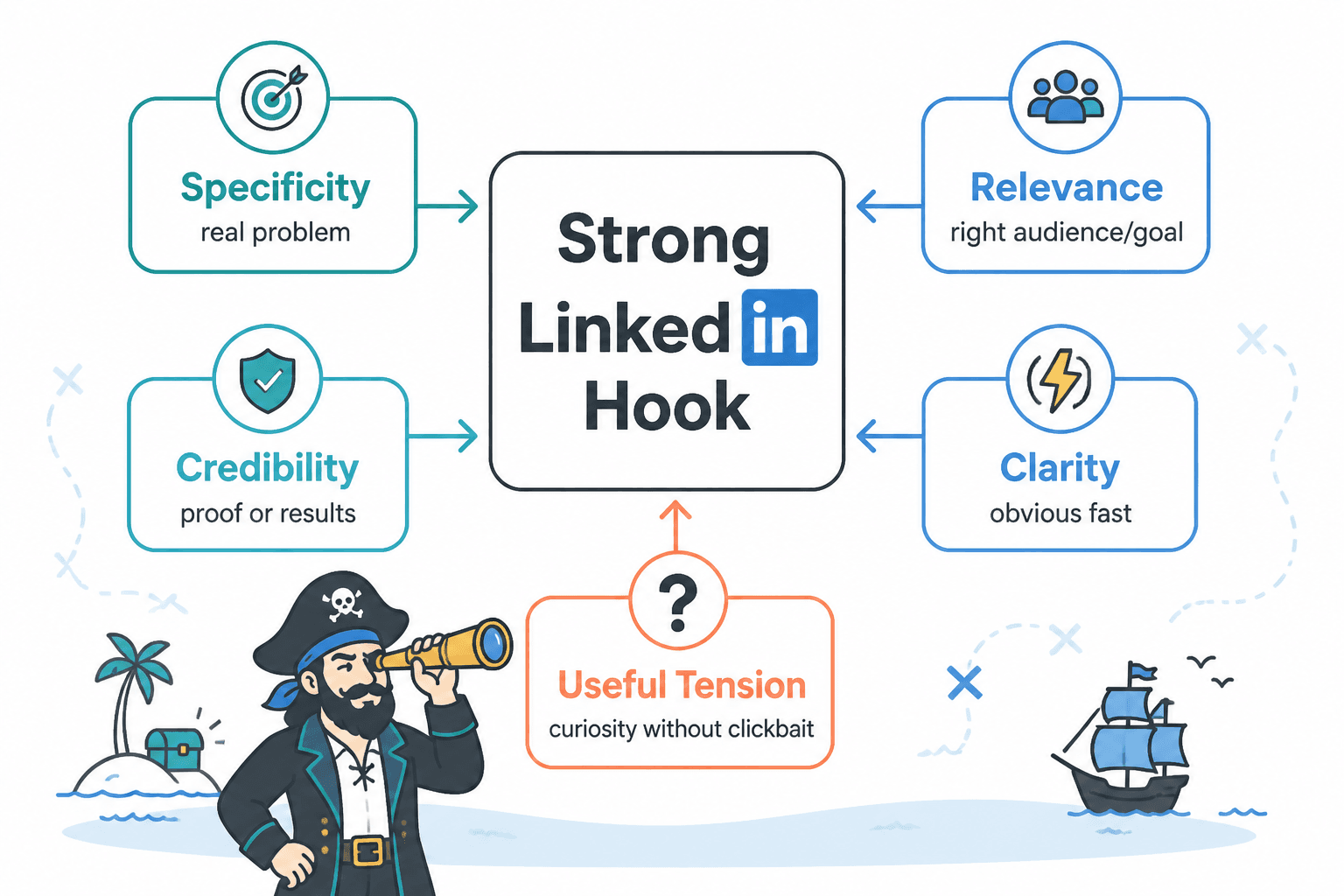
For this kind of audience, the best LinkedIn hooks usually lean on one or more of these:
- Specificity: name the real problem, not a motivational cloud
- Relevance: speak to an audience, use case, or business goal
- Credibility: hint at proof, experience, pattern recognition, or results
- Clarity: make the point obvious fast
- Useful tension: create curiosity without sounding like a tabloid
That also means a lot of popular hook formulas on LinkedIn are overrated. “I’m humbled to share…” is not a hook. “Nobody talks about this…” is usually followed by something everybody has heard 900 times. And “I used to think X, now I think Y” has been worn down to dust unless the contrast is genuinely sharp.
7 LinkedIn hook types that actually work
You do not need infinite originality. You need a handful of strong patterns you can adapt to your ideas.
1. The direct problem hook
Best when your audience is feeling a pain point right now.
Examples:
- Your LinkedIn posts do not need more polish. They need a clearer point.
- If your content gets likes but no leads, the problem probably is not reach.
- Most consultant content dies in the first line because it opens with context nobody asked for.
2. The sharp opinion hook
Best when you have a point of view and can back it up.
- Thought leadership is not dead. Empty thought leadership is.
- Personal branding advice gets weird the second it starts confusing visibility with trust.
- Being “consistent” on LinkedIn is not enough if every post sounds interchangeable.
3. The contrast hook
Best when the difference between bad and good is useful to show.
- Most people write LinkedIn posts to sound smart. The better move is to sound useful.
- Good content is not always long. It is usually specific.
- The problem is not that your post is short. The problem is that it says very little.
4. The proof-led hook
Best when you have a result, pattern, or observation worth trusting.
- I reviewed 100 consultant posts. The same hook mistake showed up everywhere.
- The posts that brought the best leads for my clients were not the longest ones.
- After rewriting dozens of founder bios, one issue keeps wrecking trust fast.
5. The anti-fluff hook
Best when your niche is drowning in cliches and your readers know it.
- Your CTA does not need to sound like a webinar funnel from 2017.
- You do not need a “content strategy” made of 19 color-coded tabs to post something useful this week.
- Most bio advice is obsessed with sounding impressive. It should be obsessed with being clear.
6. The specific lesson hook
Best when you want to teach something practical fast.
- A simple LinkedIn post rule: if the first line could fit on any account, rewrite it.
- One easy formatting fix can make your posts instantly more readable.
- Here is the hook test I use before publishing any authority post.
7. The audience-callout hook
Best when you want relevance to hit quickly.
- Coaches: if your content sounds supportive but never specific, this is probably why it stalls.
- Consultants, stop opening posts with your process before the reader even knows the problem.
- Personal brands: being recognizable is nice. Being understandable is more useful.
Weak LinkedIn hooks vs stronger rewrites
The fastest way to improve is to see the difference.
| Weak hook | Why it flops | Stronger rewrite |
|---|---|---|
| I’m excited to share some thoughts on content strategy. | No tension, no specificity, no reason to care. | Most content strategy fails before the content even gets written. |
| Here’s what nobody tells you about personal branding. | Vague and overused. | Personal branding gets much easier once you stop trying to sound broadly impressive. |
| I used to think consistency was everything. | Predictable setup with weak stakes. | Consistency does not fix bland positioning. It just publishes it more often. |
| 3 lessons I learned as a coach. | Too broad and self-focused. | Three coaching content mistakes that quietly make you sound less credible. |
| Content is king. | Please no. | Useful content beats polished content when trust is the goal. |
Notice what changed. The stronger versions are not trying harder to be clever. They are simply more specific, more opinionated, and more useful.
How to format LinkedIn posts so people actually read them
Formatting matters because attention is fragile. On LinkedIn, even a solid idea can die if it looks annoying to read.
This does not mean every sentence needs its own line like the post is hyperventilating. It means your post should feel easy to scan, easy to follow, and worth the effort.
Use short paragraphs, but not chaos formatting
A good rule: keep paragraphs tight, usually one to three lines.
That gives the reader breathing room without turning the post into a chopped-up pile of fragments. If every sentence stands alone for no reason, the rhythm gets irritating fast.
Messy:
I had a thought.
About content.
And trust.
And why it matters.
Better:
Most trust-building content is not dramatic. It is clear, relevant, and specific enough to feel like it came from someone who has actually done the work.
Front-load the point
Do not spend five lines warming up to your own idea.
LinkedIn readers are not sitting down with tea, ready for your preamble. Get to the point early, then expand. One of the biggest formatting mistakes is using the first visible lines for throat-clearing instead of signal.
Throat-clearing: “Recently, I have been reflecting on conversations I have had with clients…”
Cleaner: “Clients do not usually need more content ideas. They need better angles.”
Use line breaks to control rhythm
Line breaks should help emphasis, pacing, and readability. They should not exist just because someone on LinkedIn told you spacing increases engagement.
Sometimes a standalone line is useful. It can land a point.
Use it on purpose.
Not 14 times in a row.
Lists help when the idea is genuinely list-shaped
Bullet points are great for frameworks, mistakes, examples, and steps. They are not mandatory. If the post is a short opinion or a story with one point, forcing bullets into it usually makes it worse.
Use lists when they create clarity, not because they make the post look “contenty.”
A simple LinkedIn post structure that works
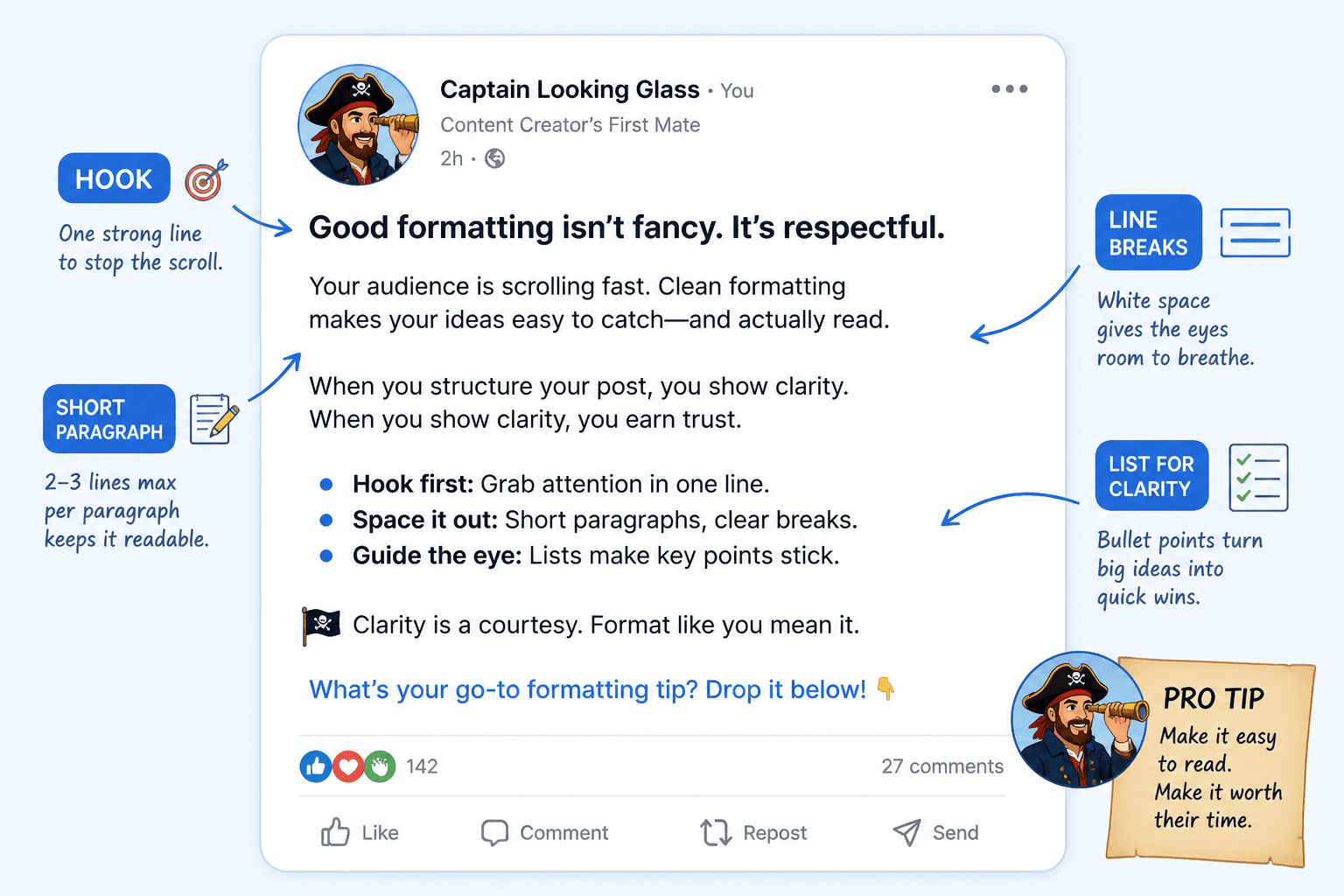
If you tend to overthink, use this structure:
- Hook: say something clear, specific, or sharp
- Context: expand just enough to frame the issue
- Main value: teach, explain, contrast, or show examples
- Takeaway: land the point cleanly
- CTA: invite the next step without becoming a street vendor
Example:
Most consultant content is too eager to sound smart.
That usually shows up in two places: vague hooks and overexplained posts.
If your first line could work for literally any niche, it is probably too generic. And if your post spends half its length circling the point instead of making it, readers leave before your useful part arrives.
A better approach:
- Lead with a problem your audience actually feels
- Use short paragraphs with a clear progression
- Cut the setup and get to the useful bit faster
- End with a CTA that matches the post
Clear beats polished almost every time.
If you want more practical examples, see these LinkedIn hooks and formatting ideas and examples.
Formatting examples for different post types
1. Short opinion post
Hook: Personal branding advice gets worse the moment it becomes performance art.
You do not need a louder voice online.
You need a clearer one.
The strongest posts usually do three things:
- say one thing clearly
- say it with specifics
- say it like a human
Trying to sound impressive is usually what makes the content forgettable.
The bigger point is simple: clearer structure and clearer writing make the piece more useful. That is usually what makes the ending land better too.