Most LinkedIn posts do not flop because the idea is bad. They flop because the hook says nothing interesting and the formatting makes the whole thing look like admin.
Creators love to blame the algorithm, their audience, or the fact that “people just do not read anymore.” Bit dramatic. Usually the real problem is simpler: the first line is weak, the structure is messy, and the post asks the reader to work too hard before they get anything useful.
If you want better LinkedIn performance, better hooks and formatting are not cosmetic extras. They are the packaging around your expertise. And packaging matters. A lot.
This guide will help you write sharper LinkedIn hooks, format posts so people actually keep reading, and avoid the tired patterns that make smart creators sound suspiciously like recycled business wallpaper. If you want a broader hub for this topic, start with LinkedIn hooks and formatting for creators, then come back here for examples you can actually use.
For the main guide behind this topic, visit the parent guide.
Why most LinkedIn hooks fail fast
A hook has one job: earn the next line.
That is it. Not “sound deep.” Not “build intrigue” by being weirdly vague. Not announce that you have thoughts. Just earn the next line.
Most bad hooks fail for one of four reasons:
- They are too vague
- They sound copied from 10,000 other posts
- They start too far from the real point
- They make a promise the rest of the post does not cash
Here are the usual offenders:
- “I used to think…”
- “Here’s what nobody tells you…”
- “Unpopular opinion…”
- “I’m excited to announce…”
- “A thread on…” energy in post form
- Vague drama with no clear takeaway
These are not bad because they are forbidden. They are bad because most people use them lazily. If your first line could fit under almost any post on the platform, it is probably not pulling its weight.
Good LinkedIn hooks usually do one of three things quickly: they make a sharp point, they name a real problem, or they create enough tension that the reader wants the explanation.
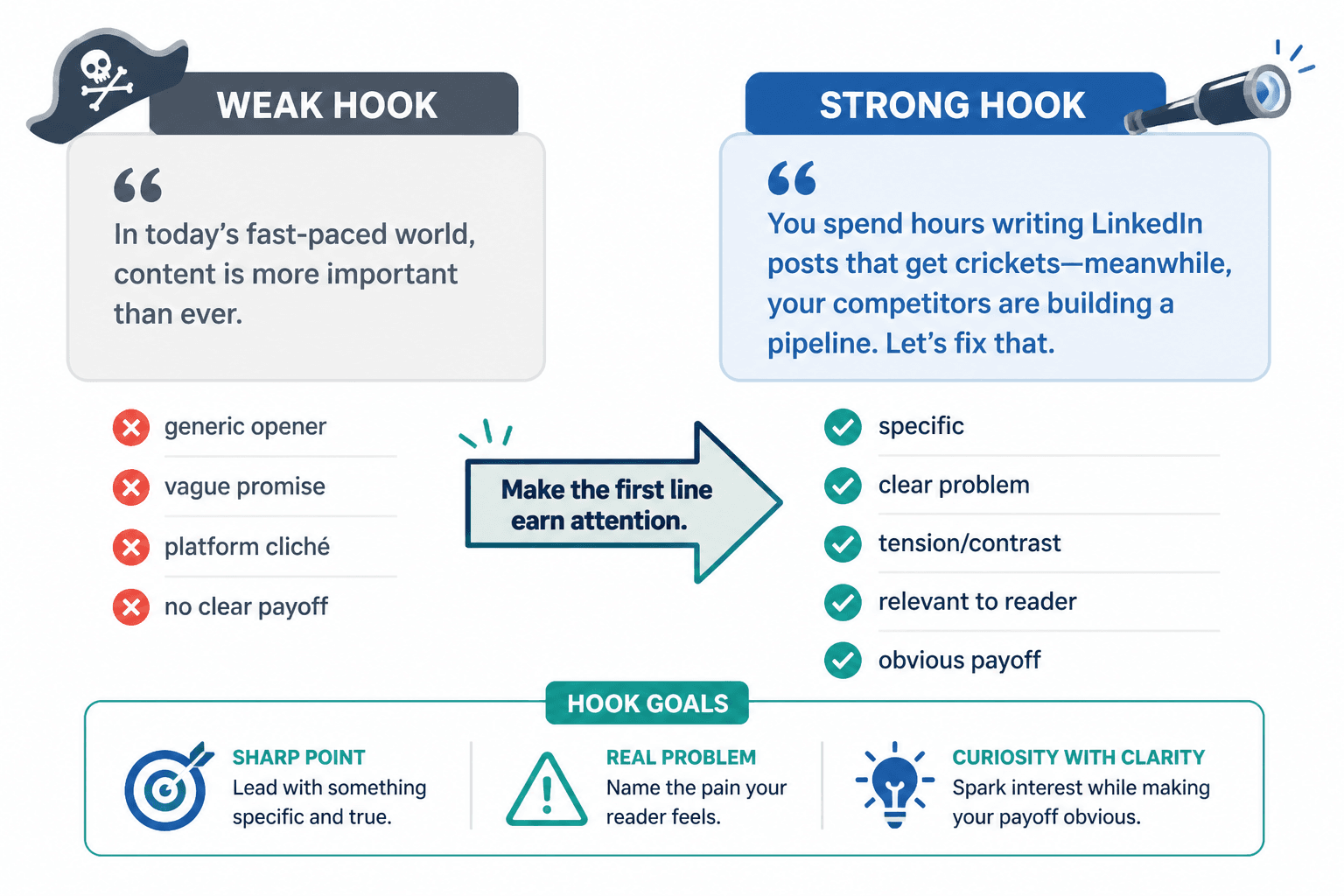
What a good LinkedIn hook actually does
The best LinkedIn hooks and formatting ideas and examples for creators all have one thing in common: they respect attention. They do not waste three lines warming up before the point arrives.
A strong hook usually includes at least one of these ingredients:
- Specificity: not “content strategy,” but “why your useful posts get polite silence”
- Contrast: what people think works versus what actually works
- Tension: a mistake, cost, frustration, or missed opportunity
- Relevance: the reader instantly sees that this is for them
- Clarity: they know what kind of payoff is coming
Notice what is not on that list: trying too hard to sound profound.
LinkedIn rewards clarity more often than cleverness. Clever can help, sure. But clear wins more consistently, especially if you are selling expertise, trust, or a service. If your audience has to decode your opening like it is an escape room clue, you have already lost a chunk of them.
7 hook types that work well for creators on LinkedIn
You do not need 97 hook formulas. You need a handful that fit your voice, your niche, and the kind of trust you are trying to build.
1. The sharp opinion hook
This works when you have a real point, not just a performative hot take.
Most LinkedIn advice about consistency is incomplete. Posting more often will not fix a positioning problem.
Why it works: it creates tension and promises a more useful angle than the usual “just stay consistent” lecture.
2. The painful truth hook
This names the thing your audience is experiencing but maybe not admitting.
If your LinkedIn posts keep getting likes but no leads, you probably do not have a reach problem. You have a relevance problem.
Why it works: it hits a sore spot and suggests the post will explain the real issue.
3. The mistake hook
Simple. Reliable. Especially good for educational posts.
The biggest mistake creators make on LinkedIn is writing posts that sound polished before they sound useful.
Why it works: readers want to know if they are making the mistake and how to fix it.
4. The contrast hook
One of the best formats for showing expertise without rambling.
Good LinkedIn posts do not look more professional. They look more readable.
Why it works: contrast creates snap. It gives the brain something to resolve.
5. The proof-based hook
Great when you have a result, observation, or repeated pattern from client work or content testing.
I reviewed 50 creator posts on LinkedIn. The ones that held attention all did one thing in the first line: they made a clear promise.
Why it works: proof earns attention more cleanly than chest-thumping.
6. The “stop doing this” hook
This can be blunt without becoming obnoxious.
Stop opening LinkedIn posts with throat-clearing sentences that could be deleted without changing anything.
Why it works: direct language cuts through. It also signals that the post will be practical, not fluffy.
7. The mini-revelation hook
This is useful when you want to shift how the reader sees something familiar.
Your LinkedIn hook is not there to impress people. It is there to reduce friction.
Why it works: it reframes the purpose of the hook in a way that feels immediately useful.
LinkedIn hook examples creators can adapt
Templates are helpful. Robotic templates are not. Use these as starting points, then rewrite them so they sound like you and match what the post actually delivers.
For coaches
- Your content does not need more motivation. It needs a clearer point.
- Most coaching posts fail before the second line because the first line sounds like every other coach on LinkedIn.
- If your audience keeps saying “this is so true” but never buying, your posts may be emotionally resonant and strategically useless.
- The fastest way to make your expertise look weaker is to explain it in abstract language.
For consultants
- If your LinkedIn content sounds smart but brings in nothing, the issue is probably not authority. It is packaging.
- Consultants lose good leads when their posts teach ideas without showing judgment.
- Posting insights is not enough. Your reader also needs to see how you think.
- The best consultant posts do not just explain what works. They explain what people keep getting wrong.
For writers and content creators
- Most bad hooks do not fail because they are short. They fail because they say absolutely nothing with confidence.
- If your post starts nicely and ends clearly but still underperforms, your middle might not be the problem. Your first line probably is.
- Good formatting cannot save a weak point. But weak formatting can absolutely bury a strong one.
- The easiest way to make your writing sound more human is to stop sanding every sharp edge off your opinions.
For solo founders and personal brands
- Founders do not need more personal branding content. They need fewer vague posts and more clear stakes.
- If your post could be written by a founder, marketer, coach, or productivity guy in a navy quarter-zip, it is not specific enough.
- Attention is nice. Recognition is better. Recognition means people know why you matter.
- Your LinkedIn content should not just sound credible. It should make the right people think, “This person gets my problem.”
How to format LinkedIn posts so people keep reading
Formatting is not decoration. It is friction control.
People do read on LinkedIn. They just do not enjoy being hit with a dense slab of text that looks like a legal disclaimer had a motivational phase. Good formatting makes your idea easier to enter, easier to follow, and easier to remember.
Here is what usually works best.
Use short paragraphs
One to three lines is usually enough for most LinkedIn posts. Four lines can work if the writing is strong and the sentence rhythm is clean. Beyond that, you are asking for commitment you have not earned yet.
Break on idea shifts
Do not hit enter randomly after every sentence like your post is hyperventilating. But do use line breaks when the idea changes, the emphasis sharpens, or you want a point to land.
Front-load clarity
The first two or three lines need to orient the reader fast. They should know what this post is about and why it matters before they hit “see more.” Mystery is overrated. Controlled curiosity works better.
Use lists when the idea benefits from them
If you are naming mistakes, steps, examples, or contrasts, lists help. But not every post needs them. Some creators turn every idea into a bulleted mini-course and drain all the rhythm out of the writing.
Keep emphasis selective
One sharp line on its own can work beautifully. Six in a row starts to feel theatrical. Same with over-formatting. If every sentence is trying to be the mic-drop line, none of them are.
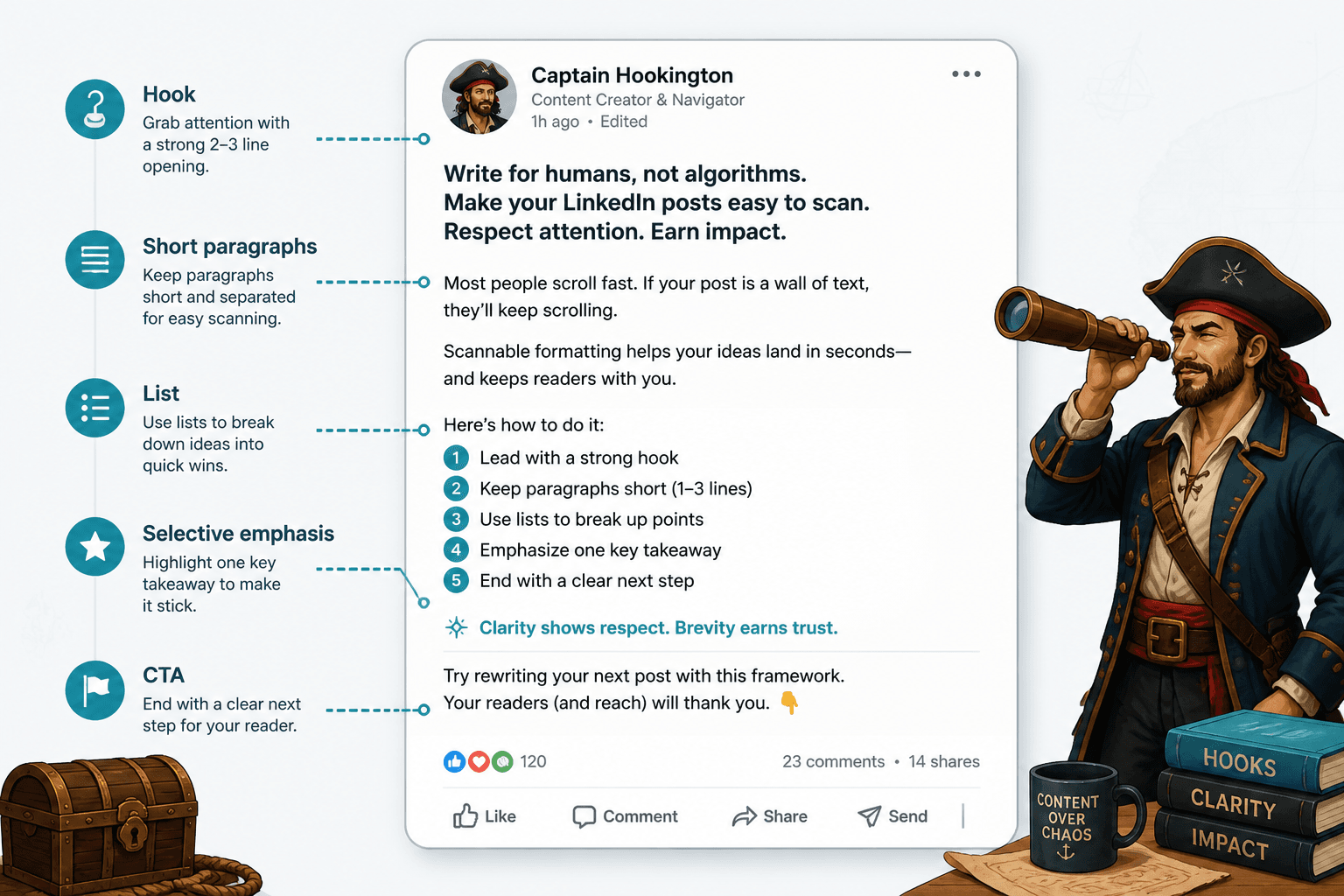
A simple formatting structure that works for most LinkedIn posts
If you want a reliable framework, use this:
- Hook: make the point or tension clear
- Expansion: explain why it matters
- Example or proof: show what you mean
- Takeaway: give the reader a useful conclusion
- CTA: invite the next step without sounding needy
That does not mean every post should feel formulaic. It means your reader should not have to search for the point with a flashlight.
Example structure
Most LinkedIn hooks are too vague to earn attention.
They hint at value without actually saying anything useful.
That is why so many solid ideas get ignored. The insight is fine. The packaging is weak.
A stronger hook makes a clear point, names a real problem, or creates meaningful tension.
If your first line could fit on a thousand other posts, rewrite it.
What hook pattern are you trying to retire from your own writing?
Clean. Readable. No drama fog. No MBA cosplay.
Before-and-after hook rewrites
This is where things usually click. A lot of creators do not need more theory. They need to see the weak version beside the better one.
Example 1
| Weak | Stronger |
|---|---|
| I used to think consistency was the key to LinkedIn growth. | Consistency helps. But it will not save boring positioning. |
Why the rewrite works: it skips the diary entry setup and gets to the useful tension immediately.
Example 2
| Weak | Stronger |
|---|---|
| Here’s what nobody tells you about personal branding. | Most personal branding advice fails because it teaches visibility before clarity. |
Why the rewrite works: “nobody tells you” is usually nonsense. This version gives the reader an actual point worth reading.
Example 3
| Weak | Stronger |
|---|---|
| I’m excited to announce that I’ve been working on something new. | Most launches underperform on LinkedIn for one boring reason: the messaging starts too late. |
Why the rewrite works: unless the audience already cares deeply about your announcement, excitement alone is not a hook.
Example 4
| Weak | Stronger |
|---|---|
| Story time. | A lot of creators think they need better stories. Usually they need better framing. |
Why the rewrite works: “story time” gives the reader nothing. The stronger version tells them what they might learn.
Example 5
| Weak | Stronger |
|---|---|
| Unpopular opinion: authenticity matters. | “Authentic” LinkedIn posts often sound fake because they are engineered for approval. |
Why the rewrite works: the stronger version is more specific, more credible, and a lot less sleepy.
Formatting mistakes creators keep making on LinkedIn
You can have a good idea and still present it badly. Here are the formatting habits that quietly kill readability.
- Opening too slowly: three lines of setup before the actual point appears
- Massive paragraph blocks: hard to scan, easy to skip
- Overbreaking lines: every sentence isolated for drama, which gets exhausting fast
- No visual rhythm: no contrast between short lines, longer explanations, and examples
- List overload: turning every post into a checklist when a paragraph would be stronger
- Soft endings: the post just trails off instead of landing
- Awkward CTAs: “Agree?” or “Thoughts?” after a post that did not invite any meaningful response
A good post has pace. It moves. It does not wobble around the point while hoping the reader is feeling patient.
How to write a CTA that does not sound desperate
The CTA is part of the post, not a weird little appendage stuck on at the end. If the post is useful and the CTA fits the conversation, people do not mind it. If the post feels like a setup for the CTA, they absolutely do.
Good LinkedIn CTAs usually do one of four things:
- Invite a specific response
- Encourage reflection
- Point to a relevant next step
- Open a conversation without forcing one
Better CTA examples:
- What kind of hook tends to work best for your audience: blunt, curiosity-driven, or proof-based?
- If your posts are getting attention but not action, check your first line before you blame the whole strategy.
- If you are reworking your LinkedIn writing, save this and test two stronger hook styles this week.
- I break this down further in this guide for creators who want better results.
Weak CTA examples:
- Thoughts?
- Agree or disagree?
- Comment “HOOK” and I’ll send you something
- DM me if you want to 10x your content game
One of those sounds like a human. The others sound like they escaped from a funnel template and are now roaming the platform unsupervised.
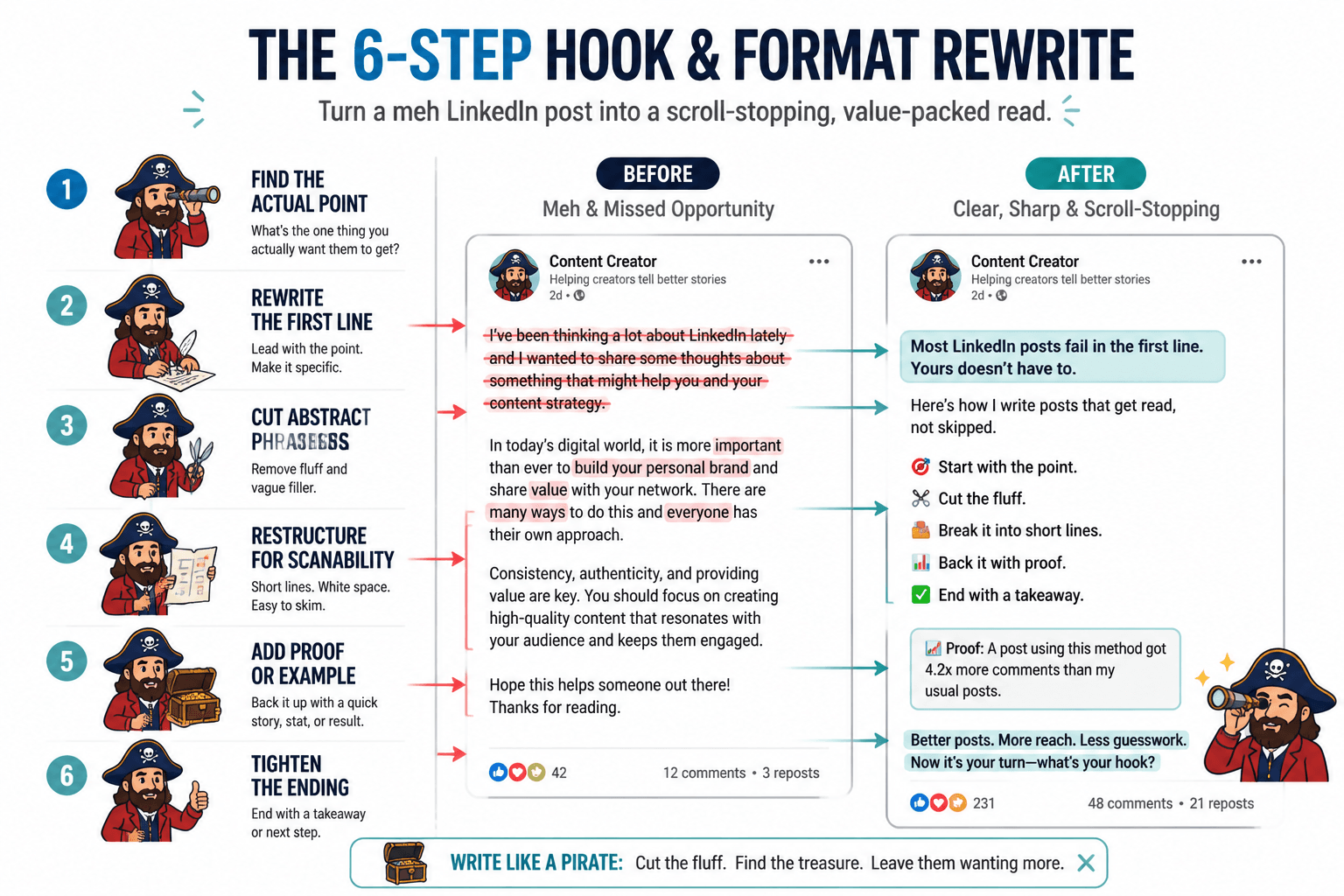
A practical process for improving your LinkedIn hooks and formatting
If your posts feel flat, do not rewrite the whole thing immediately. Diagnose it first.
- Find the actual point. What is the sharpest useful thing this post is saying?
- Rewrite the first line around that point. Remove any warm-up language.
- Cut abstract phrases. Replace “show up authentically” and “build meaningful connections” with concrete meaning.
- Restructure for scanability. Break long blocks. Group related lines. Make the post visually easier to enter.
- Add proof or example. A claim lands harder when it is demonstrated.
- Tighten the ending. End on a takeaway, question, or next step that actually fits.
This process is not glamorous, but it works. A lot of good LinkedIn writing is just patient editing plus decent judgment.
When short posts work and when they do not
Short posts can work beautifully on LinkedIn. But “short” is not the strategy. Sharp is the strategy.
A short post works when:
- The point is clear quickly
- The idea has natural snap or contrast
- You do not need much proof to make it land
- The writing is tight enough that every line earns space
A short post fails when:
- The idea is too broad
- The hook is vague
- The post feels underwritten instead of concise
- The reader needs an example and does not get one
Longer posts are useful when you need nuance, explanation, a story with a payoff, or layered proof. But longer is only better if the structure keeps pulling the reader forward.
The bigger point is simple: clearer structure and clearer writing make the piece more useful. That is usually what makes the ending land better too.