
Most newsletter funnels fail for a very boring reason: the section and the offer do not match.
You write a smart weekly insight, then tack on a random “book a call” button. You share a curated link section, then ask people to buy a premium service that has nothing to do with what they just read. Or you cram every issue with three different calls to action and wonder why nobody clicks anything except unsubscribe.
The fix is not “more funnel.” It is better alignment.
The best funnel ideas to pair with newsletter sections and formats are the ones that feel like the natural next step from the content itself. If a section builds trust, the CTA should deepen trust. If a section creates urgency, the CTA can ask for a decision. If a section teaches something practical, the offer should help the reader apply it.
That is what this article will help you do: match newsletter sections to funnel stages so your newsletter stops acting like a polite content bucket and starts pulling real weight for leads, sales, and conversions.
If you have not nailed your structure yet, start with newsletter sections and formats and then come back. A funnel works much better when the newsletter does not feel like five unrelated thoughts in a trench coat.
For the full path around this topic, head to the parent guide.
Why most newsletter funnel advice is weirdly unhelpful
A lot of funnel advice treats newsletters like one big conversion machine. Put lead magnet here. Insert pitch there. Add urgency. Repeat. Very elegant on a whiteboard. Pretty clumsy in an actual inbox.
Your readers do not experience your newsletter as a flowchart. They experience it section by section. A quick note from you feels different from a case study block. A resource roundup creates a different buying temperature than a personal story. A Q&A section does not earn the same next step as a trend breakdown.
So instead of asking, “What funnel should my newsletter have?” ask, “What next action does this section naturally set up?” That question is much more useful, and a lot less likely to produce those awkward email endings that smell faintly of webinar residue.
How to think about newsletter sections as funnel stages
Each section in a newsletter usually does one of four jobs:
- Attract attention: gives people a reason to care and keep reading
- Build trust: shows your thinking, usefulness, proof, or taste
- Create relevance: connects the content to the reader’s actual problem
- Prompt action: gives them a next step that makes sense now
When those jobs are clear, funnel pairing gets much easier. You stop stuffing the same CTA into every issue and start placing smarter offers in smarter spots.
Here is the simple version:
| Newsletter section type | Main job | Best funnel move |
|---|---|---|
| Personal note or story | Connection and trust | Soft CTA to reply, follow, or join a lower-friction offer |
| How-to section | Usefulness and credibility | Lead magnet, template, workshop, or related service |
| Case study or result | Proof and buyer confidence | Consult call, audit, service page, or product offer |
| Curated links/resources | Taste and consistency | Profile click, archive, waitlist, or low-commitment opt-in |
| Opinion/rant section | Positioning and differentiation | Newsletter upgrade, community, or authority-building next step |
| Q&A or reader problem | Relevance and responsiveness | Reply CTA, diagnostic, consultation, or product fit CTA |
| Product/update block | Direct conversion | Sales page, demo, booking, or checkout |
That is the core idea behind the best funnel ideas to pair with newsletter sections and formats: do not force the sale before the section has done the work.
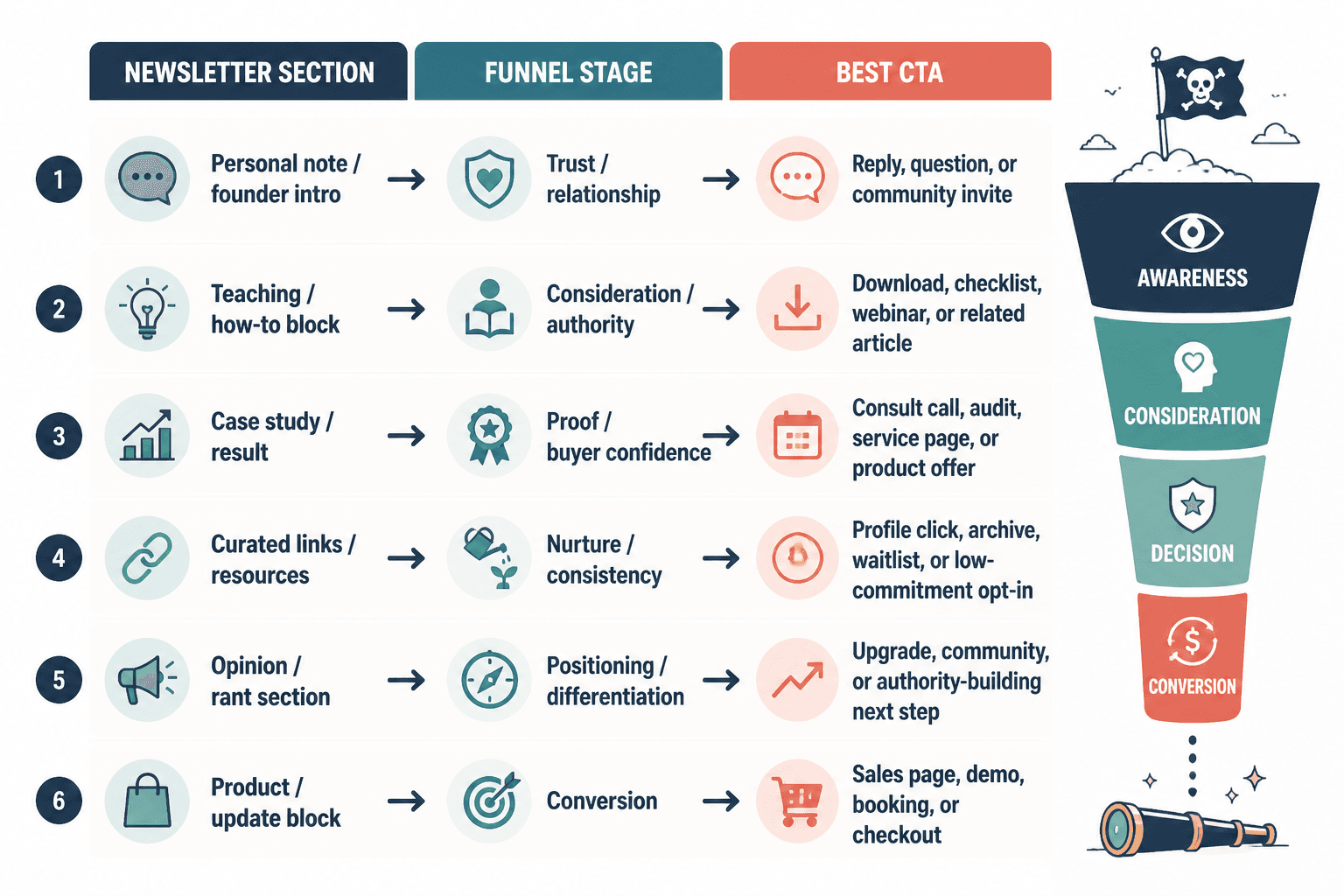
Best funnel ideas to pair with newsletter sections and formats
Now for the useful part. Below are common newsletter sections, what they do best, and which funnel ideas usually fit without feeling needy or random.
1. Personal note or founder-style intro → reply funnel or relationship funnel
A personal opening works when it makes you feel more human, not when it turns into a diary entry your audience did not request. If your intro section shares a lesson, tension, mistake, or perspective, it is great for building closeness and trust.
That means the next step should usually be conversational, not transactional.
- Reply with a question or opinion
- Join a waitlist
- Follow your main platform
- Subscribe to a deeper newsletter tier
- Download a low-friction free resource
Best for: creators, coaches, consultants, personal brands, solo founders
Why it works: the section warms the relationship. A softer CTA keeps the momentum instead of snapping the reader straight into “buy now” mode.
Example:
I spent too long assuming readers wanted more content. Usually they want more clarity. So I cut two sections from this newsletter and doubled clicks on the one that stayed.
If you are trying to simplify your newsletter without making it bland, hit reply with “simplify” and I’ll send over the structure I’d start with.
This is a simple reply funnel. The email opens a conversation, the reply signals intent, and that can naturally lead to a recommendation, offer, or service later.
2. How-to section → lead magnet or template funnel
This is one of the cleanest pairings available. If you teach something in the newsletter, offer a tool that helps the reader use it.
Not a random ebook from 2021. Something actually connected.
- Checklist
- Template pack
- Swipe file
- Prompt library
- Mini workshop
- Cheat sheet
- Diagnostic quiz
Best for: educational newsletters, strategy newsletters, writing newsletters, marketing newsletters
Why it works: the section creates relevance and trust. The free resource gives the reader a practical way to act on the advice. That makes the opt-in feel earned instead of bolted on.
Example:
If your newsletter sections keep multiplying every time you have a new idea, your format is not flexible. It is leaking.
I put together a simple newsletter section planner with 7 reusable layouts. If you want it, grab it here.
If your business model depends on leads, this is one of the smartest paths. You can also expand this approach with how to turn newsletter sections and formats into more leads or sales.
3. Case study section → consult call, audit, or service funnel
Case studies are lower in the funnel for a reason. They provide proof. They show outcomes. They reduce buyer anxiety. So if you have a case study section, stop sending people from it to a vague homepage and hoping for the best.
Send them to the offer that matches the result they just read about.
- Book a consultation
- Request an audit
- Apply to work together
- View the service page
- Join a paid program waitlist
Why it works: the reader is already seeing proof in context. They are much closer to asking, “Could this work for me?” than someone reading a broad educational tip.
Example:
One client cut their newsletter from nine sections to four, clarified the CTA in each issue, and saw replies go up by 38% over six weeks. No fancy automation. Just less clutter and a better ask.
If your newsletter is useful but not converting, you can book a newsletter teardown here.
That is a proof-to-offer jump. Very normal. Very effective. No cartwheel needed.
4. Curated resources section → archive, profile, or nurture funnel
Resource roundups and curated links are good for consistency and taste. They are not usually the strongest direct-sales sections unless the reader is already warm. But they are excellent for nudging people deeper into your ecosystem.
- Visit your newsletter archive
- Read a related article
- Follow your main platform
- Join a topic-specific waitlist
- Subscribe to a more focused email sequence
Why it works: curated sections position you as someone with judgment. That makes readers more willing to consume more of your content. It is a strong nurture move, especially if your sales cycle is longer.
You can strengthen this kind of section by studying more examples in best newsletter sections and formats ideas and examples for creators.
5. Opinion or rant section → authority funnel or community funnel
A sharp opinion section can do a lot of work if it is actually sharp. Not fake controversy. Not “hot take: consistency matters.” That is room-temperature tap water, not a hot take.
Good opinion sections help readers see how you think. That makes them useful for authority building and audience sorting. Readers who agree lean in. Readers who do not were probably not buying anyway.
- Join a paid community
- Reply with their take
- Read a deeper article on the topic
- Join a premium newsletter
- Apply for your cohort or program
Why it works: strong opinions create identity alignment. And identity alignment often matters more than generic “value” when someone decides who to trust.
Example:
Most newsletters do not need more sections. They need one section people would actually miss if it disappeared.
If you like this kind of practical content strategy without the beige fluff, the premium version goes deeper each Friday.
6. Reader Q&A section → diagnostic funnel
Q&A sections are underrated. They make your newsletter feel alive, relevant, and grounded in real problems rather than content calendar theater.
They also create a clean bridge into offers that depend on diagnosis, customization, or problem-solving.
- Reply with your challenge
- Fill out an assessment form
- Book a strategy call
- Request a review
- Join a workshop based on the topic
Why it works: the reader just saw you answer a real question. That lowers perceived risk. You are not just claiming expertise. You are demonstrating it in public.
This is especially useful for consultants, coaches, and service providers who sell clarity more than a fixed product.
7. Trend or analysis section → webinar, report, or lead nurture funnel
If your newsletter includes market analysis, platform updates, or industry shifts, readers usually want one of two things: help interpreting the change, or help applying it. That makes this section a good fit for deeper educational assets.
- Register for a live workshop
- Download a report or brief
- Join an email mini-course
- Read a pillar article
- Book a strategic advisory call
Why it works: trend content raises urgency and relevance. If the next step helps the reader respond intelligently, it feels useful, not pushy.
8. Product or offer section → direct conversion funnel
This one sounds obvious, but people still mangle it. If your newsletter has a dedicated offer block, the offer should be specific, the CTA should be singular, and the copy should not read like it was borrowed from a sales page and shrunk in the wash.
- Buy now
- Book a call
- Start trial
- Apply
- See pricing
- Join waitlist
Why it works: a clear offer section earns its place when the rest of the newsletter has already built enough trust. The mistake is making every section feel like a smaller, more desperate version of the same pitch.
How to match the funnel to the newsletter format
Sections matter, but format matters too. A short personal newsletter behaves differently from a multi-section digest. A tight tactical format supports different funnel moves than a longer essay. Here is how to think about it.
Single-idea newsletter
Best paired with one CTA only. Not two. Not “pick your own adventure.” One.
Best funnel ideas:
- Reply CTA
- Lead magnet
- Direct offer related to the main lesson
- Related article or archive click
Multi-section newsletter
This format can support more than one CTA, but they need hierarchy. One primary action. Maybe one secondary action if it truly fits a separate section. More than that and the whole issue starts feeling like a supermarket shelf.
Best funnel ideas:
- Primary CTA in the feature section
- Secondary nurture CTA in the resource section
- Reply CTA in the closing note
Essay-style newsletter
Longer essays build authority and emotional buy-in. They are usually strongest for premium subscriptions, deeper content products, strategic services, or thought-leadership-style offers.
Best funnel ideas:
- Premium newsletter upgrade
- Consulting offer
- Workshop
- Reader reply for discussion
Curated digest newsletter
Great for nurturing, not always ideal for hard sells. If the whole value is “I filter useful things for you,” then the best next step usually keeps the relationship going.
Best funnel ideas:
- Archive click
- Follow on another platform
- Join a themed list
- Upgrade for premium curation or commentary
For creators with leaner lists, this matters even more. If that is you, read newsletter sections and formats for creators with small audiences. Small audiences do not need more funnel complexity. They need less friction and better fit.
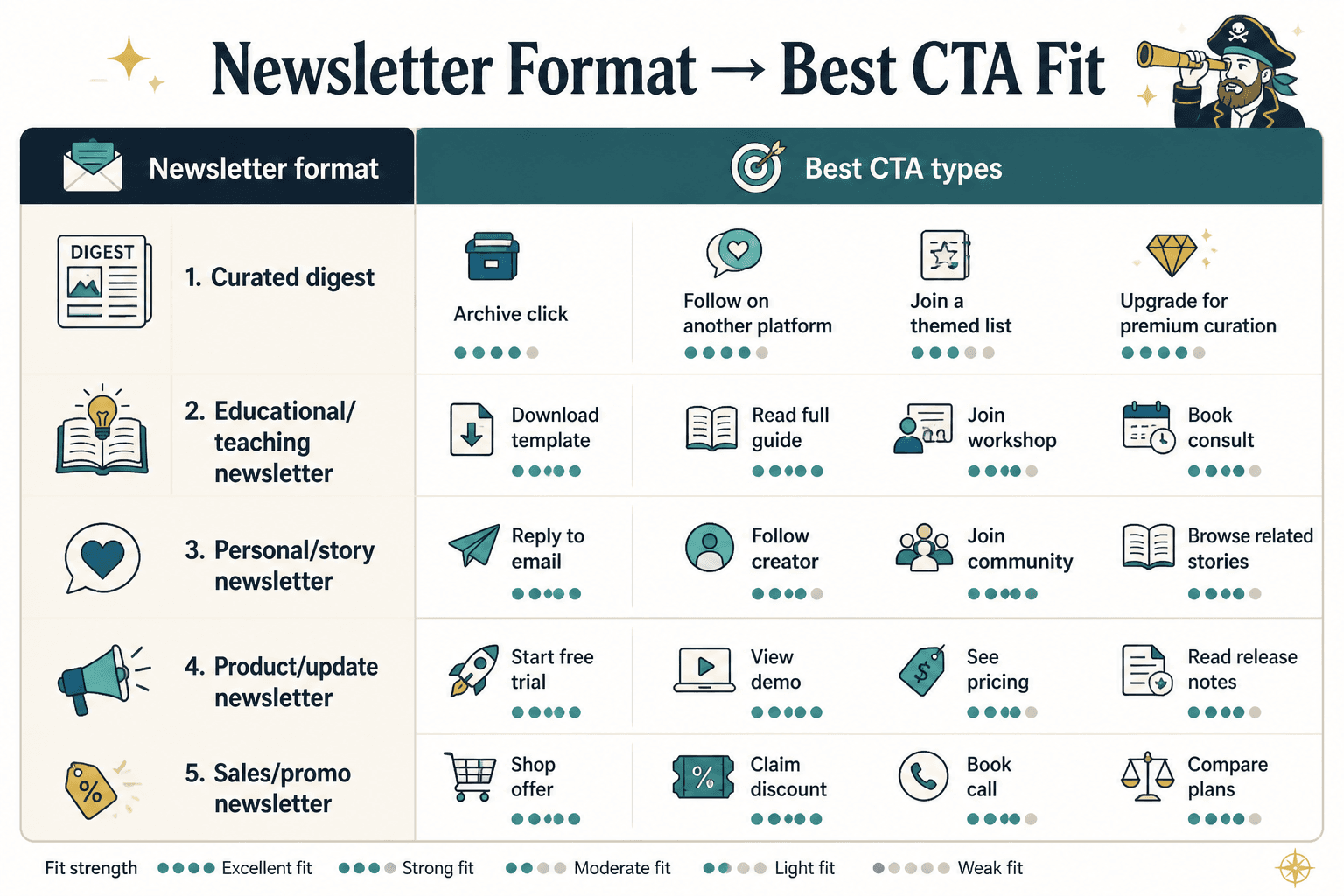
A practical way to build your newsletter funnel without making it weird
If you want a simple system, use this four-step process.
1. Name the job of each section
Ask what the section is actually doing.
- Building trust?
- Teaching?
- Showing proof?
- Starting conversation?
- Selling?
2. Match one sensible next step
Pick the action that fits the reader’s temperature after that section. Not the action you wish they were ready for. The action that makes sense now.
3. Reduce CTA clutter
If your newsletter contains five asks, none of them feel important. Pick one main CTA per issue and let the rest support it lightly, if at all.
4. Track section-level behavior
Do not just measure overall click rate. Track which sections earn replies, which links get clicks, which offers convert, and where readers drop off. A newsletter funnel improves much faster when you know which block is doing the heavy lifting and which one is just taking up space.
This is also where tools help a bit. Not magically, obviously. But the right setup can make segmentation, templates, and link tracking less annoying. If you need that side of the stack, check best newsletter platforms and template tools for newsletter sections and formats.
Common newsletter funnel pairings that look smart but usually flop
Some combinations fail so often they deserve a small public shaming.
- Personal reflection → aggressive sales pitch
Feels abrupt and transactional. - Quick curated links → expensive high-ticket offer
Not enough proof or buying momentum. - Case study → generic “learn more” CTA
Too vague. The reader just saw proof. Give them a direct next step. - How-to section → unrelated product plug
Breaks trust and lowers clicks. - Every section → different CTA
Creates confusion and decision fatigue. - Q&A section → no action at all
Missed chance. Reader interest is highest right there.
A newsletter does not need to monetize every paragraph. It needs the right ask at the right moment.
Three example newsletter funnel setups
Here are a few simple models you can steal and adapt.
Setup 1: Consultant newsletter
- Opening note: short opinion on a common client mistake
- Main section: practical teardown or framework
- Proof section: mini client result
- CTA: book a strategy session
Funnel flow: email → trust → proof → consultation
Newsletter structure works best when each section has one clear job and supports the main point of the issue. Simpler formats usually outperform busier ones when the writing stays sharp.