Most newsletter section problems are not really length problems. They are clarity problems wearing a fake mustache.
People keep asking how long a newsletter intro should be, how many curated links belong in a weekly send, or whether a “main feature” needs to be 300 words or 1,200. Fair question. But the real answer is annoyingly unsatisfying: the right length depends on what that section is trying to do, how much trust you’ve already built, and how much friction you’re adding before the reader gets to the good part.
If you want a useful answer, not a neat fake rule, here it is: newsletter sections and formats in 2026 should be as long as they need to be to earn the next line, the next click, or the next action. No more. Definitely no less.
This guide will help you choose section length based on function, not vibes. We’ll cover what works for intros, main essays, curated links, quick tips, promos, CTAs, and mixed newsletter formats, so your emails stop dragging and start pulling their weight.
If you want the broader framework first, this newsletter sections and formats resource is a solid companion. You can also browse the wider email newsletter writing hub if you’re building the whole machine, not just tuning one bolt.
For the full path around this topic, head to the parent guide.
How long should newsletter sections and formats be in 2026?
Here’s the clean version: most newsletter sections should be shorter than the writer wants and more purposeful than the average inbox allows.
That does not mean every email should be tiny. It means every section should justify its existence. In 2026, readers are still perfectly willing to read longer emails when the writing is good, the structure is clean, and the payoff is obvious. What they will not tolerate is wandering setup, repetitive insight, or a “quick update” that somehow takes six scrolls to say nothing memorable.
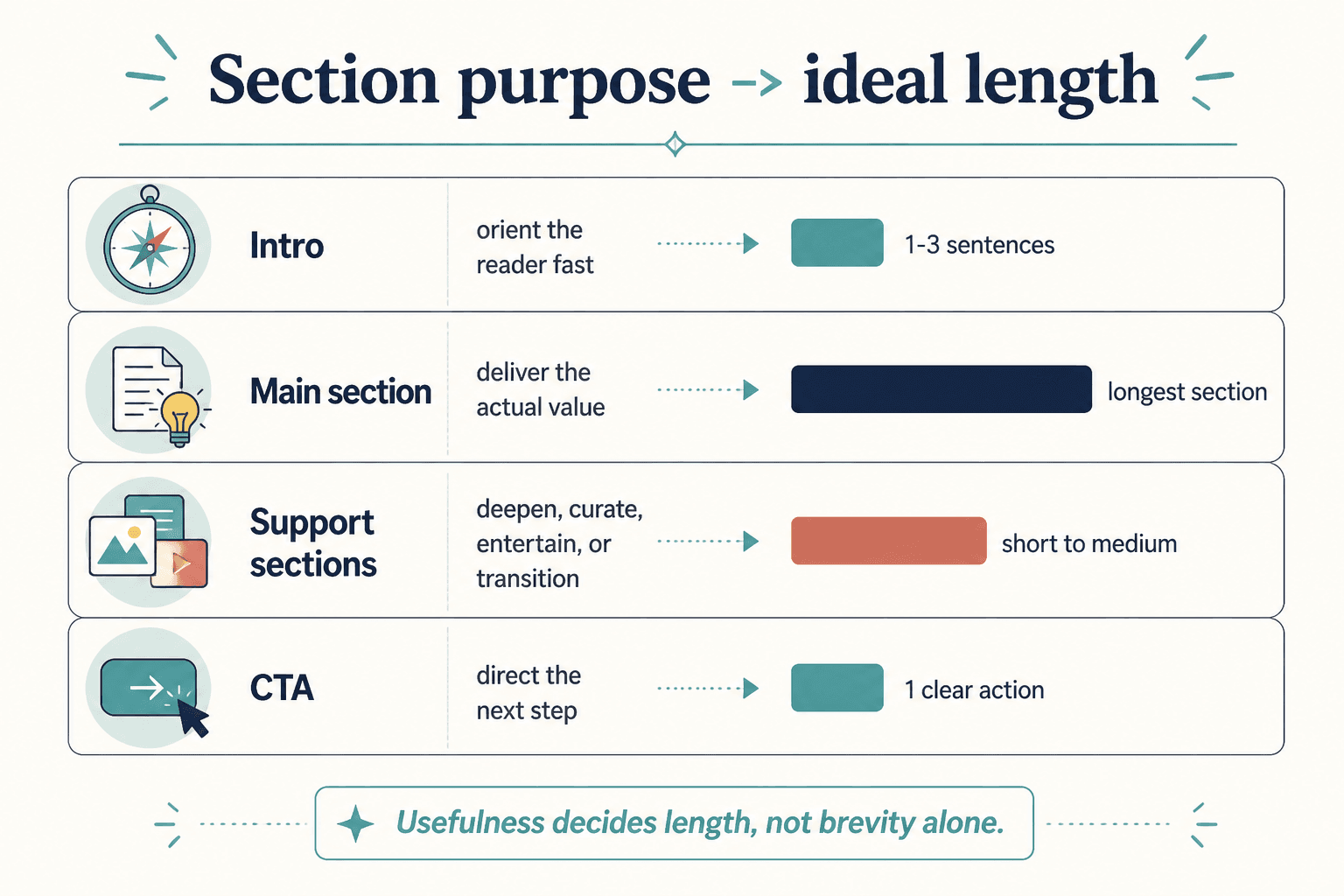
A better way to think about length is by section job:
- Intro: orient the reader fast
- Main section: deliver the actual value
- Support sections: deepen, curate, entertain, or transition
- CTA: direct the next step without sounding like a needy kiosk
If a section is long but useful, keep it. If it is short but vague, it is still bad. Brevity is not a personality trait. It is a formatting decision.
For more on choosing the right format before deciding length, read this guide for creators who want better results.
The real factors that should decide section length
Before we get into practical ranges, let’s fix the common mistake: copying somebody else’s newsletter structure because it “feels professional.” That is how you end up with a bloated intro, three unnecessary sections, and a promo box jammed into the middle like a shopping cart in a living room.
Your section length should depend on a few things.
1. Reader intent
Did people subscribe for thoughtful essays, tactical tips, industry curation, personal commentary, or product updates? The more directly your newsletter matches that intent, the more length you can earn.
If readers signed up for fast insights, a 1,400-word opening essay is not “high value.” It is a mismatch. If they signed up for a strong weekly deep dive, a 90-word fluff note will feel thin.
2. Complexity of the idea
Some ideas need room. A nuanced breakdown, a strategic framework, or a detailed case study can absolutely justify 800 to 1,500 words in one main section. But a simple opinion, reminder, or one useful tip usually collapses nicely into 150 to 400 words if you stop trying to make it sound profound.
3. Format type
A one-section essay newsletter and a multi-section curated newsletter should not be paced the same way. One is read like a short article. The other is skimmed, sampled, and clicked through.
4. Trust and familiarity
People give established writers more room. If your audience already knows your style and expects longer takes, great. If you are still earning that trust, shorter and sharper often works better than longer and “thoughtful.”
5. The next action
If the goal is to get the click, do not bury the link under a self-important monologue. If the goal is trust and authority, the section may need more substance before the CTA appears. The job changes the length.
Practical length ranges for common newsletter sections
These are guidelines, not sacred inbox law. Still, they are useful because most people either overwrite everything or under-explain the important parts.
| Section type | Typical useful range | Best for |
|---|---|---|
| Opening note / intro | 50–150 words | Context, setup, quick personal lead-in |
| Main essay / feature | 500–1,200 words | Deep insight, authority, teaching |
| Quick lesson / tip block | 100–300 words | Tactical value, punchy usefulness |
| Curated link blurb | 20–60 words each | Why it matters, not a full summary |
| Personal update | 50–200 words | Relationship building, context, personality |
| Promo section | 50–120 words | Offer, event, lead magnet, product mention |
| Closing CTA | 1–3 short paragraphs | Reply, click, buy, share, book |
These ranges work because they match how people actually read email. They scan first, then commit. So each section needs a clear shape: easy entry, obvious point, clean exit.
How long should the intro be?
Usually shorter than you think. Around 50 to 150 words is enough for most newsletters.
The intro is not your warm-up lap. It should orient the reader, set tone, and lead cleanly into the main thing. If your intro spends 280 words talking about coffee, weather, or your “crazy week,” congratulations on writing the easiest part of the email for yourself and the least useful part for everyone else.
A good intro can do one of three things:
- name the problem
- frame the lesson
- create a smooth bridge into the main section
Weak intro: “Happy Thursday. I’ve been thinking a lot lately about business, creativity, and how fast things are changing…”
Better intro: “Most newsletters lose readers before the useful part starts. So here’s how to structure sections people actually finish.”
How long should the main section be?
For a feature section, 500 to 1,200 words is a healthy range for most creator newsletters. Go shorter for one clear lesson. Go longer if you are teaching something layered and can hold attention without sounding like you are being paid by the paragraph.
If you consistently run longer than 1,200 words, the section needs one of two things: better pacing or a reason to be that long. Long can work beautifully. Long and repetitive is just expensive reader friction.
If you tend to write short, that is fine too. But short only works when the insight lands quickly. A 220-word section can be excellent if it has a sharp point, a concrete example, and a clean close. It falls apart when it is just a polite cloud of generalities.
How long should curated sections be?
Short. Very short. Usually 20 to 60 words per item.
The job of a curated section is not to summarize the entire internet. It is to help the reader decide what is worth their time. One sentence on what it is, one sentence on why it matters, done.
Bad curated blurbs either say too little:
“Interesting article on branding.”
Or too much:
“This fascinating and deeply nuanced piece explores twelve dimensions of audience trust and reminded me of something Seth Godin once said in 2014…”
Just tell people why you included it.
How long should promotional sections be?
Short enough to feel confident. Long enough to reduce friction. Usually 50 to 120 words.
You do not need a mini sales page inside every newsletter. You need a clear offer, a useful reason to care, and a direct next step. If your promo section keeps bloating, it usually means the offer is muddy or the audience fit is weak.
For help tightening those sections, read how to write better newsletter sections and formats.
Best newsletter format lengths by type
Section length gets easier when you choose the right overall format. The format decides the reader’s rhythm. Then each section can behave accordingly.
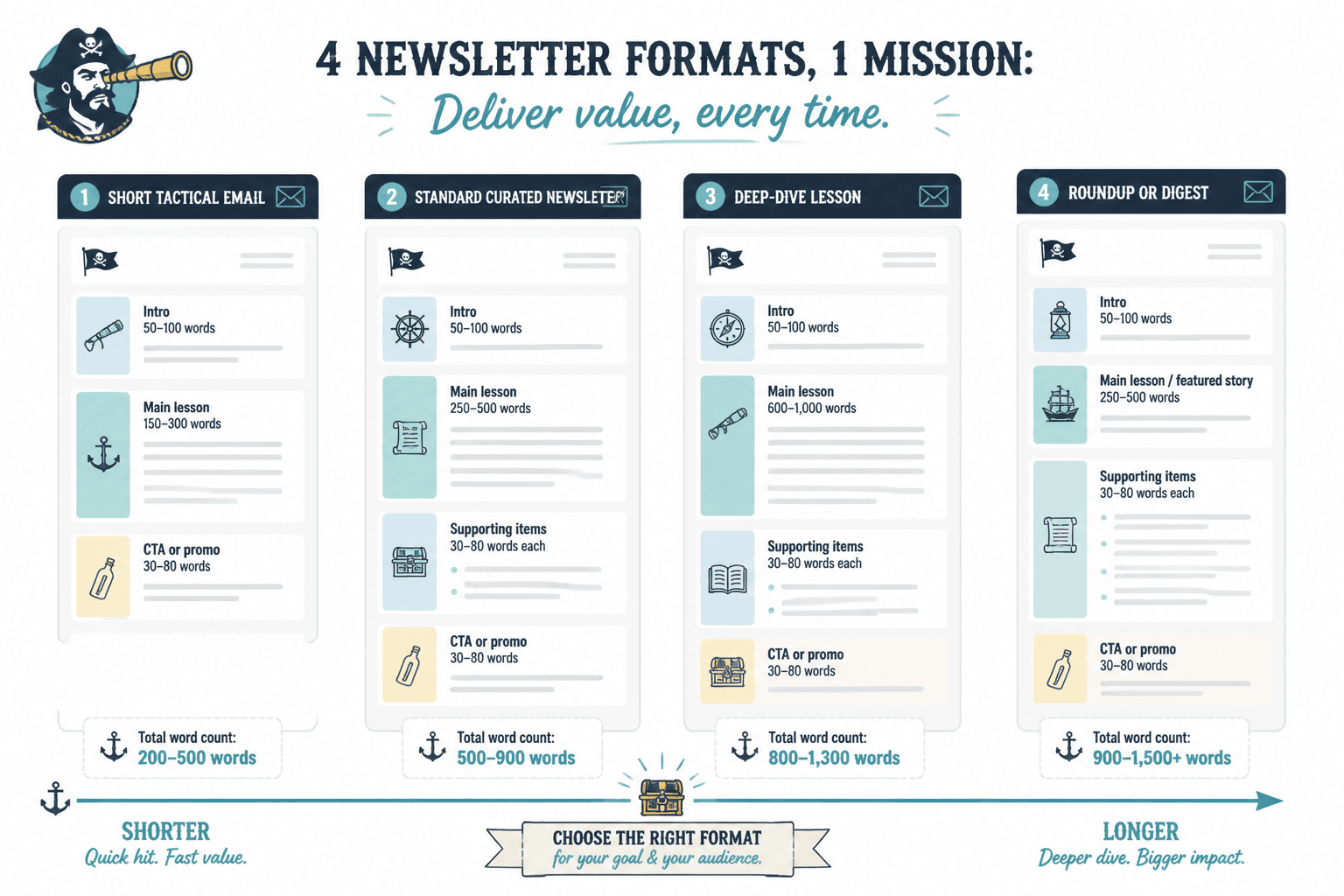
1. The one-big-idea newsletter
This format usually works best at 600 to 1,400 total words.
You open quickly, teach one main idea, then close with a CTA. This is ideal for writers, coaches, consultants, and founders with strong opinions or useful frameworks. It reads more like a short letter or compact article.
Good structure:
- short intro: 50–120 words
- main idea: 500–1,100 words
- CTA: 30–80 words
2. The curated roundup
This usually works best at 300 to 900 total words, depending on how many items you include.
Readers are skimming here. Respect that. Keep the intro brief, the blurbs tight, and the visual structure obvious.
Good structure:
- intro: 40–100 words
- 5–10 curated items: 20–60 words each
- optional short commentary block: 100–200 words
- CTA: 20–60 words
3. The mixed-value newsletter
This one combines a short essay, a few links, maybe a tool, maybe an update. It usually lands best between 500 and 1,100 total words.
This is where people often go wrong. They keep adding “just one more section” until the email feels like a buffet assembled by committee. Mixed formats need stronger editing because every extra block competes for attention.
Good structure:
- intro: 50–100 words
- main lesson: 250–500 words
- 2–4 supporting items: 30–80 words each
- promo or CTA: 30–80 words
4. The short tactical email
This works best around 200 to 500 total words.
Great for creators who want high consistency without writing a weekly novella. One useful takeaway. One example. One action. Done. Short newsletters often outperform longer ones when the value is immediate and the writing does not waffle.
If that sounds more like your style, read when short newsletter sections and formats beat long ones.
How to tell when a section is too long
You do not need heatmaps and ceremony to spot it. Most of the time, a section is too long when one of these things is happening:
- the point could be explained in half the space
- you repeat the same idea with slightly different adjectives
- the useful bit appears late
- the CTA arrives after the reader’s energy already dropped
- you included context that matters more to you than the reader
- the section has no internal structure, so it feels longer than it is
Newsletter structure works best when each section has one clear job and supports the main point of the issue. Simpler formats usually outperform busier ones when the writing stays sharp.