
Weak newsletter openings usually are not weak because the writer lacks ideas. They are weak because the section starts too late, too vaguely, or too politely.
You know the kind. A soft little runway. A few warm-up lines. A gentle “hope you’re having a great week.” Maybe a broad statement about how content matters. By the time the section gets to the point, the reader’s attention has already wandered off to Slack, coffee, or a more interesting tab.
If you want to know How to Start Newsletter Sections and Formats Without a Weak Opening, the fix is not “be more creative.” It is to start with tension, relevance, specificity, and momentum. Your section opening should earn the next sentence. Fast.
This article will show you how to open newsletter sections in a way that feels sharper, more useful, and much less like filler. We’ll cover what makes openings flop, what strong section starts actually do, and a few practical formats you can steal without sounding like a template escaped into your draft.
If you want the bigger picture, start with the parent guide.
Why most newsletter section openings feel weak
Most weak openings have one thing in common: they delay the point.
Instead of beginning with something the reader can use, react to, or get pulled into, they begin with throat-clearing. That might look like context nobody asked for, vague scene-setting, over-explaining, or a bland transition line trying very hard to sound smooth.
Here’s the problem: newsletter readers are not sitting down with a pipe and an hour of uninterrupted admiration for your sentence craft. They are scanning. They are triaging. They are deciding, line by line, whether this section deserves attention.
- Too broad: “A lot of people struggle with consistency.”
- Too soft: “I wanted to share a few thoughts on…”
- Too familiar: “Hope you’re doing well.”
- Too delayed: taking four lines to reach the actual takeaway
- Too generic: opening a section in a way that could fit literally any newsletter
A good section opening does not need drama. It needs direction.
If you’re still shaping the bigger structure of your email, this guide on newsletter sections and formats will help you build a format that does not collapse into a pile of disconnected blocks.
What a strong newsletter section opening actually does
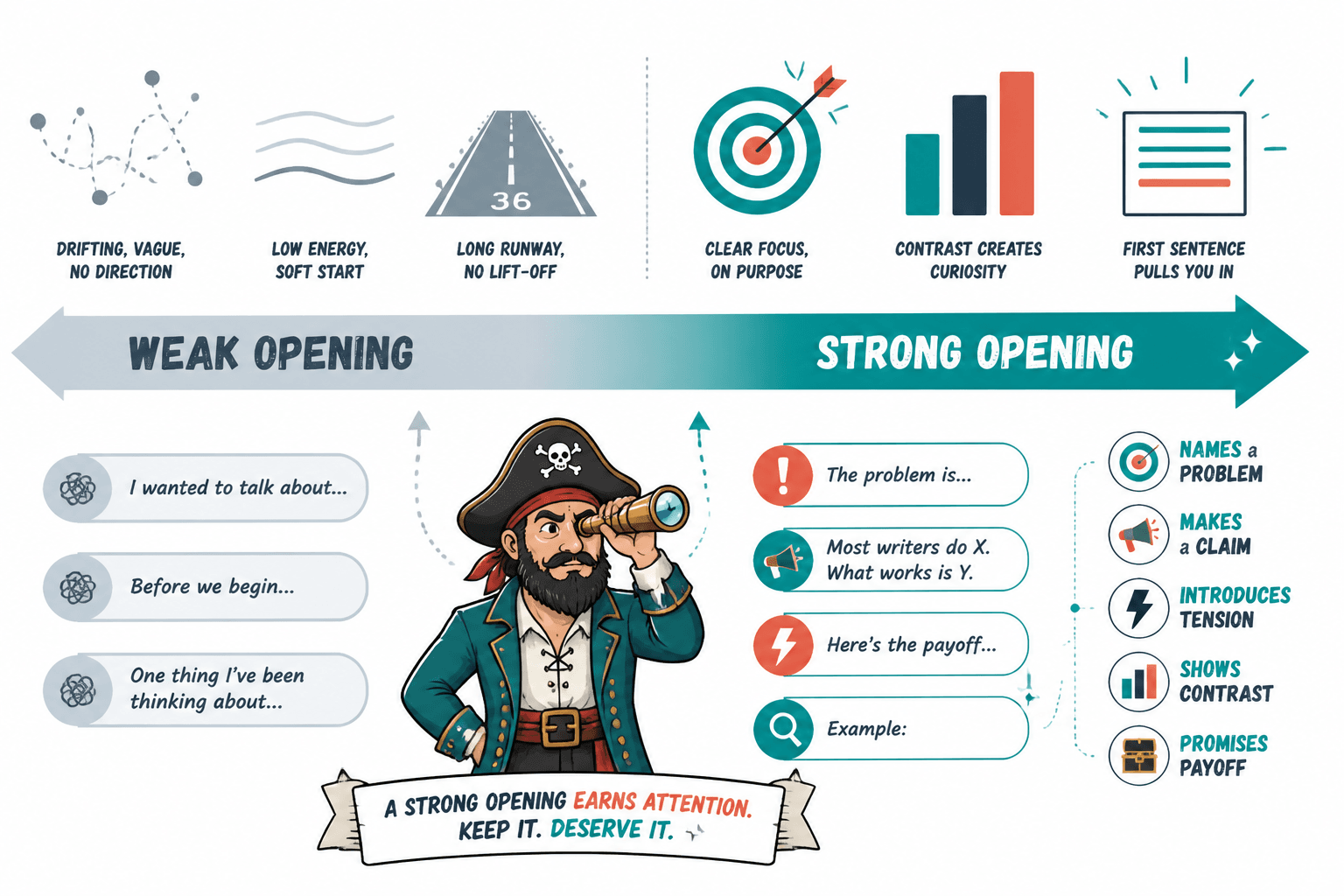
A strong opening usually does at least one of these jobs immediately:
- Names a problem the reader recognizes
- Makes a sharp claim
- Introduces a useful tension
- Shows contrast between what people do and what works
- Promises a clear payoff
- Drops the reader into a concrete example
That does not mean every section needs to sound intense. It means every section should open with purpose.
Think of the opening as a hand on the reader’s shoulder saying, “This part matters, and here’s why.” Not, “Before we begin this section, I’d like to softly announce that a section may now be occurring.”
That second version is how newsletters end up sounding like corporate porridge.
Start with the point, not the runway
The simplest way to improve a weak opening is brutally practical: cut the setup and move the real sentence to the top.
Writers often hide their best line under three smaller, safer lines because they are warming themselves up. Unfortunately, the reader experiences that warm-up as drag.
Example: before and after
Weak: “One thing I’ve been thinking about lately is how many creators struggle to keep their newsletters engaging over time. It can be difficult to know what to include and how to structure each issue. So I wanted to talk a bit about section openings.”
Stronger: “Most newsletter sections do not lose readers in the middle. They lose them in the first line.”
That stronger version gets somewhere immediately. It creates tension. It frames the problem. It earns the next paragraph.
When you are opening a section, ask yourself one useful question: What is the first sentence that would still make sense if I deleted all my warm-up lines?
That sentence usually belongs at the top.
Five reliable ways to start newsletter sections without sounding flat
You do not need a hundred opening formulas. You need a few that actually work and fit the type of section you’re writing.
1. Open with a sharp observation
This works well for teaching sections, commentary, and opinion-led newsletters.
Examples:
- “Most creators are not short on ideas. They are short on packaging.”
- “The problem with most resource sections is not the links. It’s the lazy framing around them.”
- “A clean format can still feel boring if every section opens like a memo.”
Why it works: it gives the reader a position to react to. Agreement, curiosity, friction, interest. Any of those beats indifference.
2. Open with the mistake
This is especially useful when the section teaches a fix or framework.
Examples:
- “The mistake is opening every section like it needs an introduction ceremony.”
- “Most ‘tips’ sections fail because they begin with generic advice instead of a specific problem.”
- “If your section needs three lines of setup, the structure probably is doing too much.”
This format works because readers love seeing the thing they may be doing wrong named clearly. It creates instant relevance.
3. Open with contrast
Contrast gives a section energy. It also helps readers understand nuance fast.
Examples:
- “A short opening can feel strong. A vague opening never does.”
- “Readers do not need more context. They need a reason to care about this part.”
- “Clean formatting helps, but weak section starts will still make a polished newsletter feel sleepy.”
Contrast is one of the easiest ways to create movement without sounding theatrical.
4. Open with a concrete example
If the section teaches something practical, examples are often better than abstract setup.
Examples:
- “Here’s a weak section opening: ‘This week I wanted to share a few resources.’ Here’s a better one: ‘Three resources that will save you from writing the same newsletter intro for the fifteenth time.’”
- “Take these two section starts. One sounds pleasant. The other gets read.”
- “A creator writing a roundup section does not need more polish. They need a stronger first line than ‘I found some interesting things this week.’”
Examples lower friction. The reader sees what you mean instead of decoding your explanation.
5. Open with a promise of payoff
This works well for process sections, tutorials, and resource blocks.
Examples:
- “Use this structure when you want a section to feel useful in the first sentence, not the fifth.”
- “If your newsletter format feels clean but still reads flat, this fix helps fast.”
- “Here’s a simple way to open recurring sections so they stop sounding copied and pasted.”
A payoff-led opening works best when the promise is specific and modest. Do not oversell. Readers can smell a fake drumroll from space.
Match the opening to the section type
Not every section should open the same way. A teaching block, personal note, curated link section, and offer section all need slightly different energy.
| Section type | Best opening angle | What to avoid |
|---|---|---|
| Teaching section | Problem, claim, or mistake | Long setup and generic importance |
| Personal story section | Moment, tension, or specific scene | Rambling context before the point |
| Resource section | Use case or why these links matter | “Here are a few resources I liked” |
| Opinion section | Sharp observation or contrast | Trying to sound neutral and polished |
| Promo section | Relevant problem and clear next step | Sudden pitch with no transition logic |
This is where format matters. Good newsletter structure is not just about where sections go. It is about giving each section the right kind of entrance.
If you want examples of opening blocks you can adapt quickly, read these newsletter opening section examples for creators.
A simple framework for stronger section openings
Here is a practical formula you can use when a section keeps starting weak:
- Name the real point
What is this section actually about? - Find the tension
What problem, contrast, mistake, or useful friction sits inside that point? - Lead with that
Make the tension the first line, not the third. - Follow with payoff
Show the reader what they’ll get from reading on.
That is enough to fix a lot of mushy starts.
Example using the framework
Let’s say your section is about making curated resources feel more original.
Weak start: “I wanted to share a few helpful links this week that I think you might find useful.”
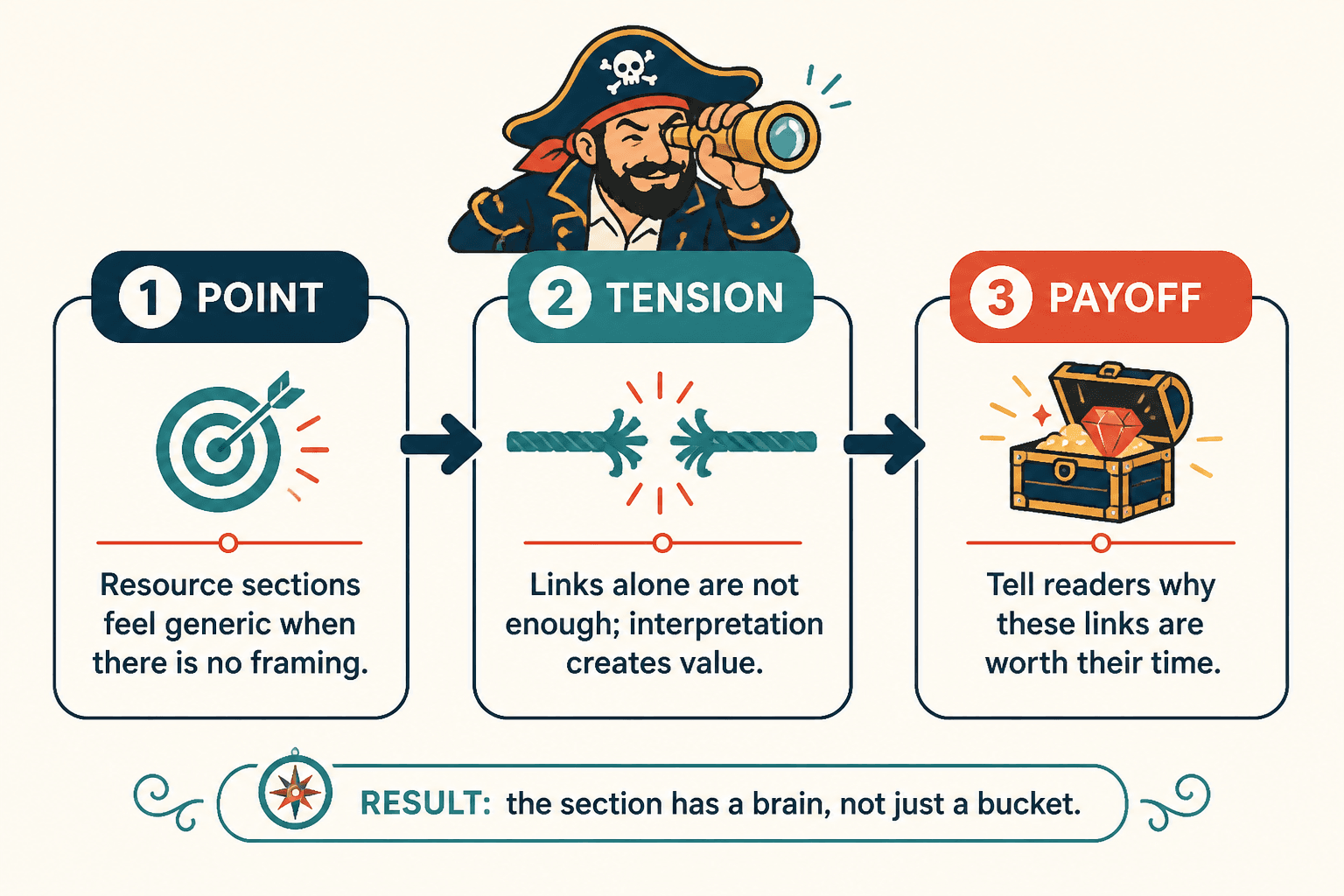
Real point: resource sections feel generic when the writer adds no framing
Tension: links are not enough; interpretation is what makes the section worth reading
Stronger start: “A resource section is not valuable because it has links. It is valuable because you tell readers why these are worth their time.”
Now the section has a brain, not just a bucket.
For more help on that specific section type, this guide on improving newsletter resource blocks without sounding generic pairs nicely with what you’re reading here.
How to rewrite a weak opening fast
If you already have a draft, you do not need to reinvent the section. You need to diagnose what the opening is failing to do.
Quick rewrite process
- Highlight the first three lines of the section.
- Underline any vague language.
- Circle the first sentence that says something specific.
- Move that idea to line one.
- Cut any sentence that only exists to “ease in.”
- Add one line that clarifies the payoff.
That edit often takes a section from limp to useful in under five minutes.
Another before-and-after
Before: “This next part is something I think a lot of people may benefit from, especially if they’ve been trying to improve their email content recently.”
After: “If your newsletter sections sound clean but forgettable, the opening is probably the leak.”
The second one is not “better” because it is shorter. It is better because it says something.
What to avoid when starting recurring newsletter sections
Recurring sections are useful, but they come with a trap: repetition starts making the opening feel auto-generated.
If you have a weekly section for resources, observations, lessons, prompts, or links, the structure can stay consistent while the opening angle changes. That keeps the format familiar without making it stale.
Newsletter structure works best when each section has one clear job and supports the main point of the issue. Simpler formats usually outperform busier ones when the writing stays sharp.