
Most personal brand newsletters do not have a writing problem. They have a format problem.
The advice might be good. The voice might be solid. The audience might even like you. But the issue still feels weirdly flat because every email arrives as the same vague blob: a long intro, a few thoughts, a soft pitch, and a quiet little death in the inbox.
Better newsletter issue formats for personal brands are not about making your emails look fancier. They are about giving your ideas a shape people can recognize, trust, and actually read. Good formatting helps readers know what kind of value they are about to get. It also makes your newsletter easier to write consistently without sounding like you copied your own homework for six months straight.
If your newsletter currently feels random, bloated, or too dependent on your mood that day, this is the fix. Here is how to choose issue formats that fit your brand, your audience, and the way you actually create.
If you want the bigger picture, start with the parent guide.
Why most newsletter issues feel forgettable
A lot of creators confuse content ideas with issue formats. They are not the same thing.
A content idea is the topic. A format is the container. “How to write better offers” is an idea. “3-part teardown with one example, one mistake, and one action step” is a format.
When you do not have a clear issue format, every newsletter starts from scratch. That creates three annoying problems:
- You waste time deciding how to structure each email
- Your readers never build familiarity with your newsletter style
- Your calls to action end up bolted on like an afterthought
The result is often a newsletter that is not bad exactly. Just slippery. Hard to remember. Hard to anticipate. Hard to turn into a habit.
Readers do not need every issue to look identical. They do need a sense that your emails have a rhythm. Familiarity lowers friction. And in email, friction kills attention faster than mediocre prose ever will.
What a strong newsletter issue format actually does
A strong issue format helps you do four things at once:
- Deliver value in a repeatable way
- Make your ideas easier to skim and remember
- Build brand recognition through consistent structure
- Create clean places for CTAs, offers, links, and replies
That last one matters more than people think. Personal brand newsletters are often trying to do more than “share thoughts.” They are supposed to build trust, spark replies, move readers to offers, and deepen your positioning. If the structure is messy, all of that gets messier too.
If you need a broader foundation before picking formats, start with the main email newsletter writing section, then go deeper with the newsletter writing hub and the parent guide on newsletter sections and formats.
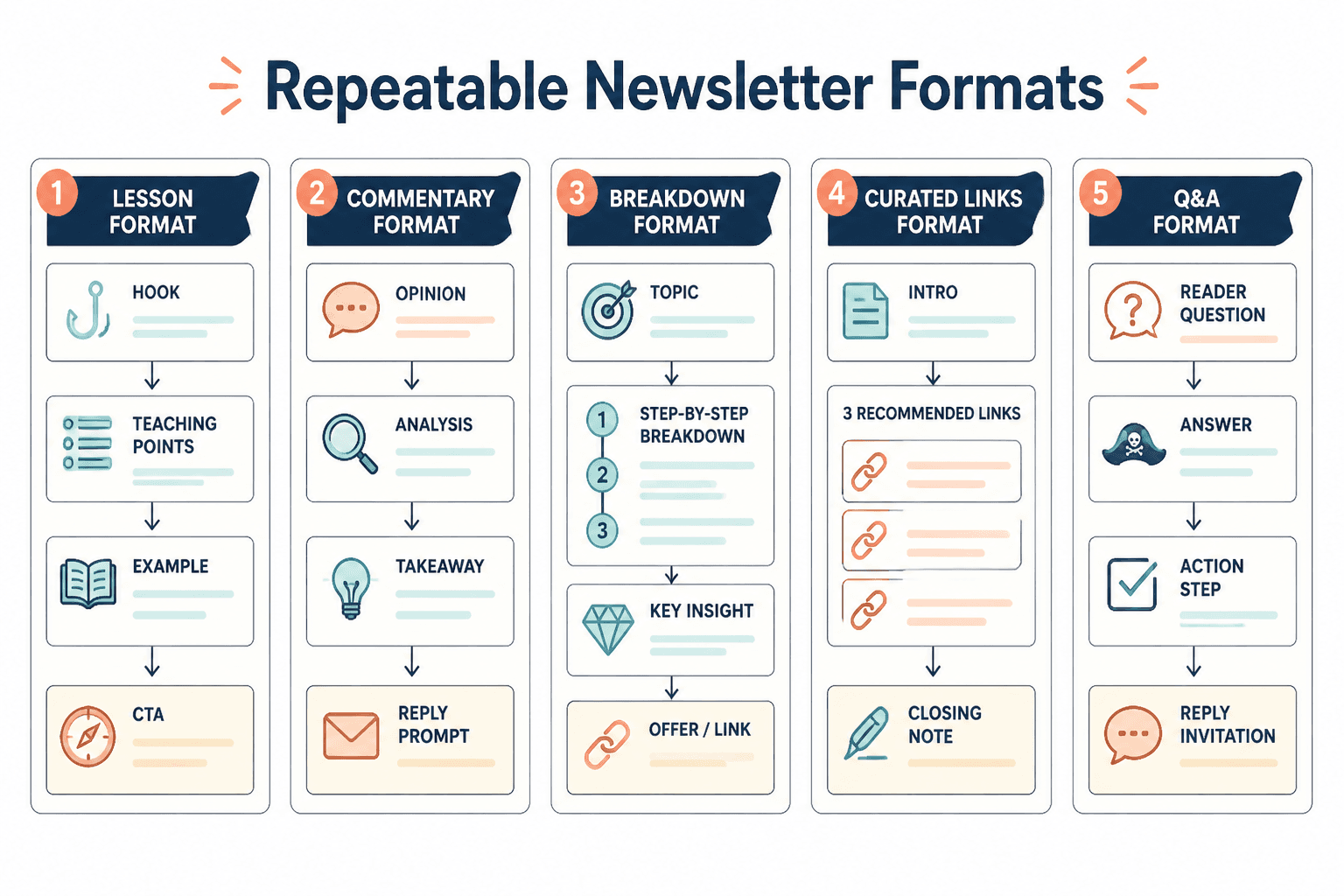
How to choose the right format for your personal brand
Do not pick a format because it looks polished in someone else’s newsletter. Pick it based on what your audience actually expects from you and what kind of trust you are trying to build.
Choose based on your strength
- If you are great at teaching, use structured lesson formats
- If you are strong on opinion and insight, use commentary formats
- If you are persuasive with examples, use breakdown and teardown formats
- If your brand is built on curation, use link-plus-insight formats
- If your audience buys through conversation, use question-and-answer formats
Choose based on reader intent
- If readers want quick wins, keep issues tight and modular
- If they want depth, use one-core-idea formats
- If they want perspective, make room for opinion and interpretation
- If they want implementation help, build in templates, examples, and action steps
Choose based on consistency, not fantasy
This is where a lot of newsletters go off the rails. Someone picks a “premium” format that requires deep research, three examples, a case study, and a custom framework every Tuesday morning. Lovely in theory. Completely unserious in real life.
The best issue format is the one you can sustain without resenting your own email list.
7 better newsletter issue formats for personal brands
You do not need one perfect format forever. You probably need two to four reliable formats you can rotate. That gives you consistency without making the newsletter feel factory-made.
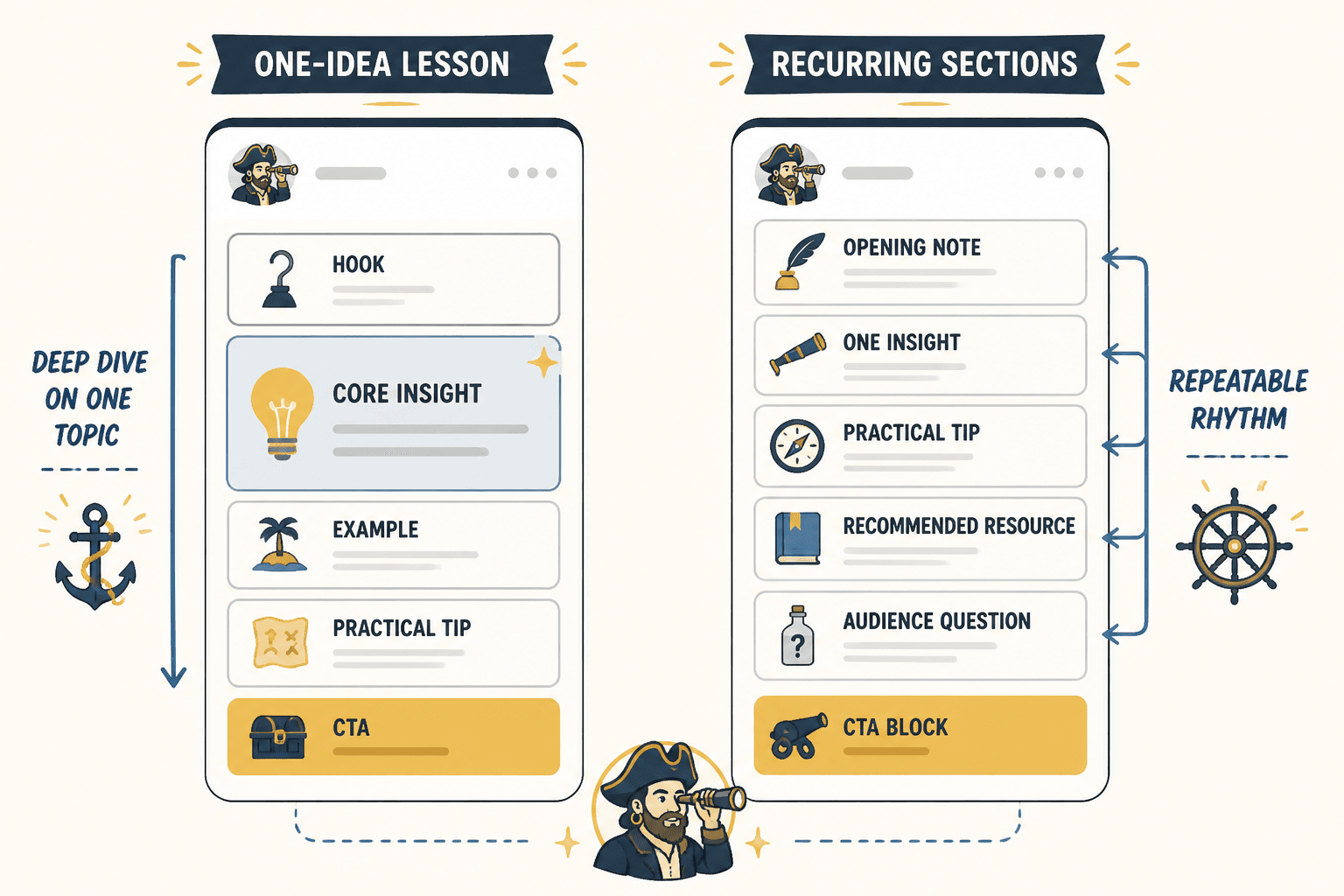
1. The one-idea lesson
This is the cleanest format for coaches, consultants, educators, and service-based personal brands. One issue. One core lesson. No side quests.
Best for: authority, trust, evergreen teaching, offer alignment
Simple structure:
- Sharp opening problem
- Main lesson
- Example or short breakdown
- Practical takeaway
- CTA
Why it works: it respects the reader’s time. It also forces you to have an actual point, which is not a small thing on the internet.
2. The framework issue
This format teaches through a repeatable model: three steps, four filters, five mistakes, one scoring system, and so on. It is especially useful if your brand sells strategy, process, or transformation.
Best for: consultants, strategists, B2B creators, experts with clear methodology
Simple structure:
- Name the problem
- Introduce the framework
- Explain each part briefly
- Show how to use it
- Invite the next step
This format is also good for repurposing into posts, threads, carousels, and lead magnets later. Clean structure travels well.
3. The breakdown or teardown
If your audience learns best from examples, this format is gold. You take a page, post, offer, funnel, email, idea, or positioning statement and explain what works, what does not, and how to improve it.
Best for: copywriters, marketers, brand strategists, business coaches, operators
Simple structure:
- Show the example or scenario
- Identify the issue
- Explain why it matters
- Rewrite or improve it
- CTA to get help, reply, or read a related resource
These emails often get strong engagement because they are concrete. People love seeing the gears move.
4. The curated insight issue
This is not just “here are some links.” That format is fine for media brands, less fine for personal brands trying to build a point of view. The better version is curated items plus your interpretation.
Best for: thought leaders, niche curators, industry commentators, creators with strong taste
Simple structure:
- One theme for the issue
- Two to five curated items
- Your take on why each matters
- One broader lesson or trend
- CTA
The trick here is adding enough interpretation that readers want your newsletter, not just a bookmark folder wearing a subject line.
5. The answer-a-real-question issue
This format works because it starts where the audience already is. Instead of inventing a clever angle every week, you answer a real question from a client, lead, subscriber, or common market confusion.
Best for: service businesses, coaches, consultants, educators, newsletter-first brands
Simple structure:
- State the question
- Give the short answer
- Explain the nuance
- Offer a practical example
- Invite replies with more questions
This is one of the easiest issue formats to sustain because your market keeps handing you material. Very considerate of them, really.
6. The opinion plus lesson issue
For personal brands with a stronger voice, this is a great way to build loyalty. You take a clear stance, explain why you hold it, and turn that opinion into something useful.
Best for: founders, writers, strategists, creators with strong perspective
Simple structure:
- Bold opening claim
- What most people get wrong
- Your reasoning
- Practical implication for the reader
- CTA
Important difference: this is not ranting for cardio. The issue still needs a payoff for the reader.
7. The recurring sections issue
This is the most magazine-like option. Instead of one long piece, the issue includes a few repeatable sections readers can expect each time.
Best for: creators with broad expertise, community-led brands, newsletters that publish frequently
Example structure:
- Opening note
- One insight
- One practical tip
- One recommended resource
- One audience question
- CTA block
This can work beautifully, but only if each section earns its place. Too many section-based newsletters become a kitchen junk drawer in email form.
If you want help building those blocks, read how to write better newsletter sections and formats and simple newsletter sections and formats CTA blocks templates for busy creators.
How to structure each issue so it reads cleanly
Even the best format can get ruined by sloppy sequencing. Good issue structure is not just about what sections you include. It is about the order.
A clean personal brand newsletter issue usually flows like this:
- Hook the reader fast. Open with the problem, observation, or tension. Skip the rambling preamble.
- Deliver the main value early. Do not make readers dig through your life update to find the useful part.
- Add proof, example, or explanation. This is where trust gets built.
- Land the takeaway. Make the lesson clear enough to use.
- Use one clear CTA. Not three half-committed ones fighting in a trench coat.
If you want your issue formats to perform better, this sequence matters more than fancy copy tricks. Readers should never feel lost inside the email.
Formats by goal: reach, trust, leads, or sales
Different issue formats do different jobs. Picking without knowing the job is how newsletters become busy and ineffective.
| Goal | Best issue formats | Why they work |
|---|---|---|
| Build trust | One-idea lesson, answer-a-real-question, framework issue | Shows clarity, expertise, and usefulness |
| Increase replies | Question issue, opinion plus lesson, recurring sections | Creates easy entry points for conversation |
| Generate leads | Breakdown, framework, practical lesson with CTA | Moves readers naturally toward a resource or service |
| Strengthen positioning | Opinion plus lesson, curated insight, teardown | Shows how you think, not just what you know |
| Support sales | Case-style lesson, breakdown, recurring CTA-ready format | Creates trust before asking for action |
You can also rotate formats based on your publishing schedule. For example:
- Week 1: one-idea lesson
- Week 2: audience question
- Week 3: teardown
- Week 4: opinion plus lesson
Now your newsletter has variety, but your audience still knows what kind of value to expect.
Newsletter structure works best when each section has one clear job and supports the main point of the issue. Simpler formats usually outperform busier ones when the writing stays sharp.