
Most people treat internal linking and content updating like housekeeping.
Tidy up a few links. Refresh an old post. Fix a headline. Maybe feel productive for 14 minutes.
That is fine as far as it goes. It just leaves money on the table.
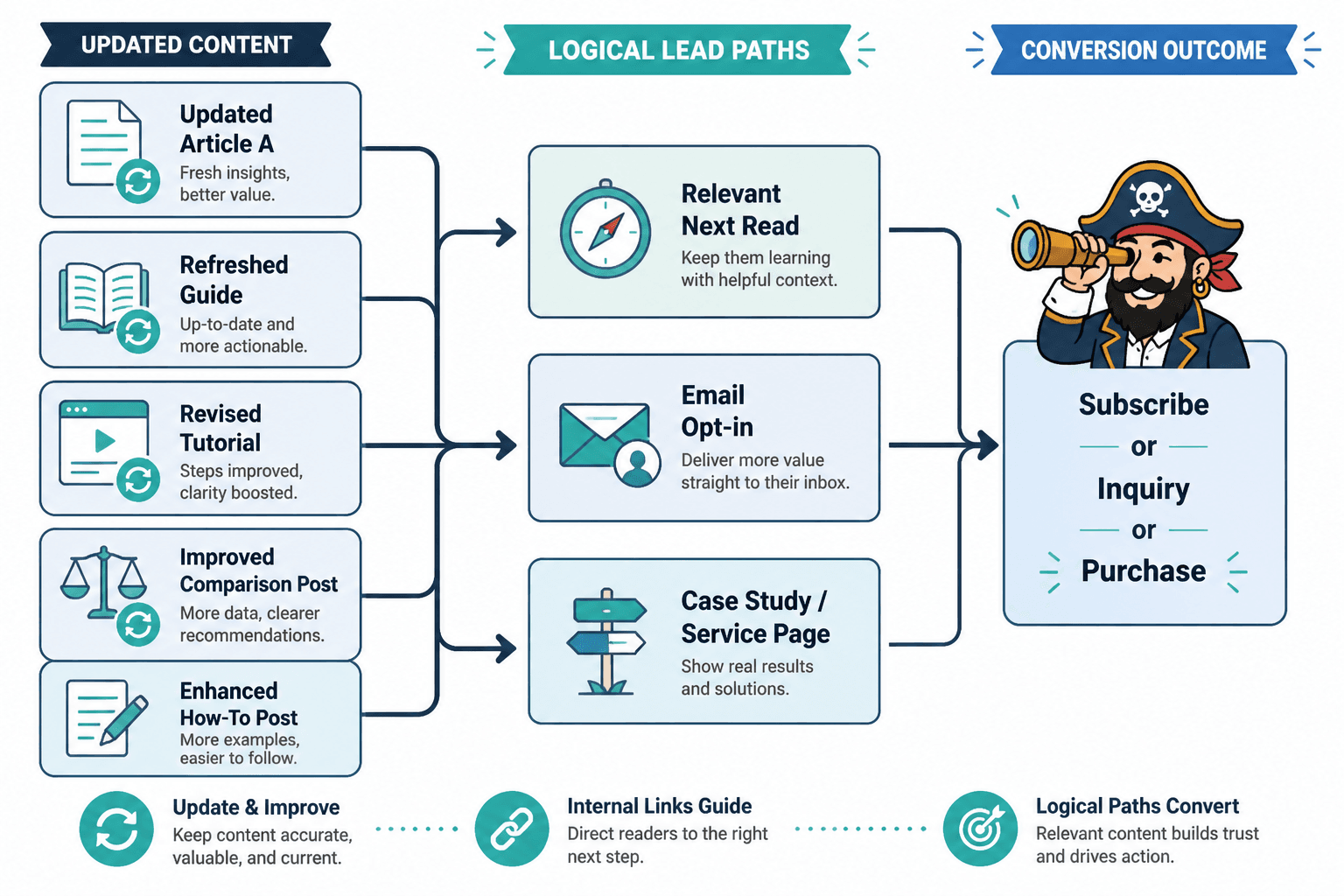
If you are already spending time improving old articles, those articles should not only rank better or read better. They should move people somewhere useful. That is where funnel thinking comes in. Not the sleazy kind with fake urgency and pop-ups behaving like raccoons. The useful kind. The kind that turns existing traffic into subscribers, inquiries, leads, and sales without wrecking trust.
The best funnel ideas to pair with internal linking and updating are usually simple. You update a post, improve the path to the next relevant piece, add a smart next step, and make the reader’s journey less random. That is it. No need to build a 27-step automation just because some guy on the internet owns a whiteboard.
Here’s how to pair internal linking and updating with funnel moves that actually make sense for creators, consultants, coaches, solo founders, and service businesses.
For the main guide behind this topic, visit the parent guide.
Why internal linking and updating work so well with funnels
Funnels tend to fail when they are bolted onto content as an afterthought.
You publish a blog post. It gets some traffic. Then months later you slap a generic CTA at the bottom that says something like “book a discovery call today” and wonder why nobody bites. The problem is not that readers hate action. It is that the path makes no sense.
Internal linking and updating fix that because they let you shape intent after the fact. You can take a post that is already attracting attention, clarify what the reader likely needs next, and create a cleaner route toward a conversion step.
Done well, this gives you three advantages:
- Better relevance: readers go from one useful piece to the next instead of bouncing around your site like confused tourists.
- Better trust: your CTA feels earned because it follows useful content rather than interrupting it.
- Better conversion: readers who keep moving are more likely to subscribe, inquire, or buy.
This is also why internal linking and updating are not just SEO chores. They are conversion infrastructure.
What makes a good funnel match for updated content
Before getting into specific funnel ideas, it helps to know what you are looking for.
A good funnel match should feel like the natural next step for someone who just read the article. Not your favorite offer. Not your most expensive thing. Not the thing you wish they wanted. The next step that makes sense from their current level of awareness.
Usually that means matching the funnel to one of these reader states:
- Problem aware: they know something is off but need clarity and examples.
- Solution aware: they know the type of help they need and want options or frameworks.
- Provider aware: they are comparing experts, tools, services, or methods.
- Ready to act: they need a checklist, template, consultation, audit, or offer page.
If your updated article attracts problem-aware traffic, asking for a call too early will usually flop. If your article attracts provider-aware traffic, sending them to another fluffy beginner explainer is not much better.
Good funnels respect momentum. They do not reset it.
Best funnel ideas to pair with internal linking and updating
Here are the funnel structures that tend to work best when you are refreshing old content and tightening internal links.
1. Article to article to lead magnet
This is one of the cleanest options for educational content.
You update a broad article that gets traffic. Inside it, you add links to more specific supporting articles. Then those supporting articles point to a lead magnet that solves a narrower problem.
Example flow:
- Top-level article on internal linking and updating
- Link to examples article
- Link to templates and tools article
- Each deeper article points to a relevant checklist, swipe file, or audit resource
This works because the first click builds interest and the second click builds intent. By the time the reader sees the lead magnet, it feels useful instead of pushy.
For this topic, that could mean linking readers from a broad systems article into examples of internal linking and updating for creators and templates and tools for internal linking and updating, then offering a simple content update checklist or internal link map template.
2. Article to article to service page
If you sell a service, this one is often stronger than trying to send cold blog readers straight to a booking page.
Start with an educational article. Update it so it links internally to a more strategic, decision-stage article. That second article should do more of the selling by showing the stakes, common mistakes, opportunities, and signs that someone may want help.
Then the CTA points to your service.
In this cluster, a smart move is to guide readers from educational content toward how to turn internal linking and updating into more leads or sales. That article naturally sits closer to buyer intent. Somebody reading that is not just curious. They are thinking about business outcomes.
This is the difference between “here is some advice” and “here is why this matters commercially.” That distinction matters a lot if you want your content to pull actual weight.
3. Article to newsletter signup
Not every visitor needs a funnel with five moving parts. Sometimes the smartest next step is getting them onto your list.
This works especially well for updated evergreen articles that attract search traffic from people who are interested but not ready to buy. If they like your thinking, your newsletter becomes the bridge between first visit and future sale.
The key is to make the newsletter CTA specific. “Join my newsletter” is lazy. “Get practical content systems, SEO writing ideas, and better ways to turn articles into leads” is much better because it tells people what kind of brain they are subscribing to.
Internal links help here by increasing article depth before the opt-in appears. A reader who visits one page is browsing. A reader who clicks two or three relevant pieces is leaning in.
4. Article to case study to consultation
This is the trust-heavy version, and it works very well for consultants, strategists, and done-for-you providers.
The updated article attracts someone with a problem. An internal link takes them to a case-study-style article or results breakdown. Then the case study ends with a soft consultation CTA.
The logic is simple: education creates interest, proof reduces risk, and the call gives them somewhere to go next.
If you do not have formal case studies, use credible proof instead:
- process breakdowns
- before-and-after content examples
- mistakes you fixed
- results trends without fake precision
- mini client scenarios with clear context
Just do not fake authority with vague chest-puffing. Readers can smell that from orbit.
5. Article to topic hub to multiple conversion points
If you have several related articles, a topic hub can be the middle of the funnel.
This is especially useful when you are building authority around a content system, service category, or core strategic problem. The hub organizes your best pieces, gives readers options based on their stage, and lets you place multiple CTAs without cluttering every individual article.
For example, readers can move from a specific article into your broader blog SEO writing content ecosystem, such as the main blog SEO writing section or the more focused internal linking and updating hub. That gives you a cleaner structure than trying to make one article do every job.
A strong hub can offer:
- best starter articles
- deeper examples and templates
- beginner vs advanced paths
- newsletter signup
- audit or consultation CTA
- service links
6. Article to self-qualification CTA
This one is underrated.
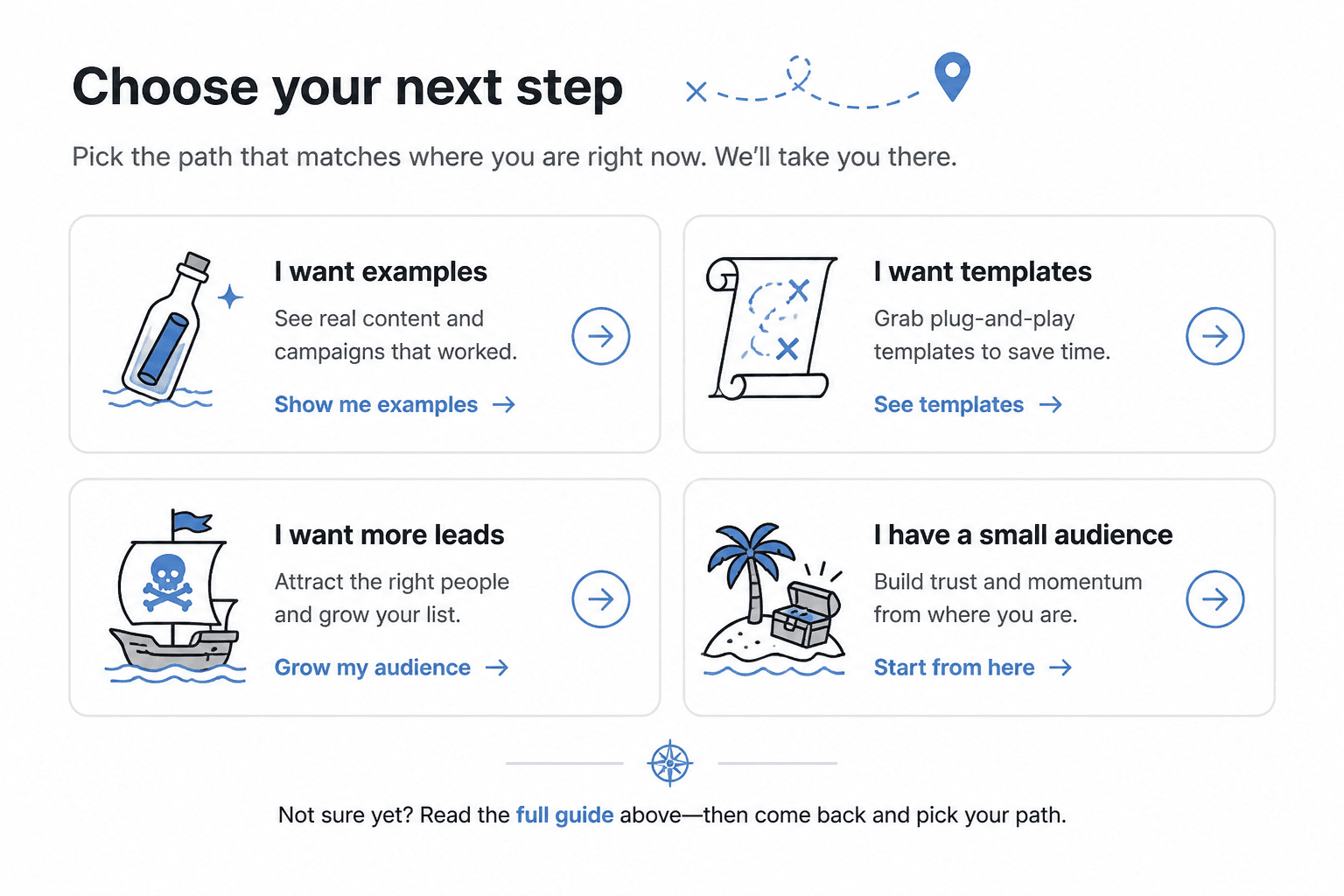
Instead of pushing every reader into the same next step, use your updated content to help them sort themselves. Link to different paths based on what they need.
For example:
- If you want examples, go here.
- If you want templates, go here.
- If you want more leads, read this next.
- If you have a small audience, start here.
This works because it lowers friction. People do not like being shoved into a funnel. They do like choosing their own useful next step.
That makes articles like internal linking and updating for creators with small audiences especially useful. It speaks to a specific reader context instead of pretending everyone has the same traffic, authority, or patience.
7. Article refresh to CTA upgrade
Sometimes the funnel idea is not a whole new structure. Sometimes it is just upgrading a weak CTA inside an article that already has traffic.
This is one of the highest-leverage moves in content updating because the article is already working on some level. It just is not directing readers well.
Weak CTA:
Contact me if you need help.
Stronger CTA:
If your old articles are getting traffic but not moving people toward inquiries or signups, read this guide on turning internal linking and updating into more leads or sales next.
The second one gives context, names the problem, and offers a relevant next move. Which is kind of the whole job.
How to choose the right funnel for each updated article
Not every article should point to the same destination. That is how you end up with awkward funnels and disappointing conversions.
Use this simple decision filter when updating content.
| Article type | Best next step | Best funnel fit |
|---|---|---|
| Broad educational guide | Specific related article | Article → article → lead magnet |
| Example-heavy article | Template, tool, or checklist | Article → resource signup |
| Commercial-intent article | Service or consultation page | Article → sales-focused article → offer |
| Authority article | Case study or proof page | Article → case study → consultation |
| Beginner traffic article | Newsletter or hub page | Article → newsletter or topic hub |
| Niche audience article | Segment-specific next step | Article → self-qualification path |
A good rule: if the reader still needs clarity, send them sideways to more useful content. If they already have clarity and need confidence, send them toward proof. If they have both, give them an offer.
How to build these funnels into your updating process
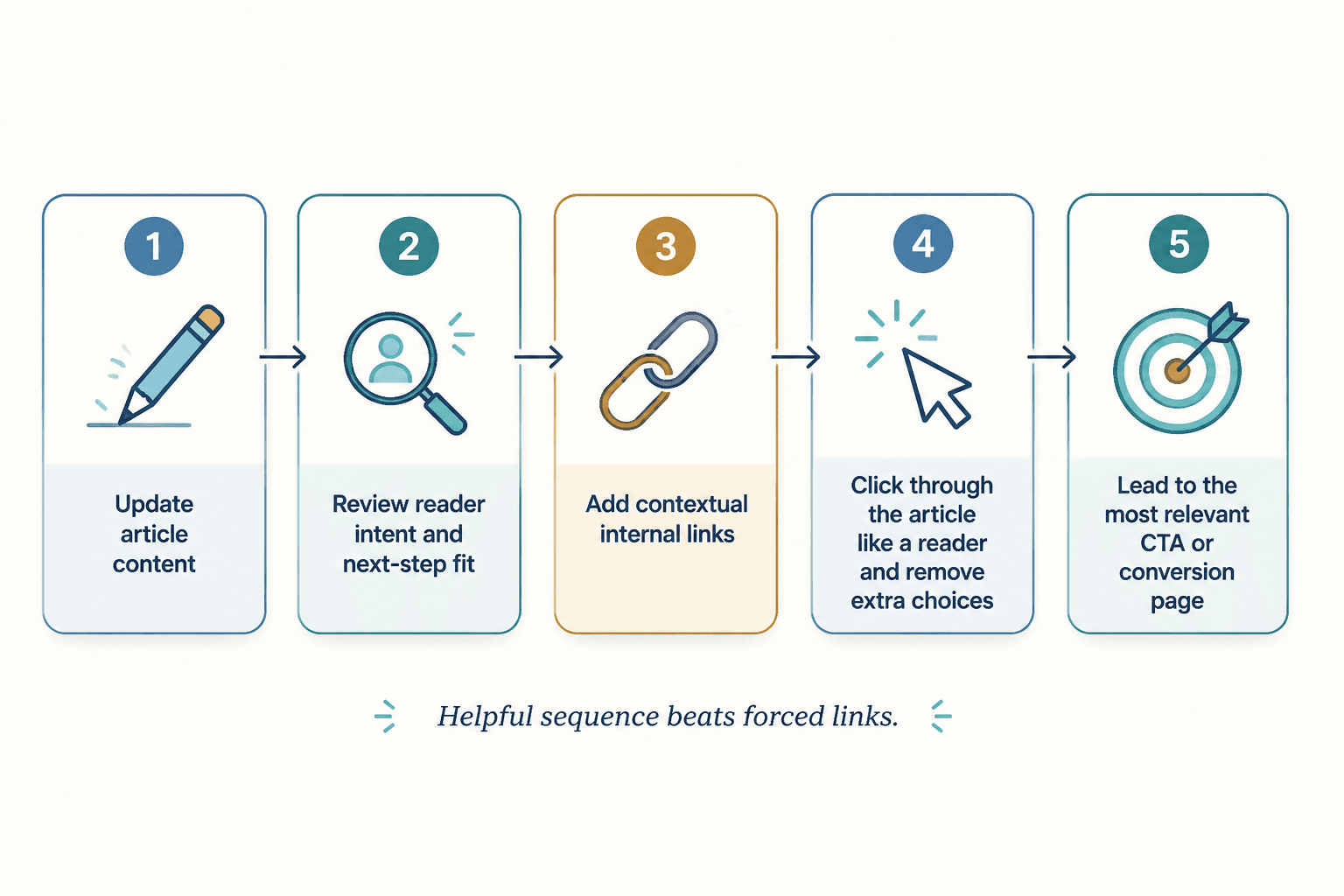
You do not need a giant migration project. You need a repeatable process.
Step 1: Identify traffic articles with weak next steps
Start with posts that already get traffic, impressions, clicks, or steady engagement. These are easier to improve than dead posts with no traction at all.
Look for signs of weak funneling:
- no CTA at all
- generic CTA with no relevance
- few or no internal links
- links only pointing upward to broad category pages
- no path toward examples, tools, proof, or offers
Step 2: Map the intent of the article
Ask what the reader likely wants after finishing the piece.
Not what you want. What they want.
If the article teaches a concept, they may want examples. If it shows examples, they may want templates. If it diagnoses a business problem, they may want a solution path. This part is common sense, which is maybe why people love skipping it.
Step 3: Add internal links with actual purpose
Do not just sprinkle links because some SEO checklist told you to. Add links that move the reader deeper into the topic or closer to action.
For this topic, a practical internal link structure might look like this:
- Main article links to the parent hub and broader topic area
- Main article links to examples, tools, small-audience, and lead-generation subtopics
- Subtopic articles link back to the hub and across to related subtopics
- Higher-intent subtopic articles include stronger CTAs to services, audits, or signup offers
That creates a network, not a dead end.
Step 4: Rewrite the CTA to match the article
The CTA should feel like the next page of the same conversation.
Some practical CTA styles that work well here:
- For examples: “If you want to see what this looks like in practice, read these internal linking and updating examples for creators.”
- For tools: “If you want to make this faster, here are templates and tools worth using.”
- For small audiences: “If your traffic is still modest, start with this small-audience version instead of copying big-site advice.”
- For leads: “If you want this to generate inquiries instead of just tidier articles, read this next.”
Step 5: Review the funnel after the update
After updating the article, click through it like a reader. Does the next step make sense? Are there too many choices? Does the CTA appear before the article has earned it? Are you linking to pages that actually help, or just pages you wish got more traffic?
This matters because a funnel is not just a sequence. It is a reading experience. Clumsy reading experiences do not convert well, no matter how many arrows you draw in your docs.
Common mistakes when pairing funnels with internal linking and updating
A few things go wrong again and again here.
Sending every article to the same offer
This is lazy and usually ineffective. Different articles bring different intent. Respect that.
Using vague CTAs that ask for too much too soon
“Book a call” is not inherently bad. It is just often premature. Especially if the article itself is top-of-funnel and educational.
Adding links with no thought to sequence
Not every internal link is a funnel link. Some links provide context. Some deepen authority. Some should move readers toward action. If every link does a different random thing, the article feels messy.
Ignoring smaller audience realities
If you are a smaller creator or newer site owner, your funnel should not assume huge traffic volume. You may need simpler next steps, stronger niche specificity, and more trust-building before conversion. That is not a disadvantage. It is just reality with less delusion attached.
If that is your situation, the article on internal linking and updating for creators with small audiences is the better next read than a bunch of advice built for giant sites with teams and budget.
Updating content without measuring whether the path improved
You do not need a full analytics war room, but you should watch basics like:
- internal link clicks
- newsletter signups from updated posts
- service page visits from content
- time on site across article paths
- lead quality from blog-origin traffic
If the article gets more traffic but the funnel still does nothing, the issue is probably not the update alone. It may be the offer, the CTA, the sequence, or the fit.
A practical internal-link funnel path for this topic cluster
If you want a concrete model, here is a clean way to structure this topic cluster.
- Start from the parent internal linking and updating hub
- Link to this article on the best funnel ideas to pair with internal linking and updating
- From here, guide readers to examples and ideas if they need practical application
- Guide process-oriented readers to templates and tools
- Guide conversion-focused readers to more leads or sales
- Guide smaller creators to the small-audience version
- From those pages, offer the most relevant signup, audit, inquiry, or service CTA
Internal linking improves when each update makes the next useful step clearer. Cleaner structure usually does more work than a bigger pile of links ever will.