
Longer does not automatically mean better in SEO work. It often just means slower, messier, and harder to maintain.
That is especially true with internal linking and content updates. A lot of site owners assume the “serious” version of this work means giant audits, bloated update briefs, and marathon refresh sessions where every page gets rewritten like it offended somebody personally. In practice, short internal linking updates often beat long ones because they get done, they stay focused, and they improve the parts that actually move the page.
If you are trying to improve a blog, content hub, or article cluster without turning basic maintenance into a full-time identity, this is the part that matters: small, targeted updates usually outperform sprawling “refresh everything” efforts. Not because depth is bad, but because unnecessary depth is expensive and weirdly easy to get wrong.
Here is how to tell when short internal linking updates are the smarter move, what those updates should include, and how to avoid the common mistake of mistaking “more work” for “better SEO.”
For the main guide behind this topic, visit the parent guide.
Why short internal linking updates often work better
Internal linking and updating are not performance art. The goal is not to produce the most impressive spreadsheet. The goal is to help search engines understand your site better, help readers move through it more easily, and strengthen the pages that deserve more attention.
Short updates work because they usually focus on one of a few high-impact jobs:
- Adding relevant links from stronger pages to underlinked pages
- Fixing outdated anchors or generic anchor text
- Updating old references, examples, or stats
- Improving the intro, subheads, or CTA on an existing page
- Refreshing cluster connections so related pages support each other properly
Those changes do not require a six-hour rewrite session. They require judgment.
A short update also creates less collateral damage. The more you change at once, the easier it is to mess with ranking intent, break internal logic, remove useful phrasing, or accidentally flatten a page into generic SEO paste. People do this all the time. They call it optimization. Sometimes it is just vandalism with a checklist.
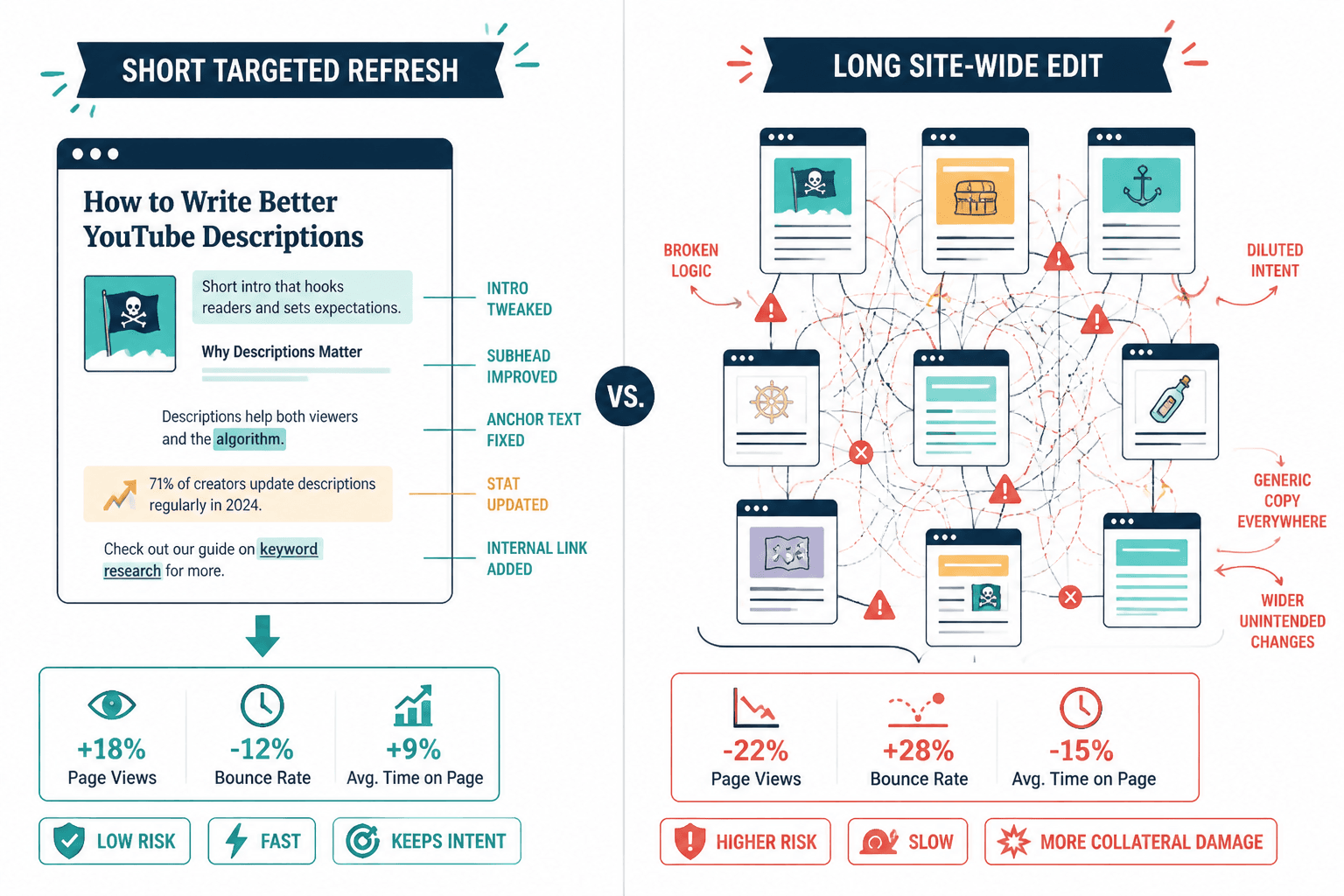
When short internal linking updates beat long ones
When Short Internal Linking & Updating Beat Long Ones really comes down to context. Long updates still have a place. But short ones usually win in these situations.
1. The page is mostly fine and just poorly connected
If the page already answers the query well, a full rewrite is often overkill. The bigger problem may be that the page is buried, isolated, or linked with lazy anchors like “click here” or “read more.”
In that case, the fix is not “write 1,200 more words.” The fix is usually:
- Add links from relevant, authoritative pages
- Improve anchor text to reflect the destination topic
- Link both up and across the cluster where it makes sense
- Remove internal links that are vague, broken, or random
If you want a broader system for this, the internal linking and updating guide is the right starting point.
2. The content is aging, not failing
There is a difference between a page that is genuinely weak and a page that is just a bit stale.
If the structure is good, the intent is still right, and the topic still matters, then a short update can do plenty:
- Replace outdated examples
- Refresh wording in the intro
- Add a few internal links to newer related content
- Tighten headers so the page is easier to scan
- Update the CTA or next-step path
This kind of refresh is faster, easier to repeat, and less likely to wreck whatever the page is already doing well.
3. You are managing a content cluster, not a single heroic page
Clusters benefit from consistency more than drama. One giant update to one page is often less useful than ten short updates across ten connected pages.
Why? Because internal linking strength comes from relationships. If your pillar and support pages are not properly connected, then over-polishing one article will not fix the bigger problem.
This is especially relevant if you are working from a broader blog SEO writing and article systems context. Cluster performance usually improves through repeated, deliberate maintenance, not one theatrical refresh per quarter.
4. Your team or workflow has limited time
This one is not glamorous, but it matters. The best update process is the one your team can actually sustain.
Short update cycles are easier to schedule, easier to train, and easier to review. They also reduce the odds that “we need to update the site” becomes a vague item that sits in project management software until the heat death of the internet.
A 20-minute update checklist used every week will often outperform a giant refresh sprint that only happens twice a year.
5. The issue is discoverability, not depth
Some pages are not underperforming because they are too short. They are underperforming because nobody and nothing important on your site points to them.
That is a discoverability problem. Internal links solve discoverability better than padding does.
If a useful article is stranded three clicks deep with no meaningful contextual links, adding another 700 words may do absolutely nothing. Adding five relevant links from pages that already carry authority might help far more.
What a good short update actually includes
A short update should still be intentional. “Quick” is not the same thing as sloppy.
In most cases, a solid short internal linking update includes four parts.
Review the page’s job
Before you change anything, confirm what the page is supposed to do.
- What query or topic does it target?
- Is it a pillar page, support page, or conversion page?
- What related pages should it connect to?
- What should the reader do next?
If you skip this step, you end up adding links because they exist, not because they fit. That is how people create internal link soup.
Fix or add a handful of meaningful internal links
This is the core of the update. Add contextual links where the reader would genuinely benefit from the next page.
Good internal links usually do at least one of these things:
- Clarify a related concept
- Move the reader deeper into the topic cluster
- Support a claim with a more specific article
- Point to a next-step guide
- Connect a broad page to a narrower one, or vice versa
For practical writing tips, this piece on how to write better internal linking and updating is a useful companion.
Refresh obvious stale elements
This does not mean rewriting the whole page. It means fixing the bits that quietly date the article or make it less useful than it should be.
- Old year references
- Outdated examples
- Weak intro copy
- Clunky subheads
- Redundant paragraphs
- A CTA that no longer fits the site structure
Often, the right update is boring in the best way. It makes the article cleaner, fresher, and better connected without making it feel rewritten by committee.
Check the cluster logic
One short update should not create a new orphan page or a one-way relationship that makes no sense. Make sure the page still sits properly inside the larger content structure.
If you are seeing messy overlap, duplicate targeting, or refreshes that accidentally cannibalize each other, this article on cluster refresh mistakes that hurt performance is worth reading next.
Short update vs long update: how to choose
Not every page deserves the same level of effort. That should be obvious, yet here we are.
| Situation | Short update is usually enough | Long update is usually better |
|---|---|---|
| Page quality | The page is solid but lightly stale or underlinked | The page is thin, outdated, or badly structured |
| Search intent fit | Still matches the topic well | No longer matches what searchers likely want |
| Internal linking | Main weakness is poor connectivity | Links are weak and content itself is also weak |
| Cluster role | Support page needs better integration | Pillar page needs a major rebuild |
| Resources | You need repeatable maintenance at scale | You can justify deeper editorial work on a key asset |
If you are unsure, start shorter. It is usually easier to escalate from a focused update to a deeper rewrite than to undo a bloated rewrite that stripped out what made the page useful.
And if your question is really about update size in general, not just short versus long, this guide on how long internal linking and updating should be in 2026 can help frame the decision more clearly.
The real advantages of shorter update cycles
Short updates are not just easier. They have strategic advantages.
They make consistency realistic
A site that gets small, intelligent improvements every month is often healthier than a site that gets one giant annual refresh followed by eleven months of neglect.
Consistency matters because internal linking is cumulative. Each good connection makes the site easier to crawl, easier to navigate, and easier for readers to explore. That value compounds.
They reduce over-editing
Long update sessions invite meddling. People start changing sentences that were fine, adding fluff to “increase comprehensiveness,” and stuffing in awkward links just to justify the effort. It becomes less about improving the page and more about proving something happened.
A shorter update forces sharper choices. You fix what matters most and leave the rest alone.
They are easier to measure
If you make ten major changes at once, it becomes harder to understand what helped. If you make a handful of targeted updates, patterns are easier to spot.
This is not laboratory science. SEO rarely gives you that level of clean certainty. But smaller changes do make performance review less muddy.
They scale better across growing sites
A small site can sometimes get away with heavy manual overhauls. A larger site usually cannot. Once you are managing dozens or hundreds of articles, lighter update systems become much more practical.
That is where process matters. Not glamorous process. Just functional process that does not collapse under its own ambition.
What people get wrong about “doing more”
There is a persistent SEO habit of assuming a task becomes better when it becomes larger. More pages in the audit. More links added. More paragraphs refreshed. More comments in the doc. More time spent staring into the analytics abyss.
But internal linking and updating are not judged by effort. They are judged by usefulness.
Here are the common ways longer updates go sideways:
- Adding too many internal links on a page without clear relevance
- Using repetitive exact-match anchors in a way that reads terribly
- Rewriting pages that only needed fresher links and examples
- Changing intent accidentally by stuffing in adjacent topics
- Creating bloated “comprehensive” pages that are harder to scan
- Updating pages in isolation and breaking cluster coherence
This is why short updates often win. They tend to be less ego-driven. You are solving a problem, not auditioning for the role of Most Dedicated SEO Person in the Building.
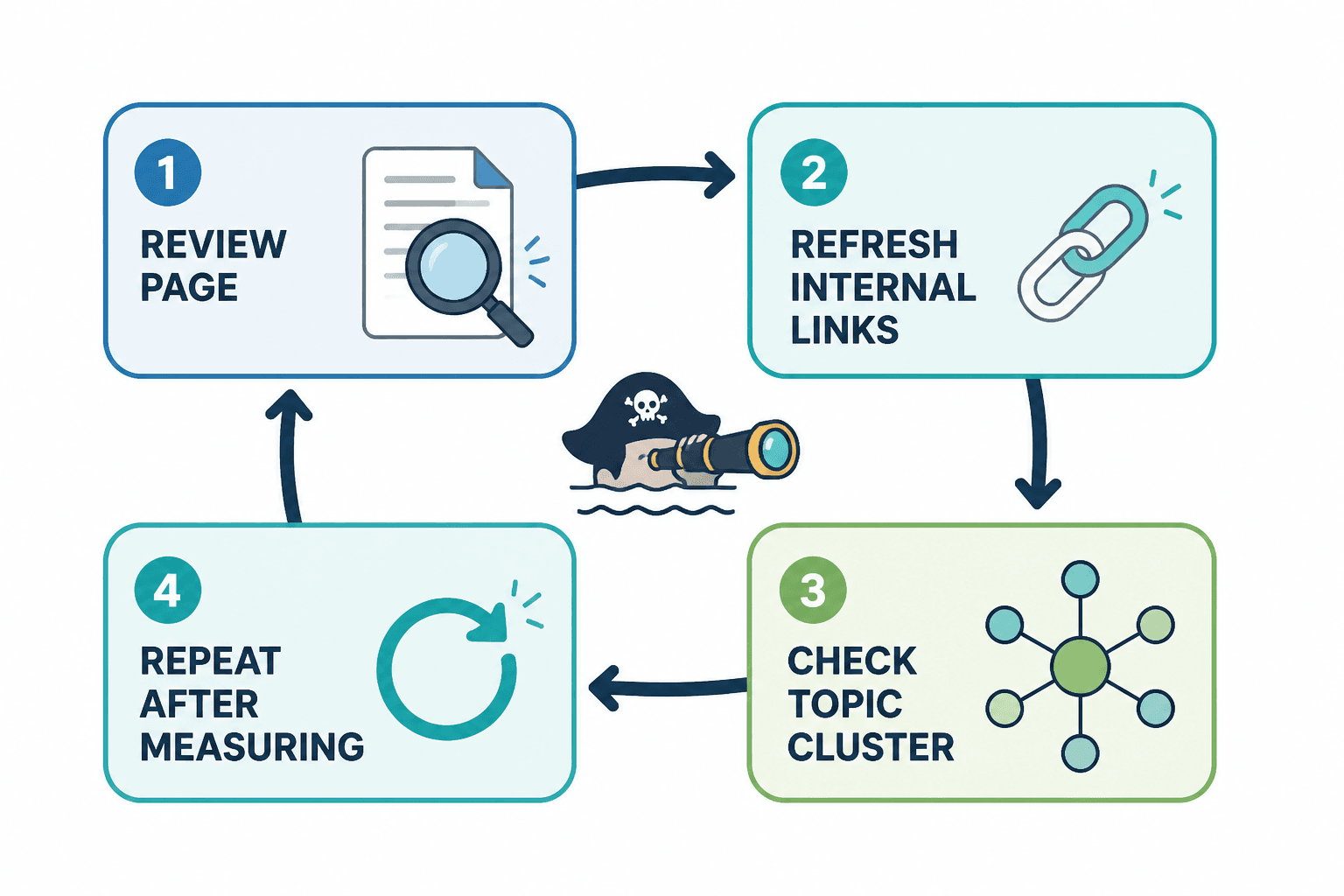
A practical short-update process you can actually repeat
If you want a clean way to handle this, use a lightweight five-step process.
- Pick the page
Choose a page with decent quality but obvious linking, freshness, or structural gaps. - Check its cluster role
Confirm what it supports, what supports it, and which related pages should be connected. - Make 3 to 7 meaningful improvements
Add or refine internal links, refresh stale wording, tighten one weak section, improve the next-step path. - Do a quick quality pass
Make sure the links read naturally, the anchors are useful, and the page still feels coherent. - Move on
Do not keep editing because the document is open and you feel powerful.
That last step matters more than people think.
One of the easiest ways to waste time in content operations is to keep polishing a page after the high-value work is done. At that point, your returns drop fast. Better to improve another page in the same cluster and strengthen the network around the content, not just the content itself.
How tools help without taking over the whole job
Tools can make short update workflows much easier, especially if you are working across a larger site. They can help you spot internal link opportunities, broken paths, orphaned content, and stale pages faster than manual review alone.
What tools are good for:
- Finding pages with low internal link counts
- Surfacing orphan or weakly connected content
- Auditing anchor text patterns
- Spotting old pages that have not been refreshed in a while
- Helping prioritize update candidates
What tools are not good for:
- Knowing which link is actually helpful for the reader
- Understanding nuance in topical relationships
- Deciding how much rewriting a page really needs
- Replacing editorial judgment with a cheerful dashboard
If you need help choosing the right stack, this guide to SEO tools and site auditing tools for internal linking and updating should save you some wandering.
Signs your short updates are too short
To be fair, not every short update is a smart one. Some are just lazy drive-bys dressed up as efficiency.
Your update is probably too thin if:
- You add links without checking whether they fit the paragraph
- You refresh dates but ignore bigger quality issues
- You touch one page without reviewing nearby related pages
- You keep “updating” content that actually needs a rewrite
- You treat every page as equally important
Short works best when the page is already close. If the page is weak at the foundation level, a tiny update will not magically rescue it. A cracked wall does not need a new picture frame.
That is the real distinction: short updates are excellent for maintenance, strengthening, and connection. They are not a substitute for rebuilding pages that were poorly planned in the first place.
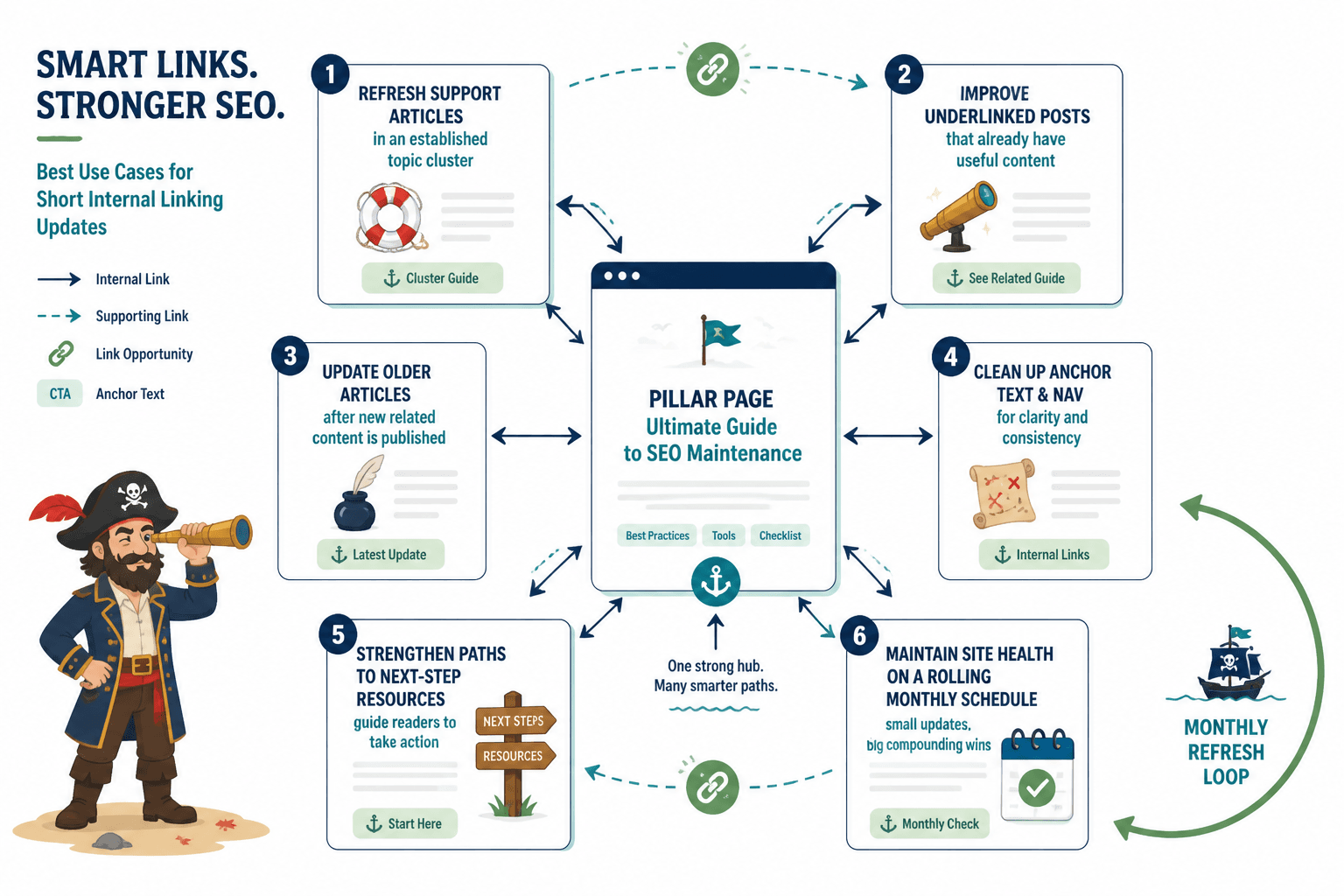
Best use cases for short internal linking and updating
- Refreshing support articles inside an established topic cluster
- Improving underlinked posts that already have useful content
- Updating older articles after publishing new related content
- Cleaning up anchor text and in-content navigation
- Strengthening paths from informational pages to next-step resources
- Maintaining site health on a rolling monthly schedule
These are the kinds of jobs where short updates shine. They are fast, strategic, and compounding. They respect the fact that SEO maintenance is ongoing work, not a dramatic seasonal cleanse.
Quick FAQ
Are short internal linking updates enough for most blog posts?
Often, yes. If the post is already useful and aligned with search intent, better internal links and a light freshness pass can be enough.
How many internal links should I add in a short update?
There is no magic number. Add the links the page genuinely supports. In many cases, 2 to 5 meaningful changes are enough.
When should I do a full rewrite instead?
When the page is thin, badly structured, off-intent, outdated in core substance, or no longer competitive on usefulness.
Do short updates help clusters?
Yes, especially when you apply them across multiple related pages instead of obsessing over one article.
Can tools automate this completely?
No. Tools can help you find opportunities. They cannot replace judgment about relevance, reader flow, or content quality.
Do the smaller fix that actually matters
When Short Internal Linking Updates Beat Long Ones is not really a case for doing less work. It is a case for doing the right work.
Internal linking improves when each update makes the next useful step clearer. Cleaner structure usually does more work than a bigger pile of links ever will.