
Most internal linking and updating advice is boring for the same reason most weak content is boring: it treats the reader like a search engine with a wallet.
You have seen it before. “Add 3 to 5 internal links.” “Refresh old posts regularly.” “Link to related content.” Technically fine. Practically useless. It tells people what to do in the flattest possible way, then acts surprised when the writing feels stiff and nobody clicks anything.
If you want to know how to fix boring internal linking and updating, the real job is not stuffing more links into old posts like you are hiding vegetables in a child’s pasta. The job is to make links feel helpful, make updates feel purposeful, and make the article itself stronger because of both.
That means better context, better timing, better transitions, and fewer dead little phrases like “check out this post for more.” We are going to fix the writing side of this, because the technical side is only half the problem. A lot of internal linking underperforms simply because it sounds like it was added by a sleepy plugin intern.
For the main guide behind this topic, visit the parent guide.
Why boring internal linking and updating happens in the first place
Internal linking gets boring when people treat it like a compliance task instead of part of the reading experience.
Same with updating. A lot of “updated” content is not really updated. It is cosmetically touched up. Maybe a date changed. Maybe one paragraph got tweaked. Maybe somebody added a sentence about “current trends” and called it fresh. That is not an update. That is a light dusting of SEO theater.
Readers can feel the difference, even if they do not say it out loud. Useful internal links feel like guidance. Weak ones feel like detours. Useful updates make the article clearer, sharper, and more complete. Weak ones feel like somebody opened the hood, stared at the engine for ten seconds, then closed it again.
- Links are added because a checklist said so, not because the moment called for them.
- Anchor text is vague, repetitive, or obviously engineered.
- Updates change wording but not usefulness.
- The writer links to “related” posts that are only loosely related.
- Every link sounds like a tiny CTA in a trench coat.
- No one thinks about what the reader needs right here.
That last point matters most. Internal links are not decorations. They are directional choices. Updating is not maintenance for maintenance’s sake. It is an editorial decision about what still deserves attention and what now needs more clarity, proof, examples, or structure.
If you want the broader strategy behind this topic, start with the main internal linking and updating guide. Then come back here if your problem is not just performance, but prose.
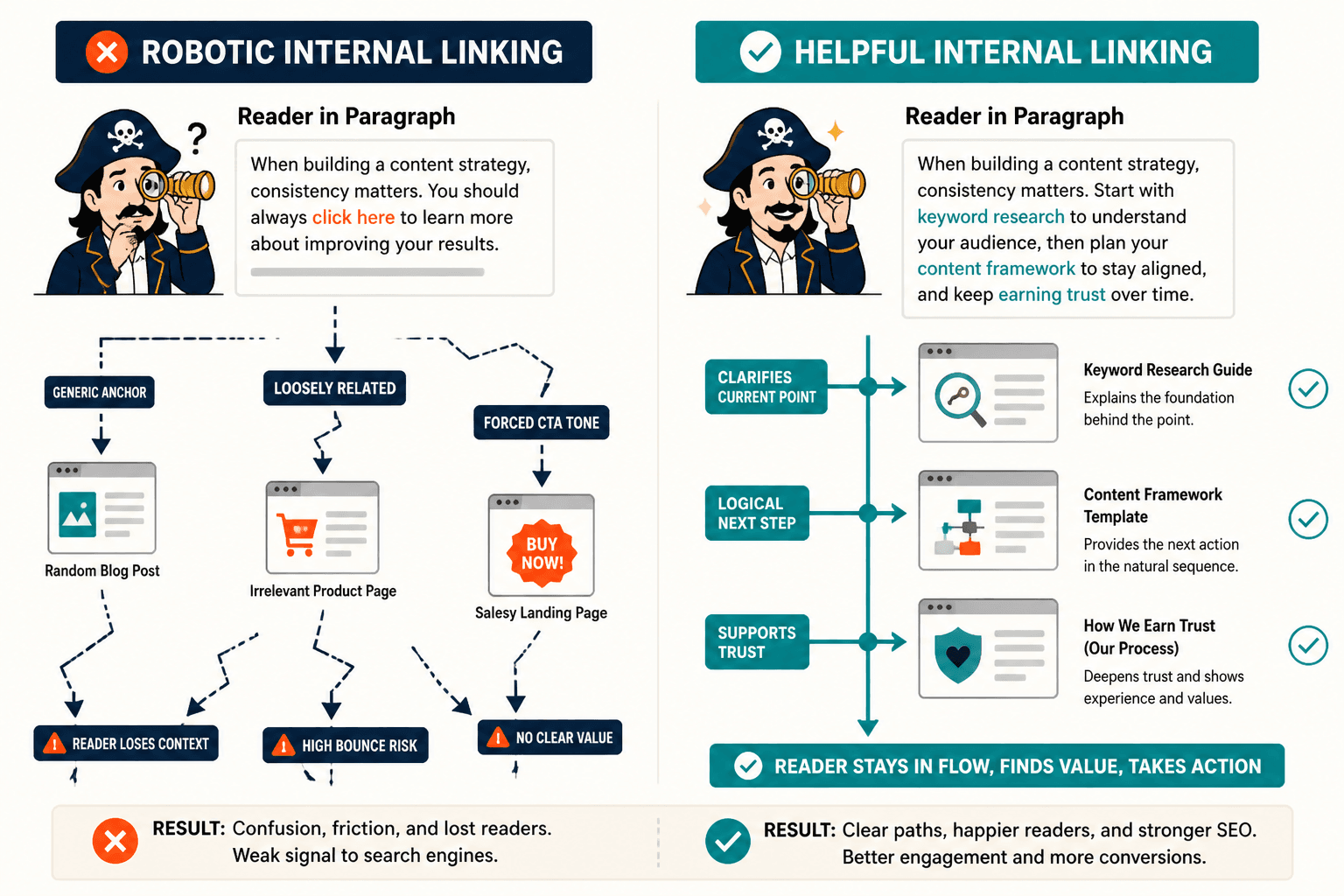
What good internal linking actually does
Good internal linking does at least one of three things:
- It helps the reader understand the current point better.
- It gives the reader a logical next step.
- It deepens trust by showing you have actually covered the topic properly elsewhere.
That is the standard. Not “contains link.” Not “supports site architecture.” Those things matter, sure, but if the link does not make sense in the sentence, it will often underperform no matter how technically correct it is.
Think of an internal link as a tiny editorial promise. You are saying: this next page will reward your click. If that promise is weak, generic, or misleading, readers stop trusting your links fast. Once that happens, the rest of your content cluster starts acting like a dusty filing cabinet instead of a useful system.
The easiest test
Read the sentence without the link. Then ask: does the linked page genuinely complete, sharpen, or extend this exact idea?
If not, do not link there just because the topic shares a few nouns.
For a cleaner foundation, you may also want to read how to write better internal linking and updating. That covers the baseline mechanics. This article is more about making it not read like a compliance memo.
How to fix boring internal linking in the writing itself
The fastest way to improve internal linking is to stop treating the link as the main event. The sentence is the main event. The link should support the sentence, not hijack it.
1. Stop using dead anchor phrases
Some anchor text is technically serviceable and still painfully dull.
- read more here
- check out this article
- learn more in this post
- click here
- related article
These phrases say almost nothing. They create zero intrigue, zero clarity, and zero confidence. Worse, they often interrupt the rhythm of the paragraph because they sound bolted on.
Instead, anchor the link in the actual idea:
- better internal linking and updating
- update triggers without sounding generic
- cluster refresh mistakes that hurt performance
- writing internal linking without sounding salesy or robotic
See the difference? The second version sounds like part of the thought, not a side quest.
2. Make the sentence earn the click
Good internal links often come after a sentence that creates a clear need.
Weak: You can also read this article about internal linking.
Better: If your links keep sounding like miniature pitches instead of useful guidance, this breakdown on writing internal linking without sounding salesy or robotic will help.
The better version gives the reader a reason. It frames the problem, then offers the link as the solution. That is a small change, but it makes internal linking feel much more natural.
3. Link from moments of tension, not filler
The best places to add internal links are often the moments where a reader naturally wants more detail.
- After you mention a mistake but cannot unpack it fully
- When you introduce a framework with a deeper explanation elsewhere
- When a subtopic matters, but is not the main point of the current article
- When a reader will likely ask “okay, but how do I know when to do that?”
This is where updating and internal linking work together nicely. During an update, you are not just scanning for stale facts. You are looking for moments where the article could guide the reader better than it currently does.
4. Cut the fake “related content” voice
A lot of internal links sound like this:
You may also be interested in these related resources.
No one talks like that unless they have been kidnapped by a content hub.
Write the link the way a sharp editor would recommend the next piece:
- If your refresh process is random, fix the update triggers first.
- If you are linking across a topic cluster and nothing seems to lift, these cluster refresh mistakes that hurt performance are usually where things go wrong.
That is cleaner, more specific, and much less likely to make readers’ eyes slide off the page.
How to fix boring updating without fake freshness
Updating content gets dull when the process is shallow. You cannot write interesting updates if you are not making meaningful editorial decisions.
Real updating usually involves one or more of these:
- Improving the introduction because it is too slow or too generic
- Adding missing examples
- Clarifying outdated or fuzzy sections
- Tightening weak transitions
- Replacing generic internal links with more useful ones
- Adding a better next step based on what the reader now needs
- Refreshing the structure so the page is easier to scan and use
A good update is not just “more recent.” It is more useful.
This is where many teams waste effort. They chase freshness signals while leaving the article’s actual weaknesses untouched. So the page is technically updated, but still awkward, vague, or thin. Search engines are not the only audience who can tell when a page has been given the content equivalent of dry shampoo.
Update for friction, not just age
Instead of asking, “What old posts should we refresh?” ask, “Where does the reading experience break down?”
That is a much better prompt because it forces you to find the actual issue. Maybe the examples are stale. Maybe the article skips a crucial explanation. Maybe the links point to weaker sibling pages. Maybe the call to action no longer fits what the article earns.
When you fix those things, the update does not just look busy. It becomes useful.
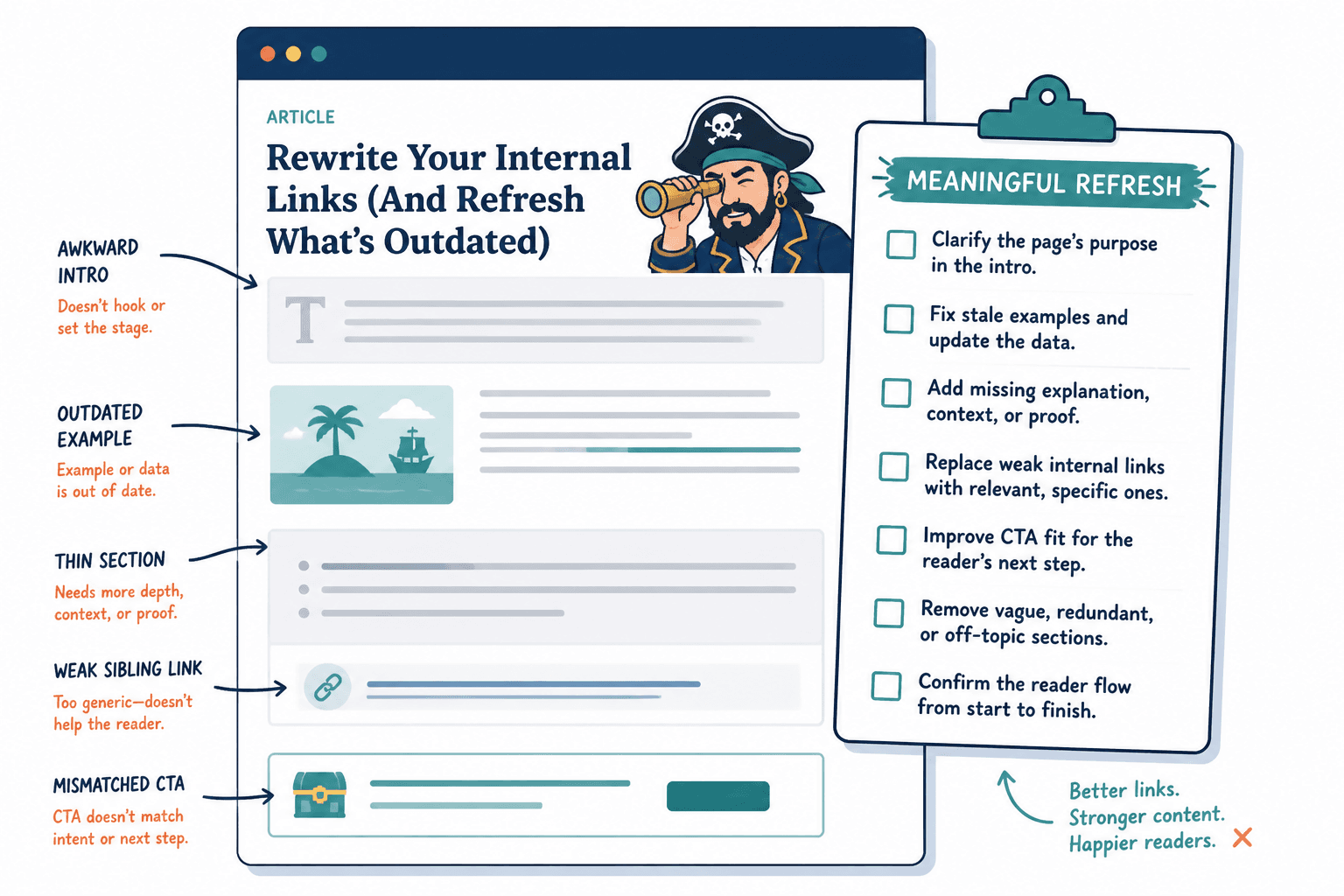
A simple rewrite process for boring internal linking and updating
If your existing article feels stiff, here is a clean process for rewriting it.
Step 1: Find the real purpose of the page
Before you add or change links, define what the article is actually trying to do.
- Teach a concept?
- Help a reader solve one specific problem?
- Move them into a deeper related topic?
- Support a larger cluster?
If the purpose is fuzzy, the linking will usually be fuzzy too.
Step 2: Highlight every existing internal link
Look at every current link and ask:
- Does this link belong here?
- Does the sentence around it make the click feel useful?
- Is the anchor text specific enough?
- Is there a better destination now available?
You will usually find at least a few links that are too generic, too forced, or too weak for the moment they are occupying.
Step 3: Mark the points where readers need more
Read the article as if you know slightly less than the writer. Where would you want an example, a deeper explanation, or a next-step guide?
Those are often your best new internal linking opportunities. Not because software found semantically related pages. Because a human found an actual need.
Step 4: Rewrite the linking sentence, not just the anchor text
This part gets missed constantly. People swap the anchor text and leave the weak sentence untouched.
Before: For more information, read our guide on updating content.
After: If your refresh process only happens when traffic drops, fix your update triggers before you touch another old post.
The rewrite is better because it names the problem, narrows the audience, and creates a logical reason to click.
Step 5: Improve the update itself, not just the link map
Once you are in the article, fix the boring parts while you are there.
- Replace vague lines with sharper ones
- Add examples where abstraction is doing too much heavy lifting
- Cut repeated points
- Tighten intros that take forever to arrive
- Make subheads more useful
Internal linking improves when the article itself improves. Shocking, I know.
Before-and-after rewrites that make the difference obvious
Sometimes the problem is easier to spot when you see the rewrite side by side.
| Before | After |
|---|---|
| Check out this related article on internal linking. | If your links keep feeling bolted on, this guide on better internal linking and updating shows how to make them part of the argument instead of an awkward add-on. |
| We also recommend updating old posts regularly. | Updating on a random schedule is how teams stay busy without getting much stronger. Start with clear update triggers so you know what actually deserves a refresh. |
| You can read more about cluster refreshes here. | If you are refreshing a whole topic cluster and performance still feels flat, these cluster refresh mistakes that hurt performance are usually the culprit. |
| Learn more in this post. | If the writing is technically fine but still sounds like a brochure, here is how to handle internal linking without sounding salesy or robotic. |
The pattern is simple:
- Name the problem
- Offer the link as a solution
- Use anchor text that tells the truth about the destination
- Keep the tone natural
Not glamorous. Very effective.
What to update inside a content cluster without making every page sound the same
One weird side effect of cluster updates is that people start copying the same linking language across every page. Suddenly your whole site sounds like one person with three approved phrases and a headache.
Yes, consistency matters. No, repetition is not the same thing.
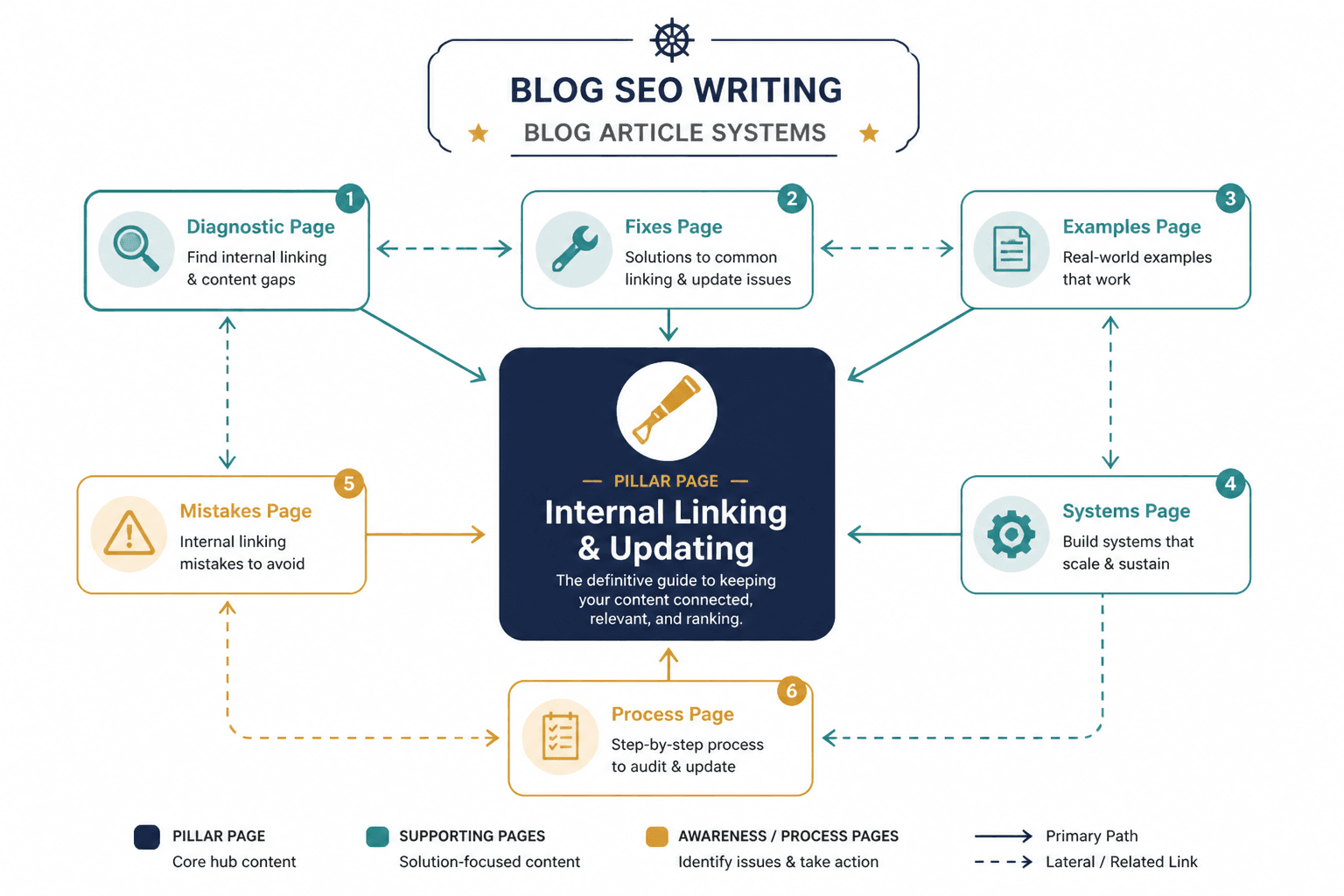
If you are working across a broader blog SEO writing system, keep the positioning of each page distinct. Some pages should explain, some should diagnose, some should compare, some should give process. The internal links should reflect those roles.
- A foundational page should link outward generously and clearly.
- A tactical page should link to deeper how-to resources when the reader needs implementation help.
- A diagnostic page should link toward fixes, examples, or systems.
- A mistake-focused page should link to the cleaner version of the process.
That is one reason the pillar page on internal linking and updating should not sound exactly like every supporting article around it. The links need to guide people through the cluster, not trap them in a maze of near-identical summaries.
If you are mapping this work at the category level, the broader blog SEO writing section and the blog article systems area can help you place these pages more intelligently.
The tone fix: how to sound helpful instead of robotic
A lot of internal linking gets weird because writers suddenly switch voices the moment they insert a link.
The article sounds human. Then the link sentence arrives sounding like legal copy from a content machine:
For additional insights, readers may benefit from exploring the following resource.
Please do not do this to people.
If the rest of your article is direct, your internal links should be direct too. If your article has personality, the links can have some too. Not clownish personality. Just normal human phrasing.
Better ways to introduce an internal link
- If this is the part you keep skipping, start here.
- If that sounds familiar, this guide will help.
- This is usually where the process breaks.
- If you want the full version, go here next.
- This is the deeper breakdown, not the polite summary.
Those lines work because they sound like a person guiding a reader, not software placing an asset.
How to know when a page needs rewriting, not just updating
Sometimes the internal links are not the real problem. The page itself is. And no amount of clever anchor text is going to rescue a muddled article.
Here are a few signs the page needs a proper rewrite:
- The intro takes too long to say anything
- The subheads are generic and interchangeable
- The article repeats obvious points
- There are links everywhere, but no clear reading path
- The examples are thin or missing
- The article sounds more “SEO aware” than reader aware
That last one is the killer. You can feel when a page has been arranged around phrases instead of usefulness. It often ranks worse than people expect because it satisfies the checklist while annoying the actual human.
When that happens, stop patching. Rewrite the article with the reader’s journey in mind, then rebuild the internal linking on top of that stronger structure.
A practical checklist for fixing boring internal linking and updating
Internal linking improves when each update makes the next useful step clearer. Cleaner structure usually does more work than a bigger pile of links ever will.
Internal linking improves when each update makes the next useful step clearer. Cleaner structure usually does more work than a bigger pile of links ever will.