
Most articles about internal linking and updating commit the exact sin they are supposed to fix: they open like a spreadsheet with a pulse.
They start with some version of “internal linking is important for SEO” and then gently drift into irrelevance. That is not a strategy. That is throat-clearing in business-casual skin.
If you want to know how to start internal linking and updating without a weak opening, the answer is not to tack on a few links and call it optimization. You need a stronger beginning, a clearer reader path, and an update process that improves the article instead of making it look like it was edited by a plugin and a committee.
This article will show you how to open stronger, place links where they actually help, update old content without flattening its voice, and turn a boring maintenance task into something that improves rankings, readability, and conversions at the same time. Which is nice, because if you are already doing the work, it might as well pull its weight.
For the main guide behind this topic, visit the parent guide.
Why most internal linking and updating intros fall flat
Weak openings usually come from one of three mistakes.
- They start with importance instead of tension.
- They explain the topic before naming the real problem.
- They sound like they were written for a search engine that majored in beige.
Your reader did not land on your article because they were dying to hear that internal linking helps site structure. They landed because something is not working. Maybe traffic is flat. Maybe old posts are decaying. Maybe their site has useful content but no path through it. Maybe they know they should update articles and just keep not doing it because the task feels weirdly shapeless.
That is your opening. Start there.
A strong intro does not begin with the topic. It begins with the friction around the topic.
If your first paragraph sounds like it belongs in a beginner SEO glossary, you are already making the reader work harder than necessary. And when you are writing about internal linking and updating, that is especially painful, because the whole point is reducing friction.
What a strong opening needs to do
A useful opening for this kind of article has four jobs.
- Name the actual problem.
- Make the reader feel seen fast.
- Hint at the payoff.
- Set up the article’s structure naturally.
That does not mean it needs to be dramatic. It just needs to be specific. You are not writing a thriller. You are writing practical content for someone who wants a better system and less fluff.
Here is the difference.
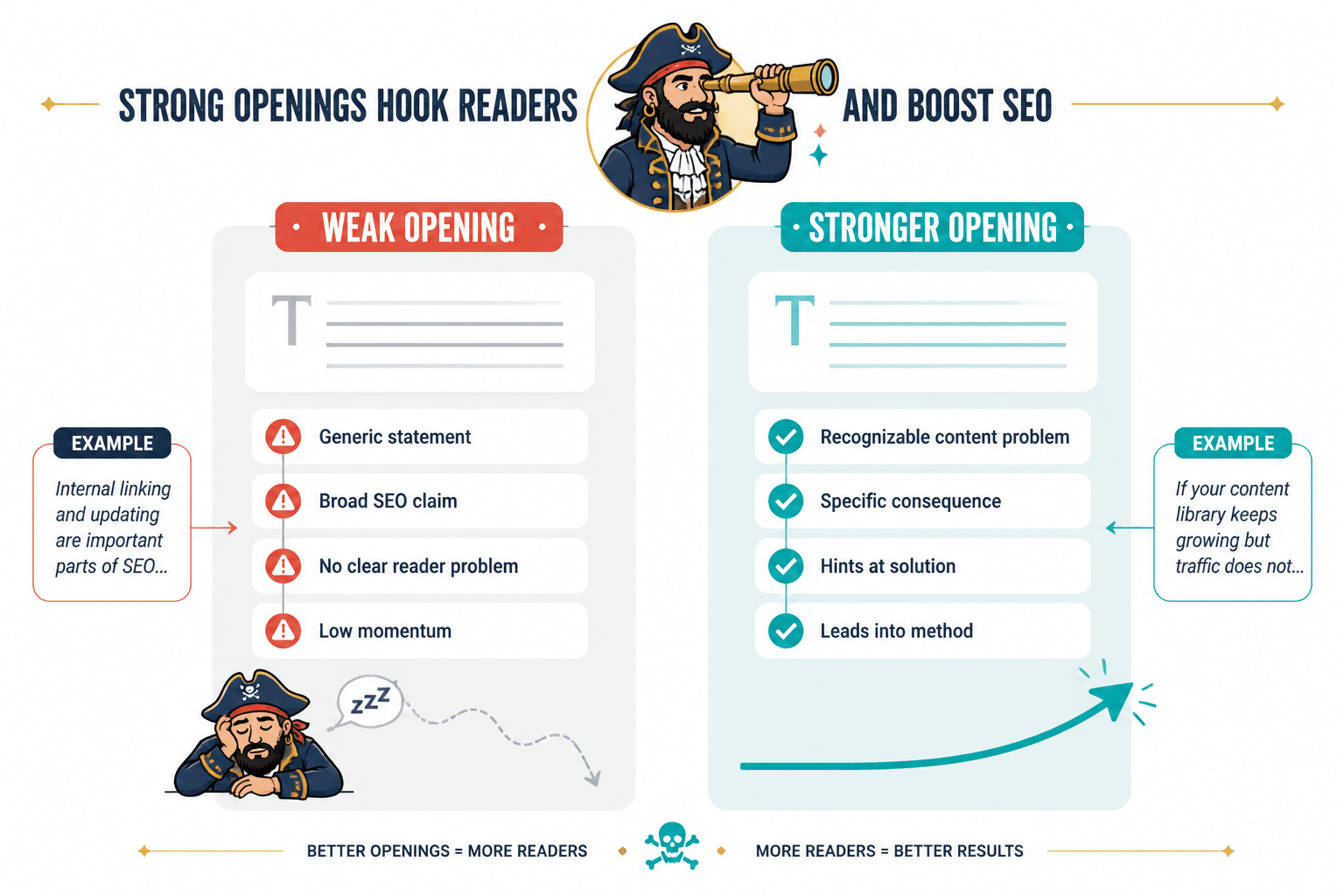
Weak opening
Internal linking and updating are important parts of any SEO strategy. By regularly updating content and linking between pages, websites can improve performance and user experience.
Technically true. Spiritually useless.
Stronger opening
If your content library keeps growing but your traffic does not, there is a good chance the problem is not volume. It is that your articles are sitting there like strangers at a networking event, not connected, not refreshed, and not helping readers move anywhere useful.
That opening works because it immediately gives the reader a problem they can recognize. It also sets up the solution without sounding like a textbook in a polo shirt.
How to start internal linking and updating without a weak opening
Here is the practical method.
1. Start with the content problem, not the tactic
Internal linking and updating are not interesting on their own. They matter because they solve problems.
- Old posts lose traffic.
- Readers hit dead ends.
- Important pages stay buried.
- Articles compete with each other instead of supporting each other.
- Your best ideas are scattered across posts with no connective tissue.
Lead with one of those. Not all five. Pick the one that best matches the article’s main promise.
If you are writing for creators, consultants, coaches, or solo founders, the opening often works better when you tie it to wasted effort. They do not want “site architecture benefits.” They want to know why they have written 70 decent articles and still feel like none of them are doing enough.
2. Use tension early
Tension gives the opening shape. It creates the gap between what the reader is doing and what they should be doing.
Examples:
- You are publishing more, but older articles are quietly dying.
- You have useful content, but no clear path through it.
- You are updating posts, but only cosmetically.
- You are adding links, but they feel forced and random.
That is much stronger than opening with definitions or benefits. Benefits matter, but not before the reader cares.
3. Make the promise quickly
Once the reader sees the problem, tell them where you are taking them. Not with “in this article.” Just say what they will be able to do.
For example:
- Here is how to update and relink old articles so they read better, rank better, and lead people somewhere useful.
- This is how to fix stale posts without turning them into bloated SEO patch jobs.
- Here is a simple way to open stronger, place internal links more naturally, and make older content earn attention again.
Short. Direct. Helpful. No theatrical hand gestures required.
4. Build the opening around one reader scenario
One reason intros get mushy is that the writer tries to speak to every possible reader type at once. That is how you end up with vague sludge like “businesses of all sizes can benefit from content updates.”
Instead, picture one situation:
- A consultant with 30 solid posts and no internal link system.
- A founder with old articles slipping in rankings.
- A writer republishing articles without improving structure.
- A personal brand with useful posts but weak conversion paths.
Write to that situation. The intro will sound more human because it is built on something a human would actually experience.
A simple opening formula that does not sound canned
If you want a reusable structure, use this:
- Problem: what is going wrong
- Tension: why the usual fix is not enough
- Promise: what this article will help the reader do better
In plain English, it looks like this:
Your old content is not underperforming because it is old. It is underperforming because it is disconnected, under-updated, and often introduced with the energy of a compliance memo. Here is how to fix the opening, improve the links, and update the article so it actually becomes more useful.
Notice what this does not include:
- No broad SEO lecture
- No generic “content is king” nonsense
- No padded history of internal linking
- No fake suspense
Just tension, clarity, and a reason to keep reading.
How to update old content without making it worse
Now for the actual updating part, because a strong intro is only useful if the rest of the article earns it.
A lot of people “update” articles by changing the date, tweaking a sentence, stuffing in a few links, and hoping Google gets sentimental. That is not updating. That is administrative cosplay.
A real update improves the article on three levels: substance, structure, and movement.
Substance: improve what the article says
Ask:
- Is the advice still accurate?
- Are there examples missing?
- Is anything too vague to be useful?
- Did the search intent shift?
- Can you answer the topic more directly now?
This is where you add new insight, sharper examples, better phrasing, clearer templates, and stronger explanations. If the article still says the same mushy thing, a new link will not rescue it.
Structure: improve how the article flows
Ask:
- Does the intro get to the point fast enough?
- Are the H2s doing real work?
- Are there sections that repeat themselves?
- Are there giant blocks of text that need breaking up?
- Are important ideas buried too low?
Sometimes the best update is not adding more. It is rearranging what is already there so the article stops wandering.
Movement: give the reader somewhere to go
This is where internal linking matters. Good links create movement. They help the reader go deeper, take the next step, or solve the next related problem without having to hunt around your site like they are searching for an emergency exit.
For broader strategy around this, the parent resource on internal linking and updating is worth reading alongside this article, especially if you are building a repeatable content system rather than fixing one lonely post.
Where to place internal links so they feel helpful, not stuffed in
Bad internal links feel like someone shoved a brochure into the sentence. Good internal links feel like the article is helping the reader naturally continue.
Use links in these places first:
- After a concept that needs deeper explanation
- After a warning that points to a related fix
- Inside a process where the next step already exists on another page
- Near the CTA or final recommendation
- In sections where reader intent naturally branches
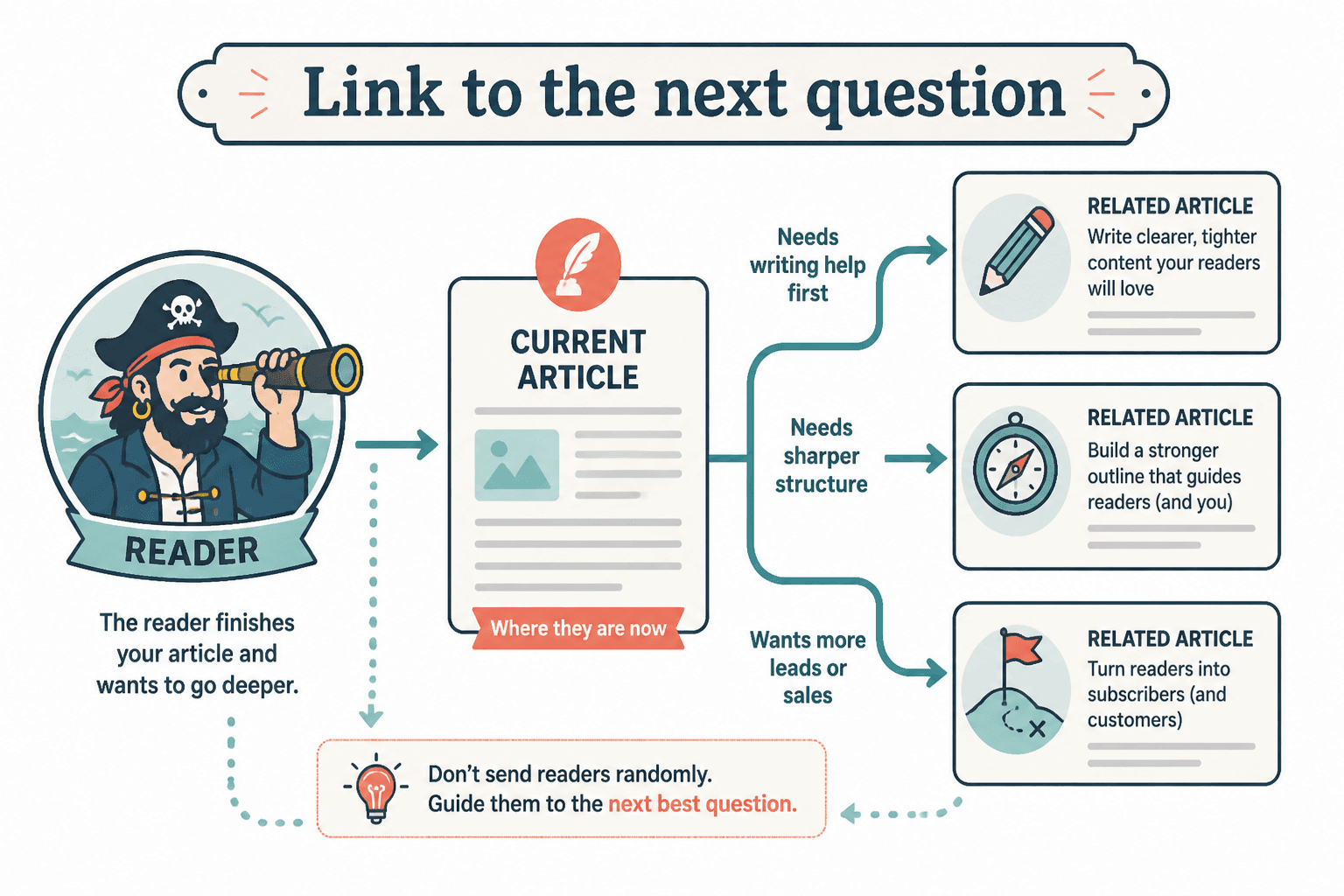
For example, if you mention that stiff anchor text can make your content feel mechanical, you can point readers to how to write internal linking and updating without sounding salesy or robotic. That link makes sense because it solves the next obvious problem.
If you are improving the quality of the article itself before linking, send them to how to write better internal linking and updating. Again, natural next step.
If the article is structurally dull and needs sharper language first, how to rewrite boring internal linking and updating is the right companion.
And if your real goal is not just traffic but conversion, link toward how to turn internal linking and updating into more leads or sales.
See the pattern? Each link should answer the reader’s likely next question. Not your publishing calendar’s next agenda item.
Anchor text that does not feel clunky
Anchor text is where a lot of otherwise decent articles suddenly sound robotic.
Clunky:
- Click here for internal linking tips
- Read this article about internal linking and updating strategy
- Best practices for SEO internal linking can be found here
Better:
- use internal links more naturally
- rewrite dull update sections
- turn old posts into better lead paths
- build a cleaner internal linking system
The goal is not to make the anchor text scream “keyword relevance.” The goal is to make it feel like part of the sentence while still being clear about what the reader gets.
A practical workflow for updating and relinking articles
If you want this to become a real process instead of a random clean-up day that vanishes from your life by Thursday, use a simple workflow.
Step 1: pick the article with the clearest upside
Start with an article that already has one of these:
- some existing traffic
- a good topic but weak structure
- ranking potential
- links pointing into it already
- strong business relevance
Do not start with your messiest article unless you have a strange appetite for suffering.
Step 2: rewrite the opening first
Before you touch links, fix the intro. If the opening is weak, the article leaks attention before the internal links ever matter.
Ask:
- Does the first paragraph name a real problem?
- Does it sound human?
- Does it avoid generic SEO throat-clearing?
- Does it create a reason to continue?
Step 3: upgrade one or two sections that deserve more depth
Add the examples, rewrites, mini-frameworks, or explanations the piece was missing. This is also where you remove filler. A lot of old content does not need more paragraphs. It needs fewer sleepy ones.
Step 4: add links where intent naturally branches
Look for points where a reader might think:
- Can you show me that?
- What does that look like?
- How do I do that next part?
- What if my issue is slightly different?
That is where a link belongs.
Step 5: check the article’s next step
Every updated article should leave the reader with somewhere useful to go. That could be:
- another article
- a category page
- a pillar page
- a lead magnet
- a contact or booking page
If your article teaches well but strands the reader at the end, you have only solved half the problem.
Step 6: link from other articles back into it
Internal linking is not a one-way patch. If you update a useful article, look for older related pages that should now point to it. This gives the article context inside your broader content system and helps search engines understand how the topic fits within your site.
That system-level thinking matters. If you need the bigger content map, browse the broader blog SEO writing and article systems resources and use this article as the opening-specific layer inside that process.
Before and after: fixing a weak opening in an update article
Here is a cleaner example of how to rewrite an intro while setting up internal linking and updating naturally.
Before
Internal linking and updating are key components of content optimization. Many website owners fail to update content regularly, which can lead to decreased traffic over time.
The issue here is not just blandness. It is that the intro says obvious things in the most forgettable way possible. It does not tell the reader what this will help them do, and it does not create enough tension to justify continuing.
After
A lot of old articles do not need a total rewrite. They need a better opening, a clearer route to related content, and a few smart updates where the advice has gone stale. If readers are bouncing early or hitting dead ends, the problem is not just age. It is that the article no longer pulls its weight. Here is how to fix that without turning the whole thing into an SEO craft project.
Better because it:
- starts with a realistic problem
- names the three main fixes
- gives the reader a reason to care
- keeps the tone human
Common mistakes that make updated articles feel worse
Some updates improve rankings and readability. Some make the article feel like a once-good room that got renovated by people who hate windows. Avoid these mistakes.
Adding links without improving transitions
If the sentence does not naturally support the link, rewrite the sentence. Do not just wedge it in and hope confidence will carry the day.
Keeping a limp intro because “the rest is strong”
The intro decides whether readers ever reach the strong part. Fix it.
Updating dates instead of ideas
If the examples are weak, the structure is messy, and the article still sounds vague, a new year in the heading is not doing much.
Linking to whatever is convenient instead of what is useful
Your reader does not care that another article exists. They care that it helps with the next thing they need.
Overexplaining internal linking inside every article
Internal linking improves when each update makes the next useful step clearer. Cleaner structure usually does more work than a bigger pile of links ever will.
Internal linking improves when each update makes the next useful step clearer. Cleaner structure usually does more work than a bigger pile of links ever will.